Over the past seven days, six people lost their lives in the national capital region while cleaning sewers after inhaling toxic gases, says the National Commission for Safai Karamcharis (NCSK), a statutory body set up by an Act of Parliament for the welfare of sanitation workers. Clearly, the law banning employment of human labour to clean sewage tanks is toothless. In theory, no person, local authority or agency can hire people for hazardous cleaning of sewers and septic tanks. The Employment of Manual Scavenging and Construction of Dry Latrines (Prohibition) Act, 1993, was amended in 2013 to include a ban on employing or engaging people to clean sewer and septic tanks. But according to a reply by the central Ministry of Social Justice and Empowerment in the Lok Sabha in December last year, more than 300 people died due to asphyxiation while working in septic tanks in 2017 alone.
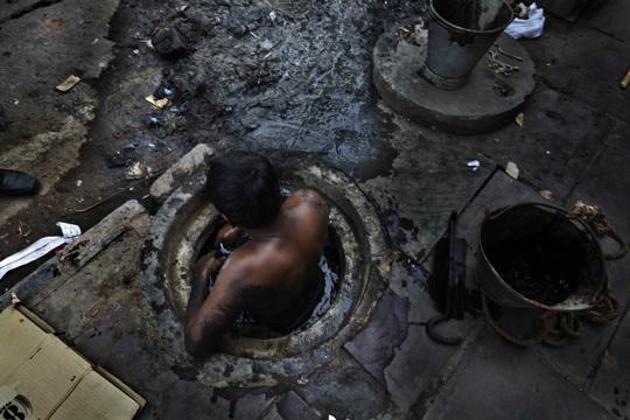
NCSK founder and Magsaysay award winner, Bezwada Wilson, says one big obstacle before evolving policies for the welfare of sewage and septic tank workers is the lack of credible data. There are no official numbers available on those employed in sewer and septic tank cleaning as opposed to those engaged in the relatively less hazardous cleaning of dry latrines, open drains and single pit toilets. Also, since most of those employed to do the cleaning of septic tanks are hired on a casual basis, contractors seldom bother to follow safety norms or provide gas masks, safety harness belts and helmets to them. The law enjoins upon the government to provide ₹10 lakh to the families of those who die inside sewers. However, data presented by the Central Monitoring Committee in 2017 said only seven states had paid compensation for such deaths in the past 25 years.
Experts say the biggest reason why the mechanised cleaning of septic tanks, the prescribed norm, remains only on paper, is lax implementation by enforcement agencies, whether it is the inspectors of civic bodies in the cities or magistrates and district collectors in rural India. If the law on manual cleaning of sewers is to be effective, the penalties — less than 10 arrests have been made across the country according to Mr Wilson and the first information report rarely reaches the charge-sheet stage — have to be stricter and even-handed. Casual workers who endanger their lives for as little as ₹300 to clean septic tanks don’t seem to be a priority either with the law enforcement agencies or politicians. This is a blot on the record of a country that boasts the largest public cleanliness programme in the world.
{{/usCountry}}Experts say the biggest reason why the mechanised cleaning of septic tanks, the prescribed norm, remains only on paper, is lax implementation by enforcement agencies, whether it is the inspectors of civic bodies in the cities or magistrates and district collectors in rural India. If the law on manual cleaning of sewers is to be effective, the penalties — less than 10 arrests have been made across the country according to Mr Wilson and the first information report rarely reaches the charge-sheet stage — have to be stricter and even-handed. Casual workers who endanger their lives for as little as ₹300 to clean septic tanks don’t seem to be a priority either with the law enforcement agencies or politicians. This is a blot on the record of a country that boasts the largest public cleanliness programme in the world.
{{/usCountry}}