The Brihanmumbai Municipal Corporation marks September 4 as its foundation day, commemorating the first democratic general body meeting of the civic body in 1873. The Kolkata Municipal Corporation traces its origins even further back, to September 4, 1726, when a Royal Charter issued by King George I established the city’s first civic governing body and Mayor’s Court.
But Delhi’s municipal body, the agency that certifies births and deaths in the Capital, however, cannot quite settle on a birthday.
Its history offers not one, but several plausible dates – February 1863, June 1, 1863, April 7, 1958 and, arguably, one as late as 2022. The Municipal Corporation of Delhi (MCD) has, at different points, chosen two of these dates to mark its institutional beginnings.
This year, it did not celebrate either.
The latest attempt came in the budget presented by the MCD standing committee, its most powerful panel, on January 28. It declared April 7 as the “MCD Foundation Day”, arguing that the corporation in its present form came into existence in 1958, when Parliament brought together 13 separate local bodies and boards under one municipal institution.
The budget said the day would be marked every year with awards for excellence in cleanliness, education, gardens and health. Schools, villages, colonies, parks, hospitals and health centres were to be recognised for their performance.
{{/usCountry}}The budget said the day would be marked every year with awards for excellence in cleanliness, education, gardens and health. Schools, villages, colonies, parks, hospitals and health centres were to be recognised for their performance.
{{/usCountry}}But April 7 came and went without a foundation-day celebration. “Our intent is clear, MCD should have a foundation day and we should celebrate its history. We will clear the confusion and observe one day from next year,” said Satya Sharma, chairperson of the standing committee.
The many colliding claims
The uncertainty is rooted in a deceptively simple question: when did Delhi’s municipal government actually begin?
Archival records accessed by HT suggest that the answer could take the city back more than 160 years, to a time when Delhi’s municipal administration was scattered.
A senior MCD official said that until 1957, municipal government in Delhi functioned under the Punjab District Boards Act, 1883 and the Punjab Municipal Act, 1911.
There were 13 separate bodies, each administering a particular area or performing a specific function. They included the Municipal Committee, Delhi; Notified Area Committee, Civil Station; Notified Area Committee, Red Fort; Municipal Committee, Delhi-Shahdara; Municipal Committee, West Delhi; Municipal Committee, South Delhi; Notified Area Committee, Mehrauli; Notified Area Committee, Najafgarh; Notified Area Committee, Narela; District Board, Delhi; Delhi State Electricity Board; Delhi Road Transport Authority; and the Delhi Joint Water and Sewage Board.
“There was no unified municipal body. The need to have a unified body to administer municipal affairs was being felt strongly, and thus a unified MCD was set up by an Act of Parliament in 1958,” the official said.
That is the basis for the April 7 date. But it is only one chapter of the story.
In November 2023, the MCD House had already passed a resolution to observe June 1 as “Municipal Day” or “Nagar Nigam Diwas”. The proposal, moved by the civic body’s Heritage Cell, sought to commemorate the “beginning of formal civic governance in the national Capital”.
That date too has a historical claim.
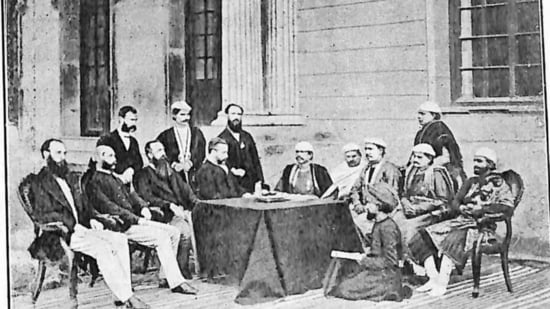
The first general committee meeting of Delhi’s municipality was held on June 1, 1863, with Colonel GW Hamilton, the commissioner, in the chair. The committee comprised 12 British and seven Indian members. Among the Indian members were wealthy and influential traders such as Lala Chhunna Mal, Lala Mahesh Das and Dewan Inamullah Khan.
But even June 1 may not be the precise beginning.
Rai Sahib Madho Pershad, an honorary magistrate who compiled a history of Delhi’s municipality in 1921, wrote that “the municipality came into being in February 1863”. On April 23 that year, he said, a kind of constituent assembly met under deputy commissioner FH Cooper to frame by-laws that would supplement Section 34 of the Police Act of 1861.
Then came the June 1 meeting of the general committee.
In simpler terms, February marks the birth of the institution, April marks the drafting of its rules, while June marks the first formal meeting of its general committee
Teething troubles
For the city’s earliest municipal administrators, however, the task was less about commemorating anniversaries and more about keeping Delhi functioning.
Pershad’s account describes a municipality that immediately turned its attention to roads, drains and sanitation. Roads were renewed, kutcha roads repaired, and drains and sewers cleared – some of which, he wrote, had not been cleaned for nearly 20 years.
To be sure, the municipality’s jurisdiction was tiny by what we understand MCD to be today. In 1863, it covered just around five square kilometres and served a population of around 121,000. Today, MCD covers more than 1,400 sq km and serves a population estimated at over 20 million.
The fledgling administration also introduced some of the foundations of modern civic governance: a sanitation and conservancy system was established, a Unani dispensary opened in Sadar Bazar, and registration of births and deaths began. In subsequent years came firefighting arrangements, water supply systems and municipal taxation.
One problem, however, appears to have survived almost unchanged: money.
Archives show that the municipality’s income from January to December 1863 was ₹98,276. Its ambitions were considerably larger. Improving the channel of the Yamuna, constructing a general hospital and setting up a vegetable market were among the projects under consideration.
“But the committee’s efforts were limited for want of funds and the fact that they had to pay no less than 50% of their income towards the cost of the city police alone,” Pershad’s memoir adds.
Over the decades, Delhi’s municipal structure continued to evolve, repeatedly changing its size, powers and administrative boundaries.
Deep Chand Mathur, who worked as the MCD director of information between 1980 and 2011, said that there have been five major changes in the number of elected municipal representatives so far. “The civic body had just 80 councillors till 1963. But then, a major decentralisation exercise was taken up with a number of powers were delegated to zonal committees and the number of councillors was raised to 100 in 1967. The number did not change for another 26 years, and then it was raised to 134 in 1993,” he said.
“Between 1993 and 2002, MCD elections were fought over 134 seats. In 2007, the number of wards was increased to 272. Later in 2022, while the Centre reunited the three separate corporations, the number of wards was reduced to 250,” Mathur said.
And that brings the city to the latest claim for the birthday.
If April 7, 1958 is considered the MCD’s foundation because it brought disparate civic bodies under one corporation, what about May 22, 2022 – the day the three corporations (North MCD, South MCD and East MCD) created after the 2012 trifurcation were reunited into a single MCD?
The question goes beyond calendars and ceremonial events. It is about what constitutes the birth of a civic institution. Is an institution established when its first organisational structure begins to emerge, when its first formal committee meets, when legislation creates a unified body, or when an existing institution is fundamentally reconstituted?
MCD officials did not respond to requests for comment.
Delhi’s answer appears to be: all of the above, depending on which chapter of its history one chooses to focus on.