As the National Democratic Alliance (NDA) secured an overwhelming victory over the Mahagathbandhan (MGB) in the Bihar assembly elections, these pages have analysed the victory in detail. There is, however, another important question worth asking. How did the candidates of different social groups perform in these Bihar elections?
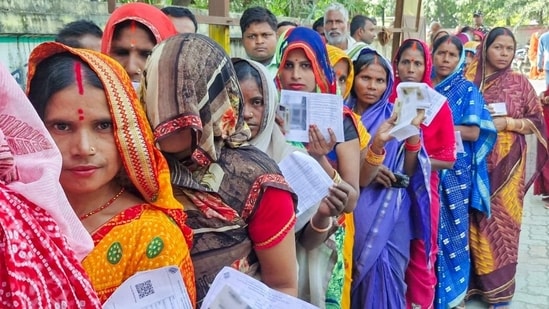
Was their performance driven by just social identity or also the political alliance they contested from? Are these patterns confined to broad social groups or do they vary at the sub-caste or
- Non-Yadav BCs had the best strike rate, Muslims the worstOf the 498 candidates put up by the NDA and MGB – this includes 12 friendly fights within the MGB and also 4 assembly constituencies (ACs) where nominations of these candidates were cancelled – the highest number was from the proverbial Hindu upper castes or those who do not belong to Scheduled Caste (SC), Scheduled Tribe (ST), Backward Class (BC) or Extremely Backward Class (EBC) groups. In Bihar, the Other Backward Classes (OBCs) are divided into BCs and EBCs. The Hindu upper castes also have the largest number of MLAs in the assembly. However, the social group with the highest strike rate is that of non-Yadav BCs, which has seen 58 MLAs being elected from a candidate pool of just 97. Muslims and Yadavs (a subset of BCs) have the worst and second worst strike rates. As is to be expected given the wide difference in overall strike rate of the NDA and the MGB, all social groups including even Muslims have a better strike rate as NDA candidates than MGB candidates. Simply speaking it means that a Muslim had a bigger probability of winning the election as an NDA candidate than a MGB one. To be sure, this is a manifestation of five Muslim candidates of the AIMIM winning this time. While upper caste MGB candidates had by far the worst strike rate, non-Yadav BC and SC candidates from the NDA had strike rates bordering almost 90%.
- Kurmis have the highest strike rate among sub-castes who had at least ten candidatesThere are six sub-castes in HT’s candidate database which have recorded a perfect strike rate of 100% in these elections. But all of them had just one or two candidates and every one of them had been fielded by the NDA. Among the major sub-castes, which had at least ten candidates in the electoral fray, Kurmis have left every one behind with a strike rate of 84.2%. While they are ranked fifth in terms of number of overall MLAs behind Rajputs, Koeris, Yadavs and Bhumihars, these four sub-castes have a significantly lower strike rate than Kurmis. The fact that the state’s incumbent and perhaps next chief minister, Nitish Kumar, is also a Kurmi, only underlines the political prowess of this sub-caste in Bihar today. Once again, there are significant differences in strike rate at the sub-caste level between the two major alliances. 15 sub-castes including Kurmis have a 100% strike rate from the NDA and they have won a total of 48 MLAs from them. For the MGB on the other hand, no sub-caste had a strike rate more than 33.3%.
- To be sure, the new Bihar assembly is far from socially representativeThis is the most important factor when it comes to a caste-wise analysis of the new Bihar assembly. 51% of the total MLAs come from just five sub-castes which have a combined share of just 15.7% in the state’s population. The cumulative MLA share hits 75% and 90% at their sub-castes’ combined population share of just 50% and 61.4%. This only underlines what we had pointed out in a three-part series before the results: political competition in Bihar continues to be a contest between competing elites with tactical alliances with other social groups.
Nishant Ranjan has been working as a data journalist with Hindustan Times since 2023. In this short period, he has established a niche for creating original datasets and utilising them to produce journalistic work that pushes the boundaries of journalism. The list of datasets and stories done by him include the following: a dataset of all 717 chief ministers India has had since 1952, a dataset of all 3,350 members of India’s council of ministers, a dataset of all 190 deputy chief ministers in India and a dataset of all 279 Supreme Court judges in India (1950-2025). He has also profiled each elected Muslim MLA/MP since 1952. He is a mining engineer by training who decided to pursue a Master's in Development Studies from TISS after working in a coal mine for 10 months. He also worked as a research associate at the Centre for Policy Research, researching local governance in India. He also has a keen interest in analyzing electoral politics and political executives in India.
Roshan Kishore is the Data and Political Economy Editor at Hindustan Times. He heads the newsroom's data journalism team, which produces Number Theory, a daily data-driven feature for the print edition and the HT app. Number Theory uses data analysis and story-telling based on it to add value to the newsroom’s daily coverage by putting stories in a larger context on a range of issues, including politics, macroeconomy, markets, global affairs and climate. Under his leadership HT’s data journalism work has established itself as a niche product in Indian journalism and pushed the boundaries of marrying academic rigour with news sense and speed. Along with writing and editing data stories, he has also been writing a weekly political economy column called Terms of Trade for HT Premium. A trained economist with an MPhil degree from Jawaharlal Nehru University, Kishore has also been a visiting fellow at the Centre for Advanced Studies of India (CASI) at the University of Pennsylvania. Along with his journalistic work, his writings have also appeared in journals such as the Economic and Political Weekly and working papers for CASI and UNESCAP.
Abhishek Jha is Assistant Editor-Data at Hindustan Times. He uses statistical programming to generate newsworthy insights from large datasets. He is part of the team that produces Number Theory, a daily data story feature of the paper’s print edition. Since March 2024, he has been writing Weather Bee, a weekly column for the Hindustan Times website. He is a chemical engineer by training, who specialises in stories related to weather, climate, and the environment. Jha has been at HT since 2018, where he offers data-driven perspective and analysis on politics, environment, weather, climate, economy and society. His work includes data coverage of elections in India and abroad, including the 2019 and 2024 Lok Sabha elections; the disasters and extreme weather resulting from changing climate, such as floods, droughts, heat waves, cold waves, and dwindling snow cap in the Himalayas; the factors that drive poor air quality in northern India; the changing patterns of land use; the Covid-19 pandemic and its impact on labour market conditions; the changing pattern of consumer spending seen in the new consumer spending surveys; and social norms seen in the surveys such as the National Family Health Survey.