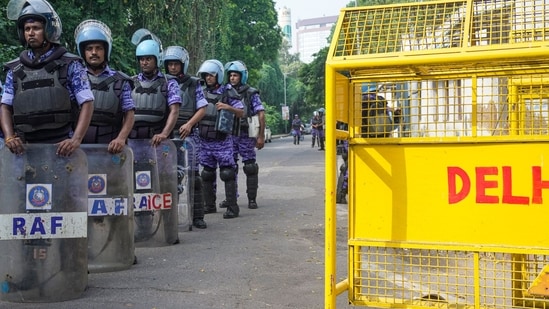
The protests in Delhi this July and earlier this month sparked a raft of allegations against police and paramilitary personnel — from not wearing name tags to surveillance using facial recognition technology, using disproportionate force for crowd control, and indiscriminate detentions. The Opposition and protestors blamed the government for many of these incidents. The police defended themselves and said they were dealing with swarms of people, many of whom were trying to instigate violence. A series of studies on policing
Representative Image/PTI
Police say they are trained about crowd control and human rights usually only at the time of joining
The 2019 SPIR surveyed 11,834 police personnel across 105 locations in 20 states and Delhi. One question that was asked was the timing of personnel’s last training on human rights and crowd control. A small share reported that they had never received such training. Irrespective of experience, a majority reported receiving the last crowd control training at the time of joining. Similarly, around 41% of overall respondents reported receiving human rights training only at the time of joining.
Using ‘tough methods’ to create fear among the public is accepted by most personnel…
The 2025 round of the SPIR surveyed 8,276 police personnel in 16 states and Delhi and tried to gauge their opinion on, among other things, the use of “tough methods to create fear among the public”. Over half the respondents thought it was important although only 20% considered it “very important”. To be sure, the surveyors left the phrase “tough methods” undefined and vague for the police. However, the majority belief in such methods could explain aggressive policing in situations such as the Delhi protests.
…and extra-judicial resolution is not universally frowned upon
Most detentions in the July or October protests are likely to have taken place under Section 172 of the Bharatiya Nagarik Suraksha Sanhita (BNSS), which allows for temporary detention or removal for petty cases where a person does not follow lawful directions given by the police. In the 2025 SPIR, police were asked if it was better for officers to give minor punishment for petty offences themselves instead of following a legal trial. While a majority favoured following a legal trial, a significant 38% thought police should administer minor punishment themselves. This proportion varied across ranks, but not dramatically.
The general public is not staunchly against government surveillance for curbing protests and political movements
While it would be useful to know both public and police perception on all aspects discussed here, that is not the case with SPIR surveys so far. For example, the 2023 survey – conducted among 9,779 people in 11 urbanised states and Delhi – focused on public perception around different aspects of surveillance and privacy. This shows that a majority of people are not opposed to the use of surveillance technology to curb protests and political movements. To be sure, there is hierarchy of acceptance among the general population for different technologies, such as facial or voice recognition still having less enthusiastic support than CCTV cameras.
Abhishek Jha is Assistant Editor-Data at Hindustan Times. He uses statistical programming to generate newsworthy insights from large datasets. He is part of the team that produces Number Theory, a daily data story feature of the paper’s print edition. Since March 2024, he has been writing Weather Bee, a weekly column for the Hindustan Times website. He is a chemical engineer by training, who specialises in stories related to weather, climate, and the environment. Jha has been at HT since 2018, where he offers data-driven perspective and analysis on politics, environment, weather, climate, economy and society. His work includes data coverage of elections in India and abroad, including the 2019 and 2024 Lok Sabha elections; the disasters and extreme weather resulting from changing climate, such as floods, droughts, heat waves, cold waves, and dwindling snow cap in the Himalayas; the factors that drive poor air quality in northern India; the changing patterns of land use; the Covid-19 pandemic and its impact on labour market conditions; the changing pattern of consumer spending seen in the new consumer spending surveys; and social norms seen in the surveys such as the National Family Health Survey.
Unlock a world of Benefits with HT! From insightful newsletters to real-time news alerts and a personalized news feed – it's all here, just a click away! -Login Now!
Unlock a world of Benefits with HT! From insightful newsletters to real-time news alerts and a personalized news feed – it's all here, just a click away! -Login Now!
Home/Editors Pick/How does police in India approach policing? | Number Theory
{{^htLoading}}
Advertisement
{{/htLoading}}
SHARE THIS ARTICLE ON
{{#usCountry}}{{/usCountry}}
Notifications
Get breaking alerts directly from the newsroom
Notifications are on!You'll be notified when news breaks