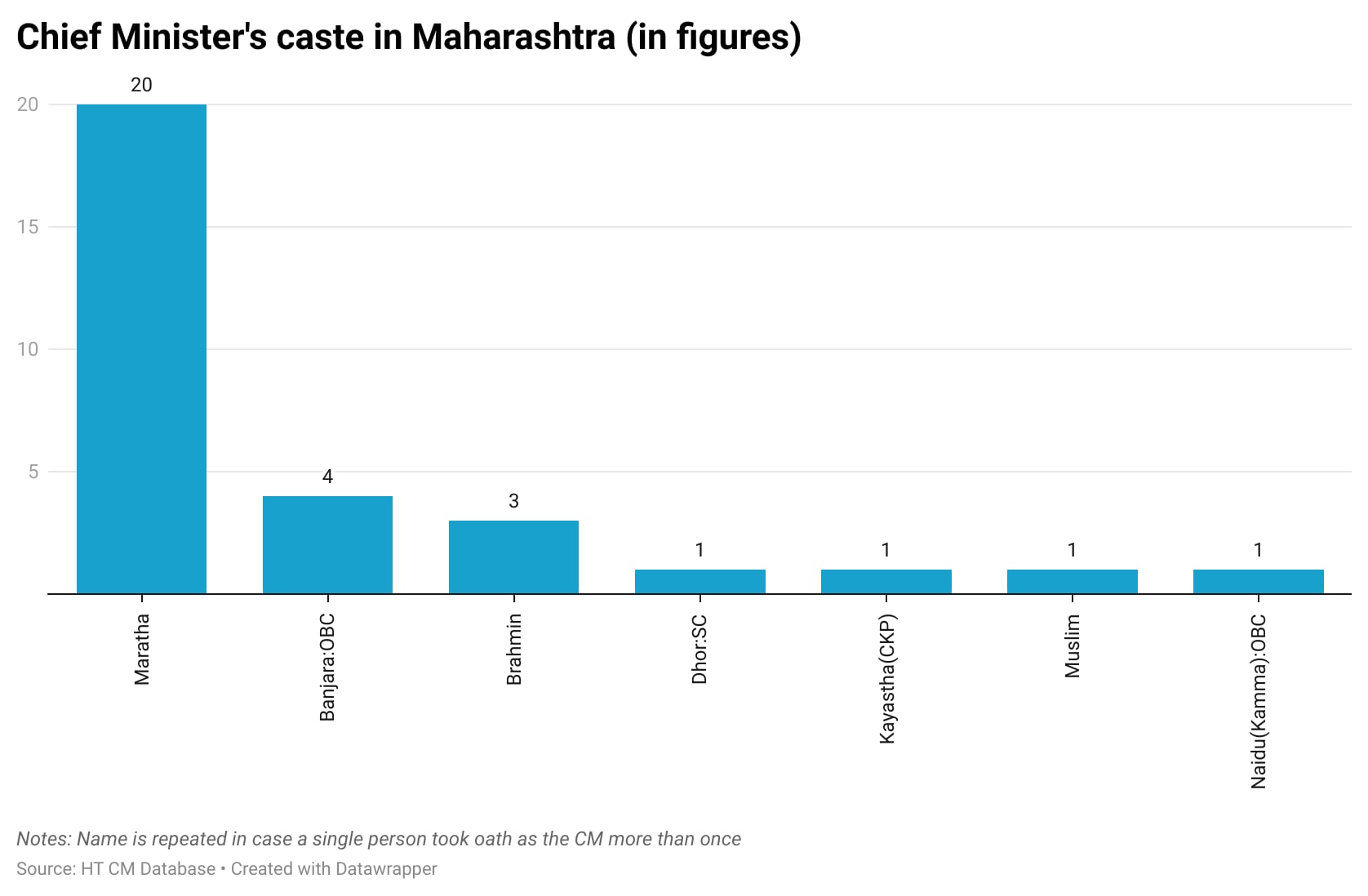
 Fadnavis’s caste identity will continue to be a limitationThis must have been the only reason why the BJP took eleven days to decide on Fadnavis’s name. As a Brahmin, Fadnavis’s own caste is a miniscule minority in Maharashtra. While there is no census data on share of different caste groups in Maharashtra’s population, survey-based estimates put the share of Brahmins at less than 2%. HT’s caste data-base of chief ministers shows that Maharashtra has had only two Brahmin chief ministers among the 20 chief ministers it has had since 1952. The state’s first Brahmin chief minister was Manohar Joshi after the Shiv Sena-BJP alliance’s first victory in 1995. Fadnavis became the second Brahmin chief minister in 2014. If he were to complete his term this time, Fadnavis would become the longest serving Brahmin chief minister in the state. Caste dominance matters in Indian politics, more so at the level of states, where electoral contests and solidarities tend to be hyperlocal. Fadnavis has a clear disadvantage here. It also means that the BJP will have to vigilant against numerically dominant caste groups using Fadnavis’s caste identity, both within and outside the party, as a counter-mobilisation trope. See Chart 1: caste-wise break-up of Maharashtra chief ministers
- But Fadnavis has proved himself by broadening BJP’s coalition without undermining his own party’s standingBJP’s rise in Maharashtra predates Fadnavis’s rise in politics. However, it used to be a junior partner of the Shiv Sena in the pre-2014 period. It was the BJP’s landslide victory in the 2014 Lok Sabha elections which gave it the confidence to challenge the status quo between the BJP and the Shiv Sena. In 2014 assembly elections hte BJP fought on its own. The gamble paid off partially with the BJP finishing as the single largest party with 122 seats, 59 ahead of the Shiv Sena. However, the BJP did not get a majority and formed a government with the Shiv Sena. Things got complicated once again in 2019 as the Shiv Sena refused give the chief-minister’s post to the BJP. Today, the BJP is closest ever to the half-way mark of 145 and it also has the tactical advantage of its allies being divided between the NCP and the Shiv Sena. This will mean a lower bargaining power for them in the Mahayuti vis-à-vis the BJP. See Chart 2: Seat share of BJP and its allies as share of half-way mark in Maharashtra in 2014, 2019 and 2024
- But governance might prove to be more difficult than politics for FadnavisThis is the most important challenge facing Fadnavis now. While he has established his acumen as a master strategist over the last ten years, governance will likely be a far more difficult challenge. The biggest case in point is the Mahayuti launching the Ladki Bahna cash transfer scheme – its success in the elections draws a lot on it – which will entail a significant fiscal burden on the state. The reason the Mahayuti government had to launch such a scheme was the engrained economic inequality in Maharashtra despite it being among the richest states in India. Sub-region wise performance of the Mahayuti in 2024 and the BJP-Shiv Sena alliance in 2019 shows that the Mahayuti has made the smallest seat share gain in the richest part of the state. This will only increase the pressure on the new government to keep the poorer regions happier. Can a Fadnavis led government deliver on this political imperative without going down the populist path of fiscal transfers which will hurt the state’s long-term growth imperatives? A success or failure here is what will define the legacy of Fadnavis 2.0. See Chart 3: Mahayuti and BJP-Shiv Sena sub-region wise seat share in 2019 and 2024
When the Bharatiya Janata Party (BJP) appointed Devendra Fadnavis as the chief minister of Maharashtra in 2014, he was a relatively unknown politician outside the state. Fadnavis's political rise has been a period of extreme turbulence in Maharashtra's politics.
First the Shiv Sena walked away from the BJP to deny a second term to Fadnavis as the chief minister. It then joined hands with the Congress and the Nationalist Congress Party (NCP). Both the Shiv Sena and the NCP suffered
Unlock a world of Benefits with HT! From insightful newsletters to real-time news alerts and a personalized news feed – it's all here, just a click away! -Login Now!
Unlock a world of Benefits with HT! From insightful newsletters to real-time news alerts and a personalized news feed – it's all here, just a click away! -Login Now!
Advertisement
{{/htLoading}}{{#usCountry}}