E-Paper



Number Theory: Why was Modi's victory margin in Varanasi lower?
Rajiv Gandhi’s 1984 victory margin of 72.2% is the highest ever victory margin for a sitting prime minister contesting a Lok Sabha election.
Published on: Jun 6, 2024, 08:23:17 IST

 Prefer HTon Google
Share via


Copy link

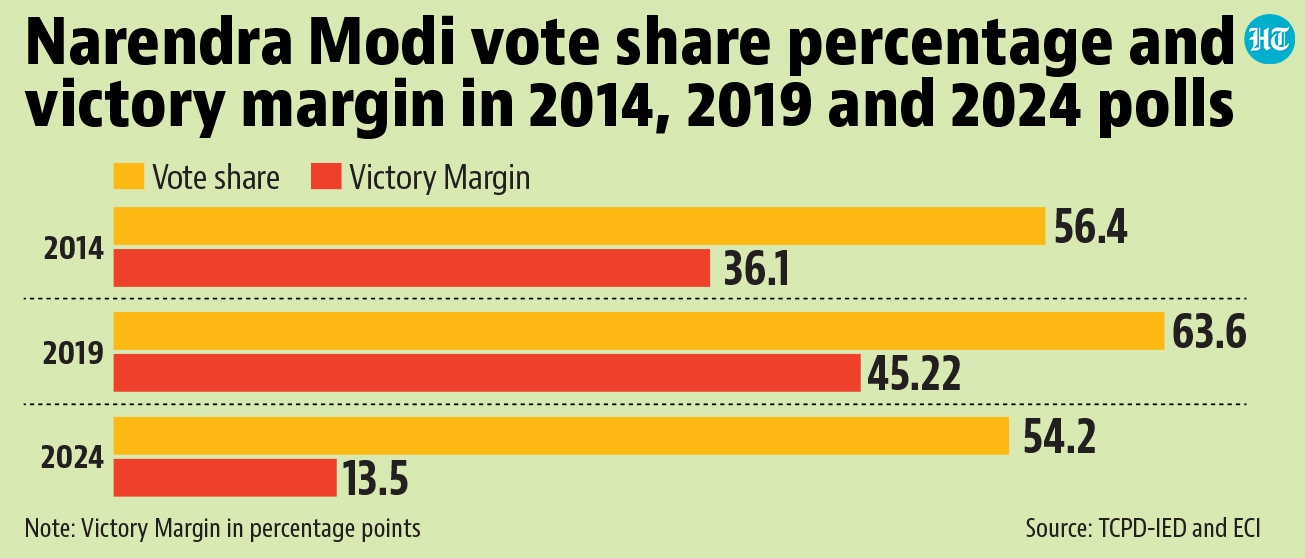
Prime Minister Narendra Modi’s victory margin in the Varanasi parliamentary constituency (PC) in these elections is 152,513 votes. Not only is this a sharp fall from the 2019 victory margin of 479,505 votes, it is also lower than his 2014 victory margin of 371,784 votes. What really happened in the 2024 elections in Varanasi? Here are four charts which answer this question.
Why was Modi's victory margin in Varanasi lower?
 Modi’s victory margin has fallen much more than his vote shareThis is the most important fact to keep in mind while reading the 2024 results. Modi’s vote share in 2024 elections is 54.2%. While this is lower than his 2019 and 2014 vote share of 63.6% and 56.4%, the fall is much smaller than what the fall in victory margins tells us. Modi’s victory margin, as a proportion of votes polled in Varanasi was 36.1% and 45.2% in 2014 and 2019. This number has fallen to just 13.5% in 2024.
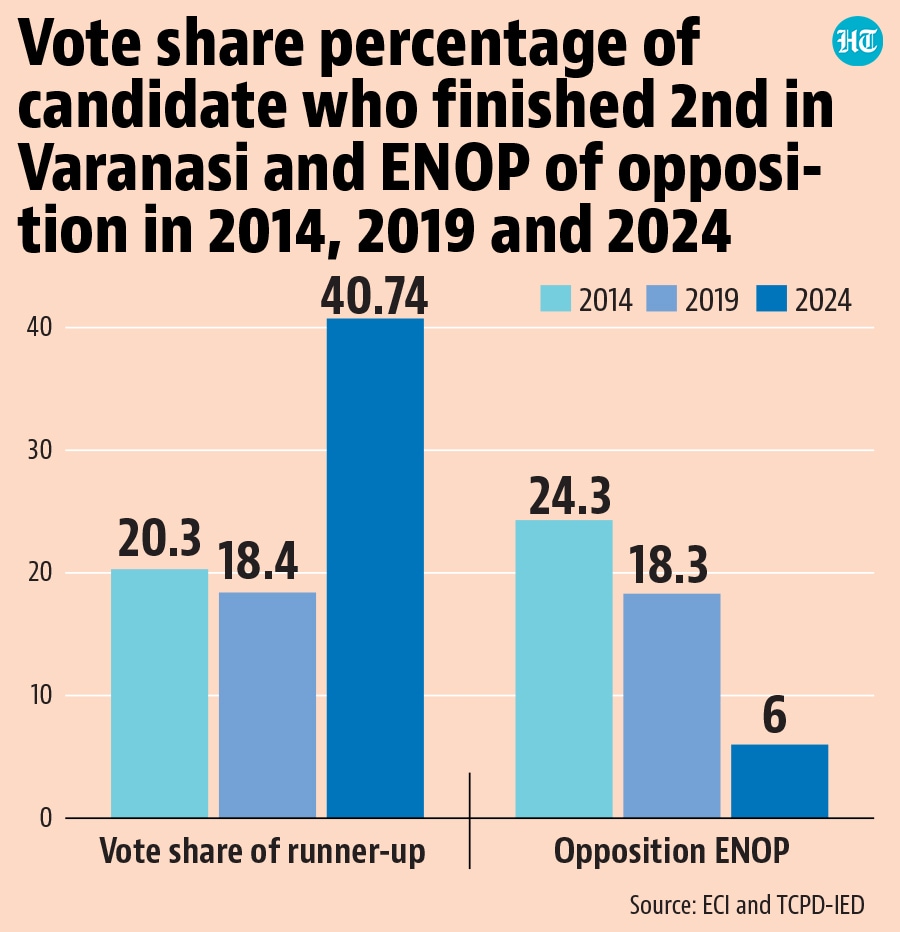
- Biggest reason behind the fall in Modi’s victory margin is a consolidation of opposition votesThe data shows this clearly. Candidates who finished second against Modi have varied in every election since 2014. In 2014, it was Arvind Kejriwal from the Aam Admi Party (AAP), in 2019 it was Shalini Yadav from Samajwadi Party (SP) and in 2024 it is Ajay Rai from the Congress. AAP fought the 2014 elections on its own in Varanasi, SP was in an alliance with Bahujan Samaj Party (BSP) and Rashtriya Lok Dal (RLD) in 2019 and the Congress and SP had an alliance in 2024. However, data clearly shows that the index of opposition unity against Modi was significantly larger in 2024 than it had been in 2014 and 2019. The number of candidates (including NOTA) who contested against Modi in Varanasi was 42 in 2014, 26 in 2019 and just seven in 2024. In terms of vote share, the candidate who finished second in Varanasi had a vote share of 20.3% in 2014 and 18.4% in 2019 elections. This number has increased to 40.7% in 2024. If one were to calculate the effective number of opposition candidates – reciprocal of sum of squares of vote share of all candidates against Modi in Varanasi – this number has fallen from 24.3 in 2014 and 18.3 in 2019 to just 6 in 2024. ENOP is a good measure of fragmentation of political contest in a constituency and a higher value indicates greater political fragmentation. If one looks at the overall ENOP including the winner Narendra Modi, this number was 2.7 in 2014, 2.22 in 2019 and 2.17 in 2024.
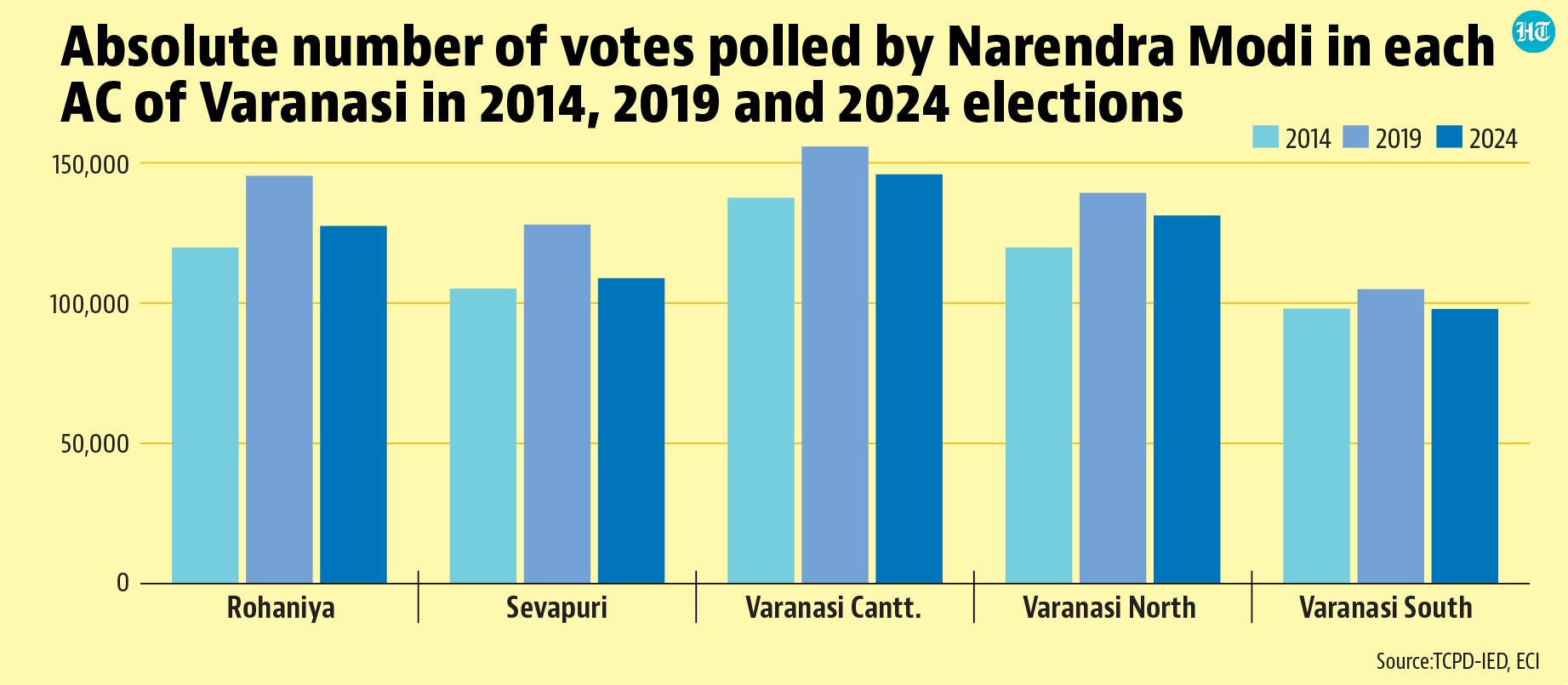
- Having said this, Modi also lost votes in every AC in Varanasi compared to 2019HT has taken the number of votes polled by Modi in each of the five assembly segments in Varanasi PC from the Returning Officer’s office. A comparison of these votes with the AC-wise break up of Modi’s votes in 2019 shows that there is an absolute fall in number of votes Modi received in every AC. When compared to 2014, Modi’s votes have increased in every AC except a loss of 180 votes in Varanasi South AC. To be sure, a more accurate comparison of Modi’s performance would have been to look at AC-wise vote share in 2019 and 2024. This is because absolute number of votes polled by a candidate can increase or decrease depending on change in strength of the electorate and turnout. However, HT could not get the number of overall votes polled in each AC for 2024. To be sure, Modi’s overall vote share in Varanasi PC has fallen by 9.4 percentage points between the 2019 and 2024 elections. This suggests that his popularity, as of now, clearly peaked in 2019, a trend which is pretty much in sync with the BJP’s overall political fortunes in the country. All five ACs in the Varanasi PC were won by the BJP or its allies in the 2017 and 2022 assembly elections in the state.
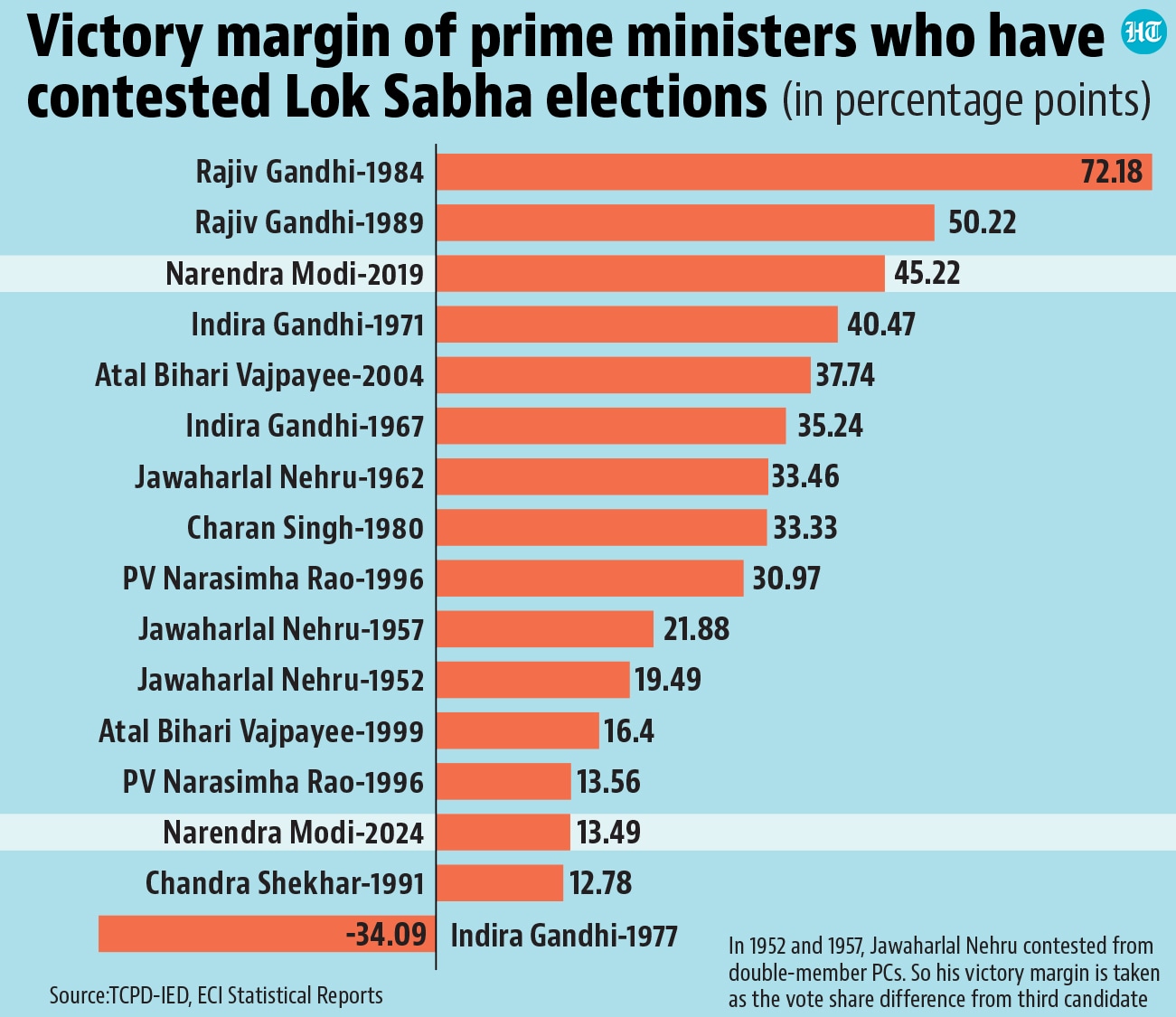
- And his 2024 victory margin is among the lowest ever for a sitting Prime Minister in IndiaHT has looked at the victory margin of every Prime Minister who contested a Lok Sabha election while holding office in India. There have been 17 such Lok Sabha contests since 1951. Modi’s victory margin of 2024, in terms of share of votes polled, is the lowest for any sitting prime minister contesting in a Lok Sabha election if one were to exclude Indira’s Gandhi’s loss in the 1977 elections held after the emergency and Chandra Shekhar’s 1991 victory margin. To be sure, Chandra Shekhar was a caretaker PM when the 1991 elections were held. Rajiv Gandhi’s 1984 victory margin of 72.2% is the highest ever victory margin for a sitting prime minister contesting a Lok Sabha election. Prime Ministers such as Manmohan Singh, IK Gujral etc. do not feature in the list because they did not contest Lok Sabha elections while holding the Prime Minister’s office.