
 E-Paper



The economics of Kerala’s religious diversity | Number Theory
.
Published on: Apr 7, 2026, 08:46:06 IST

 Prefer HTon Google
Share via


Copy link

Kerala is India’s only large state where three religious groups have a significant share in population. How does this religious diversity feed into the state’s political economy? Answering this question requires correlating the economic fortunes of state’s population with religion. Here is what an HT analysis of the relevant data shows.
The economics of Kerala’s religious diversity
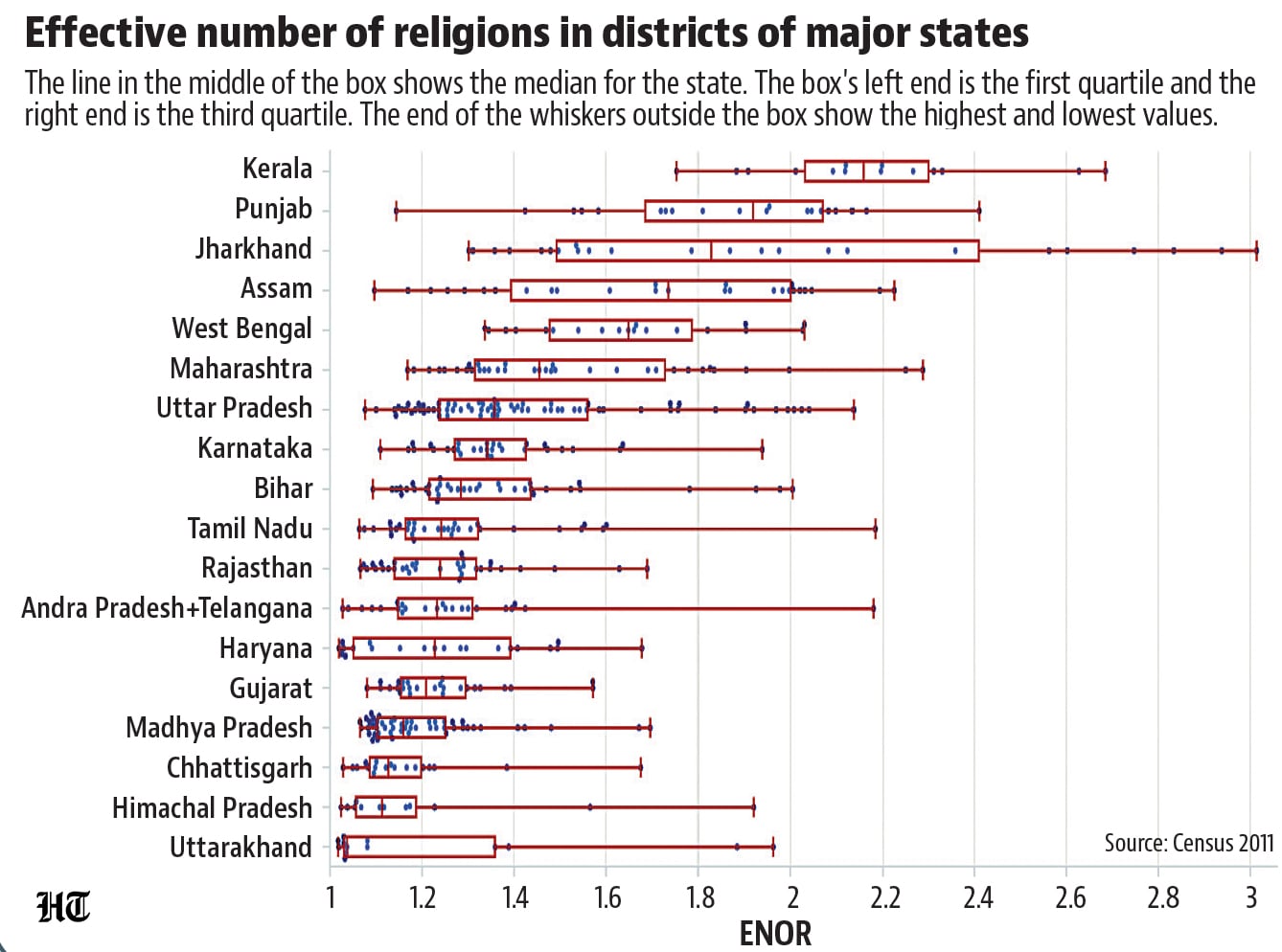
- Kerala has the highest religious diversity among large Indian statesWe use a tweaked version of a statistical measure which Number Theory readers would be familiar with. Effective number of Religious Groups (ENOR) instead of Effective number of Participants (ENOP) in elections. Simply speaking, it is the reciprocal of the sum of the squares of the share of each religious group in a state’s population. So, if just one religious group made up the total population in the state, the number would be one and if five of them had an equal share of 20% each the number would be 5. Kerala’s ENOR, as per 2011 census religious population shares was 2.48, the highest among India’s large states and the third highest after Arunachal Pradesh and Manipur. Kerala’s ENOR is 1.6 times the national average.
 Kerala’s religious diversity holds even at the intra-state levelA higher ENOR at the state level does not necessarily make smaller administrative units within more religiously diverse. A high ENOR for a state can also be the result of a concentration of different religious groups in different parts rather than all parts of it having religious diversity. Kerala performs better even on this count. It has the highest median ENOR at the district level. It is important to underline that district-level religious diversity can vary drastically for states with similar headline ENOR. Bihar and Uttarakhand – they have similar state level ENOR -- are good examples in the chart given below.
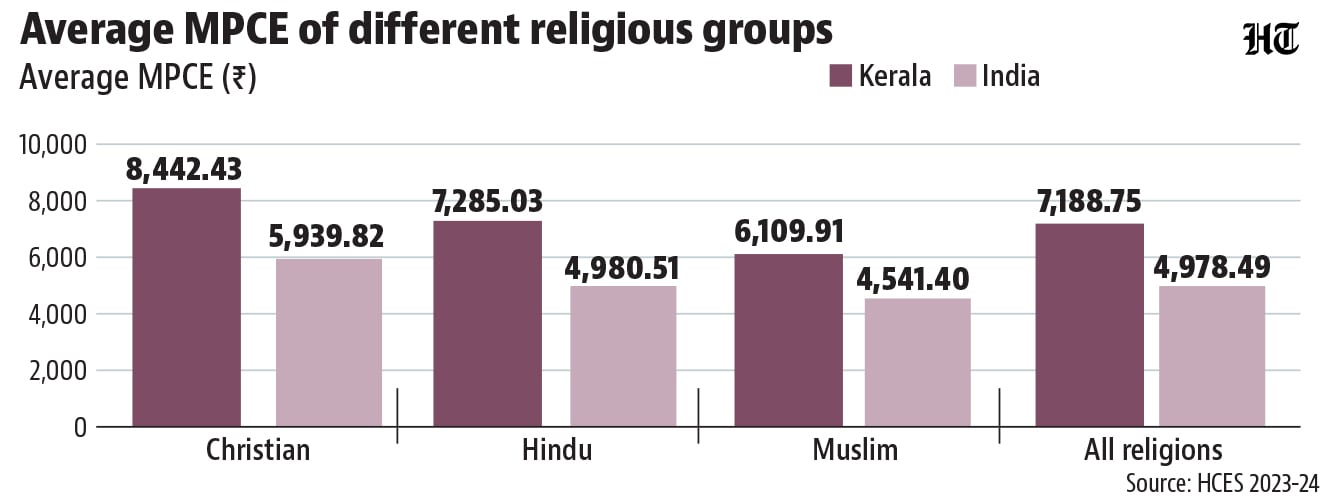
- Kerala’s religion-wise consumption standards follow the national pattern, but with greater inequality and overall advantageHow rich or poor are Kerala’s religious groups vis-à-vis each other? One way to look at it is to compare the monthly per capita consumption expenditure (MPCE) of the three main religious groups in Kerala, which account for almost all of its population. The ranking follows the all-India pattern of Christians being the richest, followed by Hindus and Muslims. To be sure, consumption surveys tend to undercount the really rich. A comparison with national-level MPCE trends shows that the inter-religion inequality in Kerala is greater but absolute MPCE levels for Kerala are higher than all-India average for every major religious group. A similar trend can be seen in the wage-data for Kerala and all-India as seen in the Periodic Labour Force Survey (PLFS).
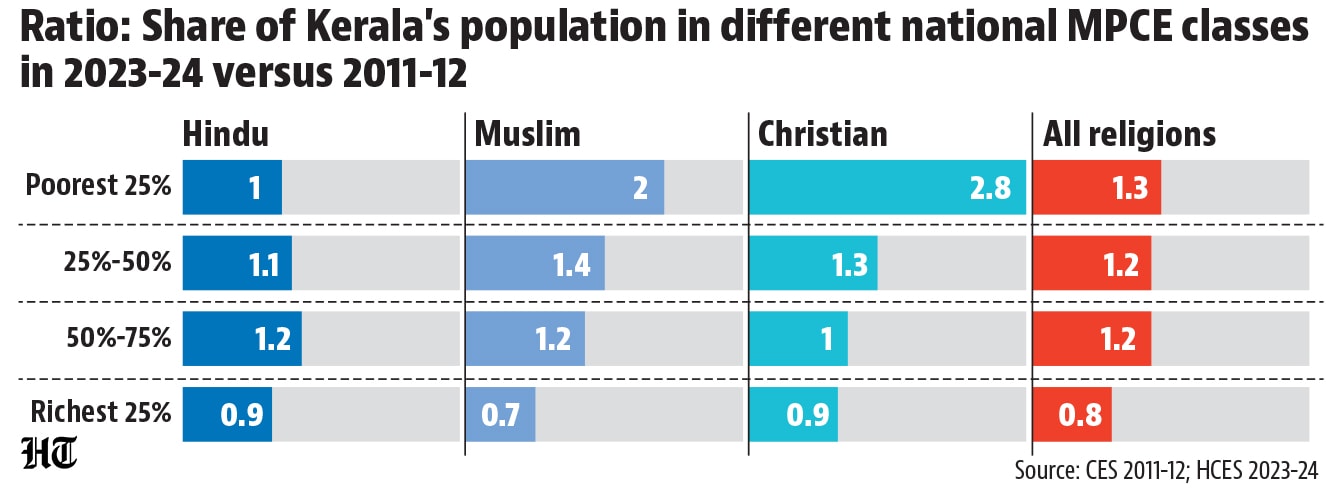
- Kerala has seen a secular loss of its consumption standard edge vis-à-vis India in the last 15 yearsHow have Kerala’s consumption standards changed vis-à-vis the rest of the country in the last decade and a half? HT has compared MPCE figures for Kerala and all-India from the 2011-12 and 2023-24 Consumer/Consumption Expenditure Surveys (CES). It shows that Kerala, and all major religious groups in the state, have lost their national advantage on the MPCE front. In 2011-12, Kerala’s average MPCE was 1.6 times the national average. This lead shrunk to 1.4 in the 2023-24 CES. If one were to distribute Kerala’s population in to all-India MPCE quartiles (bottom to top 25%), all major religious groups have seen a rise in their share in the poorer MCPE quartiles and a fall in the richer ones. To be sure, Kerala is still significantly ahead on a lot of other socio-economic indicators in the country, but its relative well-being is getting slowly eroded. Whether or not this creates an opening for a new political force in the state, or leads to a loss for the incumbent or actually rewards it because of its populist policies, remains to be seen.



Unlock a world of Benefits with HT! From insightful newsletters to real-time news alerts and a personalized news feed – it's all here, just a click away! -Login Now!


