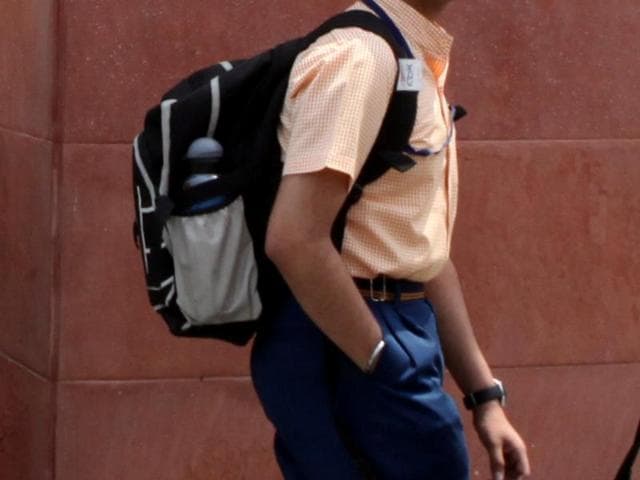
Heavy school bags up risk of back pain, bad posture
Anything more than 10% of the body weight on their shoulders can lead to not just back and posture problems, but also a host of other health conditions in children, warn experts.
Anything more than 10% of the body weight on their shoulders can lead to not just back and posture problems, but also a host of other health conditions in children, warn experts.
{{^htLoading}} {{/htLoading}}
Heavy bags can cause back pains, slouching back, head, neck and shoulder pain. In the long run, the abnormal weight on a growing spine can lead to the spine losing its natural curve.
The trend of schoolbags going heavier and heavier with each class is therefore quite worrisome.
“It may vary from child to child but we must keep the comfort level of the child in mind as to how much burden he or she can shoulder comfortably,” says Dr Deepak Chaudhary, director, Safdarjung Hospital’s Sports Injury Centre.
“Putting excess pressure can further aggravate any pre-existing problem of the spine that a child has and because children barely exercise these days they anyway don’t have strong bones and muscles,” says Dr Chaudhary.
{{^htLoading}} {{/htLoading}}
{{^usCountry}}
Since the back takes the maximum load, it also puts pressure on lower limbs (legs), knees, ankles among others.
{{/usCountry}}
{{#usCountry}}
Since the back takes the maximum load, it also puts pressure on lower limbs (legs), knees, ankles among others.
{{/usCountry}}
“What we do not realise is that we are creating a generation of unhealthy adults. These kids when they grow up, they will already be suffering from several musculoskeletal problems,” said a senior orthopaedician at All India Institute of Medical Sciences (AIIMS).
“We are seeing many cases where the person is suffering from lower back ache or knee problem; and when we probe for the reason, heavy school bags seem to be the culprit,” he said.
Over a period of time, the child may also develop scoliosis, where the spine is bent towards a particular side. “This is usually an irreversible condition and can also lead to breathing difficulty as bent spine tends to put pressure on the lungs,” he added.
Rhythma Kaul is the national health editor of the Hindustan Times. She has been reporting on public health, medicine, and medical research, with a particular focus on how government decisions and health system reforms shape people’s lives. Rhythma has over 25 years of journalistic experience. She joined Hindustan Times in 2008, and has since covered everything from pandemics and infectious diseases to cutting‑edge medical research and climate‑related health challenges. Her stories routinely track the work of the Ministry of Health and Family Welfare, department of pharmaceuticals, and key national health programmes, making complex medical science and policy accessible to a wide audience. One of her prominent news breaks has been the 2012 Baby Falak case: A two-year-old brutally battered baby girl was admitted to AIIMS-Delhi with severe head injuries, multiple fractures, human bite marks, and burns. The police investigation revealed this to be a case of multi-state human-trafficking racket. She was profiled by The Wall Street Journal for breaking this story. Rhythma holds a Master’s degree from Jawaharlal Nehru University, Delhi. Prior to Hindustan Times, she worked with the India Today Group. Rhythma can be contacted at rhythma.kaul@hindustantimes.com. Her X handle is @RamblingBrook.
{{^usCountry}}{{/usCountry}}
Stay informed with the latest updates on Education News also check CBSE Class 10 Result and Find tips to help you succeed in your academic journey and career planning on Hindustan Times.
Stay informed with the latest updates on Education News also check CBSE Class 10 Result and Find tips to help you succeed in your academic journey and career planning on Hindustan Times.