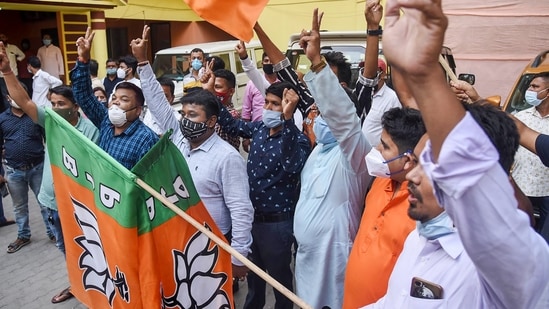
The Bharatiya Janata Party (BJP) led National Democratic Alliance (NDA) has managed to retain Assam convincingly. At 11:45 pm, the NDA, which also includes the Assam Gana Parishad (AGP) and the United People’s Party (Liberal) or UPPL had win/leads in 74 out of the total 126 assembly constituencies in the state with a vote share of 44.5%. The Congress alliance that includes the All India United Democratic Front (AIUDF) and the Bodoland People’s Front (BPF) had wins/ leads in 50 assembly constituency (AC) with a vote share of 43.8%.
The 2021 assembly elections mark a third consecutive two-thirds majority for the NDA in the state, if results are disaggregated at the AC level. The BJP contested the 2014 Lok Sabha elections on its own in the state.
Click here for full coverage on elections
The Congress, the main opposition party that ruled the state for 15 years from 2001 to 2016, has managed a seat share in the region of 20% for the fourth consecutive time in these elections.
The AIUDF’s performance has also been on similar lines. Its seat share in the 2016, 2019 and 2021 elections has been 10.3%, 9.5% and 11.1% (See Chart 1).
To be sure, the 2021 political alignment in the state was very different from 2016 and 2019. The Congress’s alliance with the AIUDF in these elections was a big change in Assam politics.
Similarly, the BPF decided to ally with the Congress instead of the BJP, after the latter ditched it in the Bodoland Territorial Council elections held in 2020. The BJP allied with the UPPL instead of the BPF. While the BJP’s alliance realignment seems to have worked, the Congress hasn’t gained much from its alliance.
A comparison of strike rates in 2016, 2019 and 2021 show this clearly. The biggest reversal in strike rates can be seen for the BPF and the UPPL, with the former’s dropping sharply and the latter winning almost three-fourth of the seats (it was the UPPL’s first election) it contested this time, although it didn’t contest the election in 2016 or 2019.
The only other party that has shown a big improvement in the strike rate is the AIUDF. However, its seat share has actually come down compared to 2016, because it contested fewer ACs in 2021 (20) compared to 2016 (74).
{{/usCountry}}The only other party that has shown a big improvement in the strike rate is the AIUDF. However, its seat share has actually come down compared to 2016, because it contested fewer ACs in 2021 (20) compared to 2016 (74).
{{/usCountry}}A region-wise analysis of performance of the BJP and the Congress underlines a subtle churn in the state’s politics though. The NDA has won 80% of the ACs in the Upper Assam sub-region, which indicates bigger consolidation from its 73.5% tally in the 2016 elections. Upper Assam has the lowest share of Muslims and the highest share of Assamese speakers in the state.
An almost mirror image of this trend can be seen in the Barak valley region, where the combined seat share of the Congress and the AIUDF has increased from 46.7% in 2016 to 66.7% in 2021; 48% of the population in Barak valley is Muslim. (See Chart 2).
These trends suggest a deepening polarisation in Assam’s politics, where the Hindu Assamese speaking population in Upper Assam might have consolidated in bigger numbers behind the NDA in response to the Congress’s alliance with the AIUDF, a party with its primary support base among Bengali-speaking Muslims.