...
...
Next Story

Weather Bee | Record ocean temperatures fuel unprecedented hurricane activity in Florida

Warm waters in the Atlantic Ocean and cooler conditions in the Pacific are driving Florida's back-to-back hurricanes

Published on: Oct 12, 2024, 08:00:12 IST
Advertisement

Back-to-back hurricanes have hit the state of Florida in the United States in the past two weeks. Others – although the threat of them falling on land is not concrete now – could also be in the offing. This might appear strange when a La Niña is yet to start, which usually allows a busy hurricane season in the Atlantic Ocean. So, what is making the hurricane season busy? HT’s analysis shows that this could be because the Atlantic Ocean
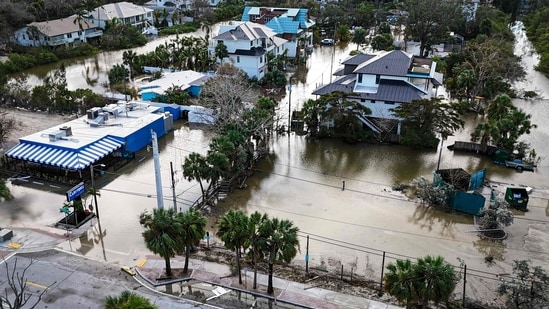
PREMIUMTOPSHOT - A drone image shows a flooded street due to Hurricane Milton in Siesta Key, Florida, on October 10, 2024. At least four people were confirmed killed as a result of two tornadoes triggered by Hurricane Milton on the east coast of the US state of Florida, local authorities said Thursday. (Photo by Miguel J. Rodriguez Carrillo / AFP) (AFP)
TOPSHOT - A drone image shows a flooded street due to Hurricane Milton in Siesta Key, Florida, on October 10, 2024. At least four people were confirmed killed as a result of two tornadoes triggered by Hurricane Milton on the east coast of the US state of Florida, local authorities said Thursday. (Photo by Miguel J. Rodriguez Carrillo / AFP) (AFP)
Deviation of September sea surface temperatures from 1991-2020 mean

To be sure, the concern with the hurricanes in Florida was not just that they had arrived late in the season, but also their intensity. What is the reason for their intensity? The short answer is a record warming in the Atlantic Ocean. Not only was the North Atlantic Ocean warmer than normal in September, but the month was also the warmest on records for large parts of the ocean.

Anomalies and extremes in sea surface temperature in September 2024

Why is the Atlantic Ocean so warm? Long-term global warming is one reason, and the one that is going to be responsible for future changes. However, the ocean has also experienced an upward bump in temperatures in recent years. Scientists have offered more than one explanation for this since last year. While some of those reasons are particular to a point in time (for example, the lack of Saharan dust that has a cooling effect on the ocean was cited as a reason last summer), there is another more permanent factor. The International Maritime Organisation imposed restrictions on the use of sulphur in marine fuels in 2020. While this prevents air pollution, the lack of pollution has also allowed the ocean surface to receive sunlight without hindrance.

Therefore, there has been a big uptick in Atlantic’s SSTs in recent years. Combined with long-term warming, this implies that hurricanes are going to be more powerful. Warmer oceans contain more energy and allow hurricanes to wreak the kind of destruction they have in Florida.

Abhishek Jha, HT’s assistant editor-data, analyses one big weather trend in the context of the ongoing climate crisis every week, using weather data from ground and satellite observations spanning decades.

Back-to-back hurricanes have hit the state of Florida in the United States in the past two weeks. Others – although the threat of them falling on land is not concrete now – could also be in the offing. This might appear strange when a La Niña is yet to start, which usually allows a busy hurricane season in the Atlantic Ocean. So, what is making the hurricane season busy? HT’s analysis shows that this could be because the Atlantic Ocean is very warm while the equatorial Pacific Ocean is undergoing a periodic cooling down.

PREMIUMTOPSHOT - A drone image shows a flooded street due to Hurricane Milton in Siesta Key, Florida, on October 10, 2024. At least four people were confirmed killed as a result of two tornadoes triggered by Hurricane Milton on the east coast of the US state of Florida, local authorities said Thursday. (Photo by Miguel J. Rodriguez Carrillo / AFP) (AFP)
TOPSHOT - A drone image shows a flooded street due to Hurricane Milton in Siesta Key, Florida, on October 10, 2024. At least four people were confirmed killed as a result of two tornadoes triggered by Hurricane Milton on the east coast of the US state of Florida, local authorities said Thursday. (Photo by Miguel J. Rodriguez Carrillo / AFP) (AFP)

Whether or not Atlantic Ocean hurricane season is busy depends on a number of factors. A key factor is warm waters in the Atlantic and relatively cool waters in the Pacific Ocean. In simple terms, this combination allows storms forming in the Atlantic to form, travel, and intensify without much obstruction from trade winds. This is usually expected during a La Niña, which appears to be arriving later than earlier forecast. However, as HT had earlier reported, a La Niña appeared imminent in September.

While a La Niña may yet be on its way, the combination of a warm Atlantic Ocean, and a relatively cool Pacific Ocean was present in September, as the accompanying map shows. The equatorial Pacific Ocean, particularly the part used to track El Niño and La Niña (5N-5S, 170W-120W or the Niño 3.4 region), had turned cooler than normal, while the Atlantic Ocean was warmer than normal.

Deviation of September sea surface temperatures from 1991-2020 mean

To be sure, the concern with the hurricanes in Florida was not just that they had arrived late in the season, but also their intensity. What is the reason for their intensity? The short answer is a record warming in the Atlantic Ocean. Not only was the North Atlantic Ocean warmer than normal in September, but the month was also the warmest on records for large parts of the ocean.

Anomalies and extremes in sea surface temperature in September 2024

Why is the Atlantic Ocean so warm? Long-term global warming is one reason, and the one that is going to be responsible for future changes. However, the ocean has also experienced an upward bump in temperatures in recent years. Scientists have offered more than one explanation for this since last year. While some of those reasons are particular to a point in time (for example, the lack of Saharan dust that has a cooling effect on the ocean was cited as a reason last summer), there is another more permanent factor. The International Maritime Organisation imposed restrictions on the use of sulphur in marine fuels in 2020. While this prevents air pollution, the lack of pollution has also allowed the ocean surface to receive sunlight without hindrance.

Therefore, there has been a big uptick in Atlantic’s SSTs in recent years. Combined with long-term warming, this implies that hurricanes are going to be more powerful. Warmer oceans contain more energy and allow hurricanes to wreak the kind of destruction they have in Florida.

Abhishek Jha, HT’s assistant editor-data, analyses one big weather trend in the context of the ongoing climate crisis every week, using weather data from ground and satellite observations spanning decades.

All Access.
One Subscription.

Get 360° coverage—from daily headlines
to 100 year archives.

E-Paper
Full
Archives
Full Access to
HT App & Website
Games
 
ABOUT THE AUTHOR
Abhishek Jha

Abhishek Jha is Assistant Editor-Data at Hindustan Times. He uses statistical programming to generate newsworthy insights from large datasets. He is part of the team that produces Number Theory, a daily data story feature of the paper’s print edition. Since March 2024, he has been writing Weather Bee, a weekly column for the Hindustan Times website. He is a chemical engineer by training, who specialises in stories related to weather, climate, and the environment. Jha has been at HT since 2018, where he offers data-driven perspective and analysis on politics, environment, weather, climate, economy and society. His work includes data coverage of elections in India and abroad, including the 2019 and 2024 Lok Sabha elections; the disasters and extreme weather resulting from changing climate, such as floods, droughts, heat waves, cold waves, and dwindling snow cap in the Himalayas; the factors that drive poor air quality in northern India; the changing patterns of land use; the Covid-19 pandemic and its impact on labour market conditions; the changing pattern of consumer spending seen in the new consumer spending surveys; and social norms seen in the surveys such as the National Family Health Survey.

SHARE THIS ARTICLE ON
Hindustantimes wants to start sending you push notifications. Click allow to subscribe