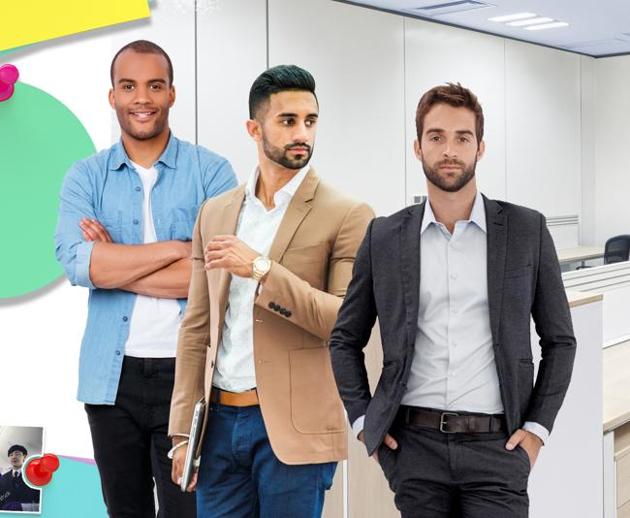
The good news for men is that the formal wear is no longer the ill-fitting stripes and checks of our father’s time. Formal shirts can be sumptuous silk, linen or cotton blends, ties have become a kind of collector’s item. Brands such as H&M, Zara, Allen Solly and Van Heusen have dedicated collections that cater to the smart casual or what they now call the ‘business casual’ look.
In most workplaces, it’s formals from Monday through Thursday. This means full sleeves, button-down shirts with collars (ideally no prints and no loud colours), trousers, ties and leather shoes, and a clean shave. Fridays are when you’re usually allowed smart casuals, and you can drop the tie, gently experiment with prints, perhaps opt for chinos or khakis. No earrings, visible body piercings or prominent tattoos. When it comes to the hair – facial or head – if you want to keep it long, it better be groomed like freshly cut topiary.
But in large parts of corporate India, this traditional mould is being discarded in favour of more relaxed dress codes that allow employees to express who they are — and create a work environment more suited to the identity of the company. This has coincided with liberalisation in India and the emergence of the start-up Silicon Valley culture in the US. Today, whether you work for Google, Netflix or Scootsy, you can get away with almost anything if it’s neat, clean and you’re not liasing directly with clients.
Ambreesh Shah, founder of Pepperfry, was recently quoted as saying that employees of the online furniture retailer don’t have a dress code. Rohit Regonayak, founder and director of tech services company Trellisys.net, based in Bengaluru, says he doesn’t think it makes an iota of a difference how a person dresses at work. People here are encouraged to wear whatever they want, even shorts, sneakers or ripped jeans. “It probably adds negative pressure to maintain a formal look rather than simply be yourself and let your work do the talking. This is especially true in innovative and creative roles,” Regonayak says.
{{/usCountry}}Ambreesh Shah, founder of Pepperfry, was recently quoted as saying that employees of the online furniture retailer don’t have a dress code. Rohit Regonayak, founder and director of tech services company Trellisys.net, based in Bengaluru, says he doesn’t think it makes an iota of a difference how a person dresses at work. People here are encouraged to wear whatever they want, even shorts, sneakers or ripped jeans. “It probably adds negative pressure to maintain a formal look rather than simply be yourself and let your work do the talking. This is especially true in innovative and creative roles,” Regonayak says.
{{/usCountry}}There are some rules that remain a given for men, even in the freest start-ups — no sleeveless attire, no open-toed shoes and pants shouldn’t stray too far above the knee.
“The work culture has changed, careers have changed, which has in turn led to the distinctive changes we see in work wear fashion,” says Ujjwal Dubey, of menswear label Antar-Agni. “With the rise of alternative careers, the fine line between work wear and casual wear has blurred and men now have the option of experimenting more with their personal style.”
Dress for you job
“At the workplace you are creating and reflecting your personal brand. Do you want to be known as the fun guy or the serious guy or one of the many variants in-between? You dress accordingly,” says Kunal Sen, senior client partner at American management consulting firm Korn Ferry. “There’s a school of thought that believes that casual dressing creates a sense of informality, which helps you connect with your team, thereby improving your quality of work.”
There is no dress code for office goers at Korn Ferry, but Kunal, who’s been in the industry for 30 years, says he wouldn’t be caught coming into work in “colourful sneakers and a T-shirt” like the younger lot do.
Among the sectors that allow smart casuals through the week — advertising, PR, entertainment — there are rules about meetings and events. A blazer can cover most fashion sins; semi-formal attire is a given at events.
“Meagre styling changes or adding of accessories can convert a formal outfit to a casual one,” says Dubey. “Layering is always an easy way to change your look. Shoes, scarves and other accessories can transform looks from formal to semi-formal to business casual to evening casual too.”
Catch your daily dose of Fashion, Taylor Swift, Health, Festivals, Travel, Relationship, Recipe and all the other Latest Lifestyle News on Hindustan Times Website and APPs.
Catch your daily dose of Fashion, Taylor Swift, Health, Festivals, Travel, Relationship, Recipe and all the other Latest Lifestyle News on Hindustan Times Website and APPs.