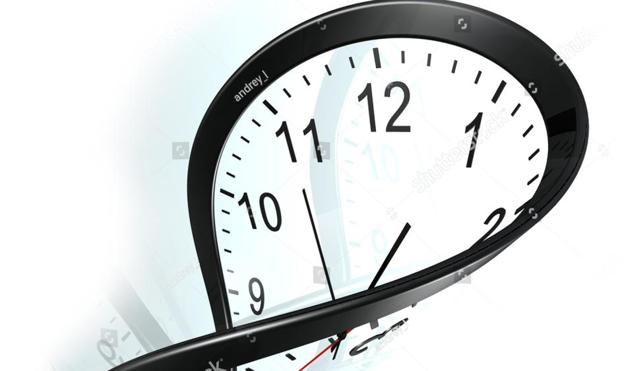
Do the days seem without structure, the weeks and months a blur? It could be the effect of the sameness of life in the pandemic, on neurons in the brain.
A paper published in Journal of Neuroscience in September indicates that sameness of stimuli makes certain neurons weary, altering our perception of time.
The paper was co-authored by Masamichi Hayashi at the National Institute of Information and Communications Technology in Suita, Japan, and Richard Ivry at the University of California, Berkeley. Hayashi and Ivry scanned volunteers’ brains while showing them the same scene — a grey spot on a screen — 30 times without pause.
After the period of adaptation, participants “saw the grey spot again, but for different lengths of time. Then, they estimated how long the object had stayed on screen”. Participants could not effectively tell the difference between the durations; at the same time, scans showed decreased activity in a group of brain cells involved in time perception, indicating ‘neuron fatigue’, the report states.
“I’ve always been interested in the neural mechanism of time perception,” Hayashi told HT. “How is the time experience represented in our brains? Why does time pass so quickly when you are having fun? Why does time slow down when you get into a car accident?”
{{/usCountry}}“I’ve always been interested in the neural mechanism of time perception,” Hayashi told HT. “How is the time experience represented in our brains? Why does time pass so quickly when you are having fun? Why does time slow down when you get into a car accident?”
{{/usCountry}}In 2015, Hayashi and Ivry began conducting behavioural experiments to confirm their own earlier brain scan experiment in this area of study. Their volunteers were mainly students aged 18 to 27.
“Our experience of time during the pandemic is probably associated with more memory-based recognition of time — the perception of time in the passing of days and months — which is a different area from the precise focus of our study,” Hayashi says. “Time estimation in the range of hundreds of milliseconds is important for a variety of daily activities, such as motor control, speech recognition and generation, playing instruments, dancing, etc. We still need to test, but I believe these time-sensitive neurons are involved in these timing-related activities too.”
The report’s findings may have other real-world applications. “Distortions in time perception and timed performances appear in patients with Parkinson’s disease, attention deficit hyperactivity disorder, and autism. We hope that our findings will provide some insight to understand these disorders,” Hayashi says.
Follow more stories on Facebook and Twitter