Every November, the cherry blossom around Ward’s Lake in Shillong becomes a sight to behold, and this year there is a reason to linger. From November 12-14, readers and writers will gather under the blossoms for the 6th Shillong Literary Festival, where Booker Prize winners Kiran Desai and Damon Galgut will share the stage with the Khasi, Jaintia and Garo communities. Each evening will feature an insightful session, ending on a musical note with performances by musicians of Chief Minister’s Grassroots Music Program (CM-MGMP). Shillong, once called the ‘Rock Capital of India’, is now known as the ‘Music Capital of India’.
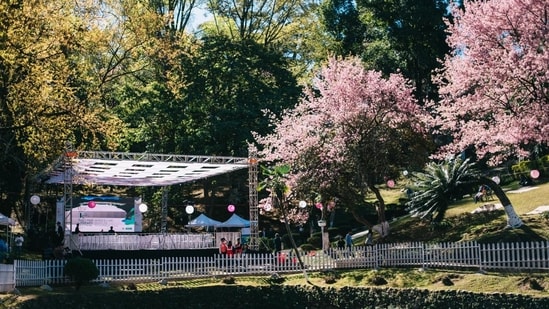
It is also a good place to understand what Meghalaya has been trying to do. The state has worked on a simple idea: a song, a weave, a recipe or a language should be able to earn a living for the person who keeps it alive.
This year, there is more to see. The Centre of Excellence for Eri Silk Weaving opened at Nongpoh, the Meghalayan Age Pavilion at Ward’s Lake, and the renovated State Central Library and House of Ryndia. Each initiative keeps traditions alive through institutions, markets and livelihoods, and not only in museums.
A young festival with a growing audience
The festival is only five years old and was launched by Meghalaya’s Chief Minister Conrad K. Sangma and Japanese Ambassador Satoshi Suzuki in 2021. With more than 13,000 visitors in 2025, the festival has also had guests including authors Banu Mushtaq, Vikram Seth and Shobhaa De. De even called it the “prettiest lit fest ever”.
{{/usCountry}}The festival is only five years old and was launched by Meghalaya’s Chief Minister Conrad K. Sangma and Japanese Ambassador Satoshi Suzuki in 2021. With more than 13,000 visitors in 2025, the festival has also had guests including authors Banu Mushtaq, Vikram Seth and Shobhaa De. De even called it the “prettiest lit fest ever”.
{{/usCountry}}This year’s line-up includes authors Kiran Desai, who won the Booker Prize in 2006 for The Inheritance of Loss, and Damon Galgut, who won it in 2021 for The Promise. First Bloom, the festival’s open call for new writers from the Northeast, closed on October 20.
After the readings, the creator economy takes the stage
The Chief Minister’s Meghalaya Grassroots Music Programme (CM-MGMP), launched in 2022, is on a mission to make music a livelihood and not just a hobby. Cafes, festivals and tourist destinations double as paid venues. So far, the programme has recorded more than 38,000 performances, engaged over 7,700 artists and invested around ₹38.7 crore. On average, an artist earns ₹10,000 per performance.
This is the heart of Meghalaya’s creator economy, and it goes beyond music. Seven festivals in 2025 drew over three lakh people and generated around ₹133 crore. The Meghalaya Film Tourism Policy 2025 offers subsidies of up to ₹1 crore for qualifying productions, and the Chief Minister’s Artist Engagement Scheme pays artists to create work in public spaces.
The next big stage is days away. The Shillong Cherry Blossom Festival, on November 20-21, has announced international headliners including Nelly, Khalid and Galantis.
Backing those who build and those who host
The same thinking applies to anyone with a business idea. PRIME, launched in 2019, supports entrepreneurs from idea to incubation, finance and market access in all 12 districts. With CM-ELEVATE, it has extended more than ₹150 crore to over 9,000 direct beneficiaries. This October, the state launched the Chief Minister’s Innovation Contest 2026, with up to ₹5 lakh for each of the top three winners, and the PRIME Digital Service Provider Platform, a zero-commission platform for verified local carpenters, electricians, plumbers and tailors.
Many of these businesses depend on visitors who come for the landscape. Meghalaya has more than 1,000 waterfalls, including Nohkalikai, described as India’s tallest, over 1,600 caves and more than 100 living root bridges. Wah Umngot at Dawki is described as India’s cleanest river, and Mawlynnong is recognised as the cleanest village in Asia.
The numbers are growing. Tourism contributed about 7.7 per cent of Gross State Value Added in FY 2025. An estimated 18 lakh visitors came in 2025, up from 16.1 lakh in 2024, and the target for 2028 is 21 lakh. For local families, the Chief Minister’s Homestay Mission offers a 70 per cent subsidy, with a target of 3,000 new homestays by 2028.
Language, craft and silk: heritage that is still in use
In Shillong, the literary festival has a natural home in the State Central Library. Open since January 19, 1974, it holds over 2 lakh volumes, and its renovated building was inaugurated on November 3.
Languages are getting the same attention. The State is working to bring Khasi and Garo onto BHASHINI, the national AI translation mission. The state cabinet has also approved the Meghalaya Official Languages Ordinance, 2026, which makes Khasi and Garo official languages alongside English. CM Sangma credited the Khasi Authors’ Society and the Achik Literature Society for the move.
The Arts and Culture Department is also strengthening the places where this heritage is studied and shown. The Williamson Sangma Meghalaya State Museum was renovated and curated in 2025 and now has 11 exhibition areas covering geology, arts and crafts, textiles, maps, stamps, Shillong’s history and Statehood, along with visual arts, children’s learning and immersive audio-visual galleries. The Sohra Experimental and Cultural Centre and the Mawphlang Heritage Museum present Meghalaya’s history, traditions and community heritage, while the Twahlongwar Open-Air Museum at Wahmawpat takes a community-based approach, combining archaeology with local participation, responsible tourism and livelihoods.
The Department has also identified 11 Arts and Craft Villages, each linked to a living tradition. The clearest example is Ryndia, the Eri silk of Meghalaya, which received a Geographical Indication tag on April 3, 2025. About 25,000 weavers and 43,000 sericulture farmers work in the sector, and women make up over 70 per cent of the textile workforce. Their work now has its own showroom, the House of Ryndia, which opened in the State Central Library Complex on November 3.
Back at the lake, a shelf for local products
The story ends where it began, at Ward’s Lake. The Meghalayan Age Pavilion, which opened there on October 13, hosts 16 PRIME-supported enterprises selling everything from Khasi fusion cuisine and Meghalaya-grown coffee to fruit wines and Ryndia shawls. The Fruit Wine Experience Centre does the same for Meghalaya’s emerging wine producers, linking locally made fruit wines with value addition, entrepreneurship and tourism. For small producers, the main difficulty is reaching customers, not the quality of their products. Meghalaya Collectives, the State’s co-brand for farmer collectives, now has 15 products listed on Amazon, and farmer collectives have traded produce worth ₹22.21 crore with buyers including Flipkart, Blinkit and Reliance.
Meghalaya is extending its model of eco-friendly, community-driven tourism to culture, language, textiles and enterprise, so that the people who keep its traditions alive also earn from them. The best way to read the rest is to visit.
Plan your visit:
- Autumn calendar 2026: Shillong Literary Festival (November 12-14), Wangala Golden Jubilee (November 11-14), Shillong Cherry Blossom Festival (November 20-21), Me’Gong Festival (December 4-5) and Winter Tales at Ward’s Lake in December.
- Plan your visit around the Shillong Literary Festival (November 12-14, 2026, Ward’s Lake, Shillong), then stay on for the Shillong Cherry Blossom Festival (November 20-21).
- Meghalaya Tourism Helpline: OneConnect (toll-free 1800-599-2026) or www.meghalayatourism.in.