Zahida Zaidi’s symbolic and experimental play ‘Doosra Kamra’ was staged on the third day of the Urdu Academy, Delhi’s 36th Urdu Drama Festival, keeping the audience engaged with its elements of suspense, fear and uncertainty. Presented under the aegis of the Taisia Foundation, the production was directed by Ahd Khan.
The play revolves around a couple, Suraj and Sonia, whose two-room home becomes the setting for a series of mysterious events. The second room gradually emerges as a space associated with fear and unanswered questions. Strange occurrences and the appearance of bodies leave the audience wondering whether the events are real or a product of the characters’ fears and perceptions.
The production was originally structured in three scenes. However, director Ahd Khan added an opening scene before the main narrative, bringing the total number of scenes to four. In this additional sequence, Suraj and Sonia discuss the second room before a mysterious and frightening stranger enters. The scene establishes an unsettling atmosphere even before the central story unfolds.
The uncertainty surrounding the room remains central to the play. As the narrative progresses, the distinction between reality, fear and illusion becomes increasingly difficult to establish. The production does not offer easy explanations, instead allowing the mystery to build until its conclusion.
Music and performances shape the atmosphere
{{/usCountry}}The uncertainty surrounding the room remains central to the play. As the narrative progresses, the distinction between reality, fear and illusion becomes increasingly difficult to establish. The production does not offer easy explanations, instead allowing the mystery to build until its conclusion.
Music and performances shape the atmosphere
{{/usCountry}}Sound and music played an important role in creating the mood of the production. The background score intensified the sense of fear during tense sequences, while quieter and more ordinary scenes were accompanied by music suited to their tone. The use of sound helped maintain the contrast between moments of apparent normality and the unsettling events associated with the second room.
The play ends on another ambiguous note, bringing together hope, fear and uncertainty about what lies ahead. This open-ended conclusion leaves the audience with questions about the events and their meaning, rather than providing a definitive explanation.
Sumit Singh played Suraj, while Richa Rai portrayed Sonia. Sarita Chaturvedi appeared as Shabnam, Gurinder Singh played the stranger, and Aman Ahmed performed the roles of Ram Prasad and Virodh Kumar. The cast received appreciation for its performances, with the work of Singh and Rai in the lead roles and Chaturvedi in a supporting role drawing particular attention.
The production brought together its narrative, performances and technical elements to create a suspense-driven theatrical experience. Khan's decision to add an opening sequence gave the play an additional layer of mystery and established the atmosphere before the main story began.
Urdu Academy's cultural programme highlighted
The programme was conducted by Reshma Farooqui, who spoke about the Urdu Academy's literary and cultural activities throughout the year. She also highlighted the academy's work in promoting the Urdu language and literature.
The 36th Urdu Drama Festival provides a platform for theatrical presentations in Urdu and brings the work of playwrights and theatre practitioners before audiences. The staging of ‘Doosra Kamra’ on the festival's third day added an experimental production to this year's programme.
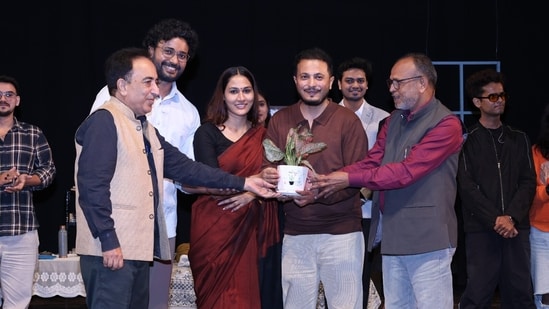
At the end of the performance, senior Urdu Academy staff members Mohammad Haroon and Uzair Hasan Quddusi presented a plant to director Ahd Khan in recognition of his creative effort. Audience members also appreciated the director and the cast for the production.
With its use of suspense, sound and an unresolved ending, ‘Doosra Kamra’ offered viewers an opportunity to interpret the events on stage and reflect on the questions raised by the story. The play's central mystery remained its defining feature, holding the audience's attention through its final moments.