Delhi's chief electoral officer has issued notices to nearly 3.31 million voters during the ongoing Special Intensive Revision (SIR) of electoral rolls. Of these, 1.9 million were flagged under "logical discrepancies"—an expansive category covering 11 sub-classifications.
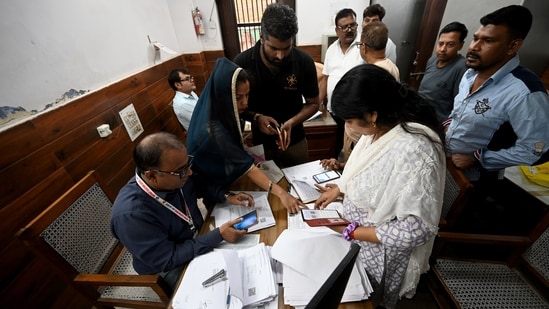
The office of the Delhi chief electoral officer late on Friday published online the list of electors served notices, days before the Supreme Court was to hear a petition by activists Anjali Bhardwaj and Amrita Johri on September 22 to seek the disclosure of voters issued notices, algorithmic parameters and operational guidelines used to flag a voter under "logical discrepancy."
In a statement on Sunday, the Delhi CEO's office clarified that issuing a notice does not mean an elector’s name will be deleted from the electoral roll.
Deep Dive
What are the common reasons for voters receiving SIR notices in Delhi?
Why are prominent figures like Arvind Kejriwal and Rekha Gupta receiving SIR notices?
How can ordinary voters contest a notice issued during the SIR process?
The notice-and-disposal window runs until October 29, ahead of the final electoral roll's publication on November 4.
In an interview to HT, OP Rawat, who served as chief election commissioner (CEC) in 2018, expressed his reservations about the process, underlining that the concept of “logical discrepancy” was initially incorporated into the electoral roll revision to detect illegal immigrants.
The Election Commission of India (ECI) doesn't clearly define parameters for raising "logical discrepancy" flags. Though we've seen some common categories across states, new ones keep coming up. As a former CEC, do you think an algorithm-driven system with this little transparency meets the due-process standard the commission owes ordinary voters?
{{/usCountry}}The Election Commission of India (ECI) doesn't clearly define parameters for raising "logical discrepancy" flags. Though we've seen some common categories across states, new ones keep coming up. As a former CEC, do you think an algorithm-driven system with this little transparency meets the due-process standard the commission owes ordinary voters?
{{/usCountry}}Logical discrepancy as a category was included in poll revisions to flag or detect illegal immigrants. But now it has become an all-encompassing category, with all kinds of criteria being introduced to flag a voter. A minor spelling mistake can lead to a notice being generated. Today, we saw how so many VVIPs have received notices. ECI has also come out with a clarification that a notice does not mean automatic deletion. But why should you even need a clarification like this? When a notice is sent to a sitting or former chief minister, the external affairs minister or India's former army chief, there should be something substantive in it. This has become a big mess.
With Delhi chief minister Rekha Gupta and Arvind Kejriwal both receiving discrepancy notices along with several other VVIPs, does their appearance on this list validate the SIR process as impartial or does it simply show that a flawed, opaque flagging system can catch anyone, VIP or not?
Actually, this kind of defence from the Election Commission doesn't hold water. You can't claim you are being egalitarian in this sense by saying that a VIP and poor people are being treated the same. A VIP getting a notice is being reported extensively in the media and is making noise. It's getting everybody's attention. We know, and we've seen that the notice will be withdrawn and resolved in no time. Whereas a poor person has no resources, no wherewithal, no name, and no technology. What will that person do? That person will feel that everything go to hell, I don't want my name on the list (electoral roll). So, the logic that SIR treats everyone the same is wrong. ECI must defend the poor much more than the rich.
The Supreme Court is hearing a plea on September 22 seeking more specifics behind each notice. Should the ECI have made this disclosure voluntarily, and what does the repeated need for court intervention say about the commission's internal transparency culture?
The Election Commission has always been proactive in helping people and being more and more transparent about its activities. That culture, though, seems to be fading away now. So, one can't say why they haven't been more forthcoming about these disclosures. Only the current leadership at the commission can answer this question.
With over 1.9 million Delhi voters flagged for logical discrepancies and given until October 29 to respond, do you think the ECI has built in enough safeguards for an ordinary voter without legal resources to actually contest a flag, compared to what a VIP's office can mobilise?
The only person who does not have enough time for this are the poor, and they are the ones who will be adversely impacted. A daily wage worker cannot work through the day and then also attend an SIR hearing in the evening. The VIPs or the upper-middle-class people won't face much of a problem. The BLO (block-level officer) will reconcile their records in no time. It would be the poor who will suffer.