A 7.4-magnitude earthquake tore through western Colombia on August 10, leaving widespread destruction and killing over 200 people. Search and rescue teams were still combing through collapsed buildings near San José del Palmar in the Chocó region, assessing the damage, as the government declared a national emergency.
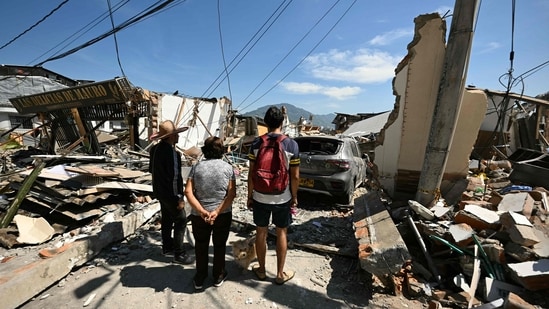
What has drawn scientists' attention, though, is not just the scale of the quake but where it happened: approximately 100km underground.
The US Geological Survey (USGS) says the depth and location suggest this was likely an intra-slab earthquake: one that ruptures inside a tectonic plate as it sinks beneath another, rather than at the boundary where two plates meet. That classification is still a working assessment, based on the earthquake's depth and mechanism, not a confirmed final finding.
Scientists are continuing to study the seismic data to pin down exactly how the rupture unfolded.
Intra-slab earthquakes
Off Colombia's western coast, the Nazca Plate, a slab of oceanic crust, is moving eastward beneath the South American Plate in a process called subduction. It doesn't vanish as it goes under; it keeps descending, bending and deforming as it sinks deeper into the Earth.
{{/usCountry}}Off Colombia's western coast, the Nazca Plate, a slab of oceanic crust, is moving eastward beneath the South American Plate in a process called subduction. It doesn't vanish as it goes under; it keeps descending, bending and deforming as it sinks deeper into the Earth.
{{/usCountry}}That bending builds up stress inside the plate itself. When the stress releases suddenly along a fault, an earthquake follows — and because the depth here points to the rupture happening inside the descending Nazca Plate itself, rather than at the shallower boundary between the two plates, geologists classify it as intra-slab.
The USGS puts the August 10 quake at roughly 110km deep, driven primarily by strike-slip faulting, within a band it classifies as "intermediate-depth" (70km to 300km).
At these depths, quakes typically come from the subducted plate deforming internally, not from movement at the shallower plate boundary.
Earthquakes in general can strike anywhere from just beneath the surface to hundreds of kilometers down, the USGS notes. Subduction zones like this one can produce them at the deeper end of that range because oceanic plates like the Nazca stay relatively cold and brittle even as they plunge into the far hotter mantle below.
Ordinarily, rock buried that deep would have heated up enough to stop fracturing and instead bend slowly under pressure, a shift geologists call the brittle-ductile transition, and the reason most earthquakes are confined to the outer few tens of kilometers of the Earth.
But because the Nazca Plate is old, cold oceanic crust descending rapidly, it resists that heating for longer than the rock around it; staying brittle, and capable of snapping into an earthquake, at depths where the surrounding mantle no longer could.
Does depth make it less dangerous? Not necessarily
Generally, a deeper earthquake shakes the surface less violently than a shallow one of the same magnitude, because the seismic energy has further to travel and weakens along the way. That much may have held true here.
But intermediate-depth earthquakes carry a trade-off: while the shaking is less intense, it spreads across a far wider area, the USGS notes. The geometry explains why, with the source sitting around 100km down, a much larger stretch of surface remains roughly equidistant from it. So the shaking doesn't taper off as sharply as it would from a shallow quake.
In simpler terms, imagine the path of seismic waves from an earthquake's epicenter to the surface as a cone. The deeper an epicenter lies, the wider is the cone.
The USGS estimated that about 10.5 million people experienced strong to very strong shaking as a result.
Local ground conditions add another layer of risk. Softer sediment can amplify seismic waves and intensify shaking in specific areas. Loose, waterlogged soil can also liquefy. This happens when pressure builds up in trapped groundwater, causing the ground to temporarily behave like a liquid. It can weaken the ground and undermine structures built on top of it.
Duration matters too. Seismologists Judith Hubbard and Kyle Bradley pointed out that standard measurements, peak ground acceleration and velocity, don't capture how long the shaking lasted. A structure that can withstand a few seconds of intense shaking may still fail if the tremors drag on considerably longer.
How common are these earthquakes?
Intra-slab earthquakes are far less common than shallow earthquakes, and they can only happen in an active subduction zone, where one plate is sinking beneath another.
The USGS classifies roughly 70% of all earthquakes worldwide as shallow (within 70km of the surface), by count. Measured instead by energy released, intermediate-depth quakes — the band Colombia's falls into — account for only about 12-15% of the total, against roughly 70-85% for shallow quakes on that same basis.
That makes them a minority of earthquakes overall, though not an unusual occurrence in a subduction zone like the Nazca-South American boundary.
Another such earthquake stemmed from the same plate: a magnitude-7.4 intra-slab earthquake struck near Calama in northern Chile in June 2024. This too was a rupture within the descending Nazca Plate. More recently, on July 27 this year, a smaller magnitude-5.4 intra-slab quake struck roughly 107km beneath the Atacama Desert in the same region. No major damage was reported.