From Sunday, November 1, Delhi will turn back vehicles registered outside the city that do not meet BS-VI emission standards. The restriction is part of the revised Graded Response Action Plan (Grap), Delhi-NCR's winter pollution-control plan, and runs until January 31, 2027.
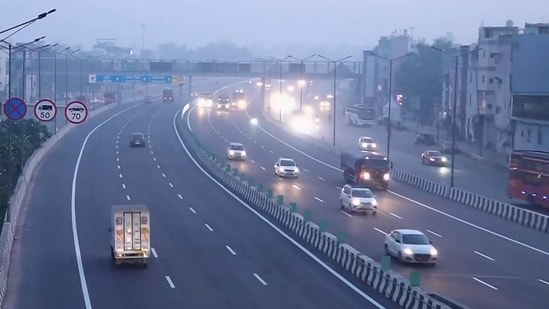
The numbers are large. Transport department estimates put the number of vehicles below BS-VI across Gurugram, Faridabad, Noida, Greater Noida and Ghaziabad at more than a million. Gurugram and Faridabad account for nearly 200,000, about 70% of them BS-III and BS-IV, along with around 50,000 commercial vehicles. Noida and Greater Noida together have more than 400,000 vehicles below the standard, more than half of them BS-IV petrol cars.
That does not mean a million vehicles will be turned back. CNG and electric vehicles, ambulances, fire tenders and specified essential-service vehicles are exempt. So are Delhi-registered vehicles, though other pollution and vehicle-age rules still apply to them. Those most likely to feel the curb are daily commuters and small-business owners who cross the border for work.
Enforcement will happen at the border. Automatic Number Plate Recognition (ANPR) cameras at checkpoints and selected lanes will scan plates and flag vehicles for checks, and authorities are reinforcing entry points on routes from Noida, Gurugram and Ghaziabad.
{{/usCountry}}Enforcement will happen at the border. Automatic Number Plate Recognition (ANPR) cameras at checkpoints and selected lanes will scan plates and flag vehicles for checks, and authorities are reinforcing entry points on routes from Noida, Gurugram and Ghaziabad.
{{/usCountry}}BS-VI vehicles still need a valid Pollution Under Control (PUC) certificate to enter the city from November 1.
Also read: No PUCC, no entry into Delhi from Nov 1: What the test measures, and pollutants it cannot trace
What is BS-VI?
Bharat Stage (BS) norms set the limits on what a new vehicle may emit before it can be sold. Manufacturers prove a model meets them in laboratory tests. India moved straight from BS-IV to BS-VI on April 1, 2020, skipping BS-V.
How much cleaner is a BS-VI vehicle?
The Centre for Science and Environment (CSE), a Delhi-based research and advocacy group, estimated that the jump would cut emissions from new vehicles by 60% to 90%, depending on the pollutant and the type of vehicle.
Diesel vehicles changed the most. Under BS-IV, a diesel car could emit at least three times as much nitrogen oxide as a petrol car; under BS-VI, about one and a half times as much, according to CSE. BS-VI also capped the number of particles a diesel vehicle may emit. The limit is designed to remove 95% of particles, and manufacturers meet it by fitting a particulate filter, which traps soot before it leaves the tailpipe.
Roadside readings show the gains hold up on Delhi's roads for most vehicles. The TRUE Initiative, with analysis by the International Council on Clean Transportation (ICCT), took about 111,000 roadside readings of vehicle exhaust in Delhi and Gurugram between December 2022 and April 2023. BS-VI private cars emitted 81% less nitrogen oxide than BS-IV cars, and BS-VI buses nearly 95% less.
Why do nitrogen oxides matter?
Vehicles emit 81% of the nitrogen oxides produced within Delhi, according to a 2018 source study by The Energy and Resources Institute (Teri) and the Automotive Research Association of India (ARAI). In the air, these gases form fine particles and ozone, a gas that irritates the lungs.
A study of Delhi's winter air led by IIT Kanpur, which analysed the city's particles hour by hour from November 2022 to February 2023, attributed 17% of fine particulate matter (PM2.5) directly to vehicles. Another 32% came from particles formed in the air from gases, including those released by vehicles.
Is every BS-VI vehicle cleaner?
Not all of them performed to standard on the road. The TRUE Initiative's readings found BS-VI CNG vehicles emitting between 1.5 and 14 times the nitrogen oxides their laboratory limits allow; one class of light goods vehicles reached 14.2 times. BS-VI taxis and light goods vehicles emitted 2.4 and 5 times as much nitrogen oxide as BS-VI private cars.
CNG vehicles, whatever their standard, are exempt from the entry curb.
Also read: Delhi govt asks schools to take measures for mitigating pollution impact
Can a PUC test tell a BS-IV vehicle from a BS-VI one?
At a testing centre, BS-IV and BS-VI vehicles face identical limits, so the test cannot tell them apart.
The PUC limits tightened in the move from BS-III to BS-IV. In the move from BS-IV to BS-VI, they did not change, although a BS-VI vehicle was built to emit far less.
The gap follows from what the test measures. It checks carbon monoxide and hydrocarbons in petrol vehicles while the engine idles, and the darkness of diesel smoke. BS-VI cut nitrogen oxides and particle counts most, and the PUC test measures neither. On its readings, a BS-VI car with a failed particulate filter or catalytic converter can look no different from a healthy BS-IV car.
That leaves a BS-IV car registered outside Delhi liable to be turned back at the border from November 1, even if it holds a valid PUC certificate. Under the road transport ministry's July 2026 draft rules, a private BS-VI vehicle would need a PUC test only once every three years until it turns six.