After Tuesday’s deadlocked election, Prime Minister Benjamin Netanyahu and his main challenger, former military chief Gadi Eisenkot, each need support from beyond their own blocs to govern Israel.
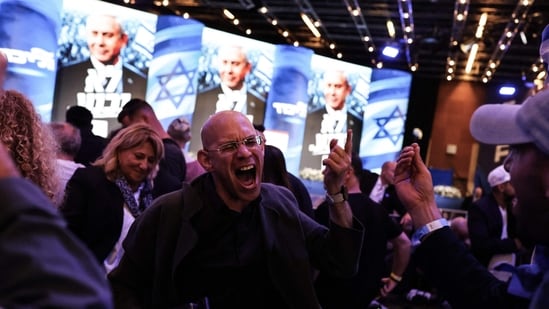
The deals they can or cannot strike in the coming weeks will decide whether the country gets a new government or another election.
Exit polls left both leaders’ blocs around 10 seats short of the 61 needed for a majority in the 120-seat Knesset. The Arab-led parties, projected to win 17 to 19 seats beyond the two blocs, have offered to back Eisenkot from outside a coalition, though he has not committed to governing with them. Netanyahu has ruled them out, and a deal between the two key contenders would require him to drop his far-right and ultra-Orthodox allies.
Neither leader has claimed victory. Yohanan Plesner, president of the Israel Democracy Institute, called the exit polls a major defeat for Netanyahu’s coalition but cautioned that Eisenkot had not emerged as a clear winner. If no government can be formed, Netanyahu stays on as caretaker prime minister until another election, and a prolonged deadlock could work in his favour.
Who holds the balance?
The two Arab-led parties were forecast to win more seats than expected, described as a historic night for turnout among Palestinian citizens of Israel. Arab citizens make up about 20% of Israel”s population, according to AFP.
{{/usCountry}}The two Arab-led parties were forecast to win more seats than expected, described as a historic night for turnout among Palestinian citizens of Israel. Arab citizens make up about 20% of Israel”s population, according to AFP.
{{/usCountry}}Both parties have said they would support Eisenkot on some level. The Joint List, an alliance of Arab parties, has said it is unlikely to join a coalition outright, but has offered a “safety net” for any government that removes Netanyahu from power. Ra’am, led by Mansour Abbas, has voiced openness to working with Eisenkot’s bloc. In 2021, Ra'am became the first Arab-led party to join an Israeli governing coalition, in a short-lived government led by Naftali Bennett and Yair Lapid.
“We refuse the occupation and racism, and we will remain here,” Faten Gattas, a Joint List candidate, told supporters in Nazareth, Reuters reported. Tal Elovitz, an Israeli political commentator, told AFP that the especially high Arab turnout “indicates a strong desire for partnership”.
Netanyahu’s bloc depends on smaller partners of its own. The far-right religious parties led by Itamar Ben-Gvir and Bezalel Smotrich were projected to win a combined 13 seats, with no major gains for either. His coalitions have also long relied on ultra-Orthodox parties that want young men in their communities to stay exempt from military service.
Exit polls indicated a drop in support for those parties, which analysts said signalled voter unhappiness over the exemptions.
What are Netanyahu's options?
As leader of the party projected to win the most seats, Netanyahu could claim the first chance to form a government. The President usually asks the leader of the largest party, though he is not bound to.
Netanyahu, 77, has served as prime minister for nearly 19 of the past 30 years and has repeatedly survived political crises.
Speaking to supporters in Jerusalem after 3am, Netanyahu called for “a strong, right-wing national government” and highlighted Israel’s military successes. He argued that he has made Israel and the world safer by killing top leaders of Hamas, Hezbollah and Iran.
His bloc is projected to win fewer seats than he needs. His coalition held 68 seats at its peak, before it began to break apart over the past year. If the exit polls hold, it would fall far short of 61. According to analysts, his bloc has no obvious place to pick up more seats, since some smaller right-wing parties failed to cross the 3.25% threshold for entering parliament.
Netanyahu has also ruled out other sources of support. On election night, he criticised the Arab-led parties and warned against including them in government. During the campaign, he told Jewish voters that backing the opposition could bring Arabs into government.
Also read: The seat arithmetic and the steps that will decide who forms Israel’s next government
What are Eisenkot’s options?
Eisenkot has vowed to form a government. “Today, Israel went out to a referendum over the leadership that will lead Israel in the coming years,” he told supporters, adding: “The people decided in favour of change.”
Eisenkot, 66, entered politics four years ago and joined Netanyahu’s war cabinet after the 2023 Hamas attack, but quit eight months later, criticising the prime minister’s leadership.
He called Netanyahu “a caretaker prime minister, without a mandate or the people’s trust”, and urged him to retire from politics. Yair Golan, leader of the leftist Democrats party and part of Eisenkot’s bloc, made a similar case:: “The public has spoken — it has fired the Netanyahu government.”
But Eisenkot’s bloc also falls short of 61. AP reported that his easiest path would involve the Arab-led parties, but that such a partnership could prove politically difficult and could alienate other opposition factions. He has not committed to governing with them, while they have offered support from outside a coalition.
A minority government is one route. A government takes office only after it wins a vote in the Knesset, and the Arab-led parties could let Eisenkot form one by backing him from outside the coalition or by abstaining in that vote. “Bottom line, at the moment it appears there is a possibility of forming a minority government headed by Eisenkot, but this could still shift depending on the final results,” Elovitz told AFP.
Eisenkot has vowed to end the de facto exemptions from military service for ultra-Orthodox men, and repeated the pledge on Wednesday. His leadership offers a break with Netanyahu and far-right allies, but not with the hawkish approach to security that has become more entrenched since the 2023 attack.
Eisenkot opposes Palestinian statehood and has ruled out a two-state solution, saying it would threaten Israel’s security. On Iran, he has said the country’s nuclear programme must be curbed, militarily if necessary, but that regime change in Tehran is “not an achievable goal”, according to Bloomberg.
Could the two camps govern together?
A national unity government, in which Netanyahu and Eisenkot shared power, would leave out the Arab-led parties.
Israeli commentators have often raised the idea, noting that Eisenkot shares Netanyahu’s views on many security issues. But this would require Netanyahu to drop his far-right allies and the ultra-Orthodox parties.
A recent precedent came in 2020. After three elections in less than a year, Netanyahu agreed to share power with Benny Gantz, a retired general who, like Eisenkot, appealed to voters in the centre, with the prime ministership to rotate between them. The partnership fell apart after a year and led to another election.
A deal now would face strong opposition from both camps, particularly from an opposition that built its campaign around removing Netanyahu. Eisenkot has already called on him to retire.
Also read: Politics, not strategy, could mean more Israeli strikes on Iran
What happens if no one reaches 61?
If no one can form a government, Israel holds another election, possibly early next year. Eisenkot has said he opposes another vote, given the high turnout.
Israel held five elections between April 2019 and November 2022 because of similar stalemates. Netanyahu’s opponents have managed to take the premiership from him only once since 2009, after four inconclusive elections in two years, and he was back 18 months later.
Reuters reported that the deadlock could work in Netanyahu’s favour by keeping him in office as caretaker prime minister through prolonged negotiations, or until another election is held. A caretaker government keeps public services running but lacks the authority to make major policy changes.
Nonetheless, staying in office would let Netanyahu join US President Donald Trump in a renewed bombing campaign against Iran after the US midterm elections next week, as both have repeatedly threatened. Trump had endorsed Netanyahu, saying he had what it takes to “finish the job” in the eight-month war with Iran.
“Israel faces a singular historical opportunity, together with our partner President Trump, to remove the existential threat of Iran once and for all. But ulterior motives must not divert us from this sacred mission,” Netanyahu told supporters.
Eisenkot warned Netanyahu not to “dare use Israel's security for your political needs” while he is caretaker prime minister, apparently referencing reports that Netanyahu had considered an attack on Iran in the days before the vote. Eisenkot also called on the security establishment to “stand firm” against any attempt to put political interests ahead of Israel’s security.
What would the next government face?
Any new government would have to deal with the dispute over draft exemptions, which is especially contentious after three years of war. It would also face demands for a commission of inquiry into the October 7, 2023 attack, in which Hamas-led militants killed 1,200 people and took 251 hostages.
Netanyahu has rejected an investigation and blamed the army for the failures that day, while his opponents say he should be held accountable for the security failures on his watch.
Israel has grown increasingly isolated over its conduct in Gaza and the West Bank, and partners in Europe and elsewhere have imposed sanctions on it. A Netanyahu government would be led by a prime minister on trial over corruption charges, which he denies, and facing an international arrest warrant over alleged crimes against humanity in Gaza, allegations he also denies.
Final results are expected on Thursday or Friday, and the official results will be published on November 4. Herzog will then consult party leaders before naming a nominee.