In a whelping box somewhere in Finland, six brown-and-white puppies lie heaped against their mother, a soft tangle of paws and pink noses rising and falling in sleep. Every so often one squeaks awake and wobbles off on unsteady legs, eyes barely open, nosing towards Hilkka for milk as the others clamber over one another to follow. Then the pile settles again, the puppies pressed close for warmth their two-week-old bodies cannot yet hold on their own.
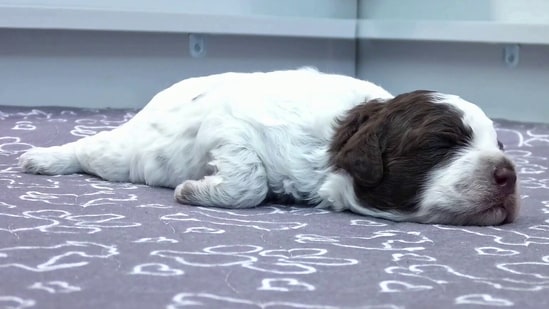
Cameras record all of it, day and night, for Pentulive, a slow TV livestream run by Yle, Finland's national public broadcaster. Pentu is Finnish for puppy. Hilkka, a five-year-old Lagotto Romagnolo – an Italian dog with curly fur – gave birth to four males and two females on October 10. By Thursday, each pup weighed roughly 1kg.
"They are just opening their eyes and their ears. They are taking their first clumsy steps," Pirjo Koskinen, the Yle science journalist who came up with the idea for the show, told the Associated Press.
The show, in its sixth season, has drawn more than 6 million views on social media in under two weeks, in a country of 5.7 million people. Yle says the stream was watched for 2.6 million hours in 2024, which its producer, Jyri Loikkanen, worked out at about half-an-hour for every Finn. Yle's science journalists hold chat sessions with viewers three times a week, and publish a podcast and online articles that follow the puppies' development alongside the breeder. A naming ceremony was set for the weekend.
This season began streaming on October 6 and runs for about ten weeks, taking viewers from the middle of autumn into Finland's darkest weeks. The puppies leave in December for homes the breeder chose before the cameras were switched on.
{{/usCountry}}This season began streaming on October 6 and runs for about ten weeks, taking viewers from the middle of autumn into Finland's darkest weeks. The puppies leave in December for homes the breeder chose before the cameras were switched on.
{{/usCountry}}The puppies mostly sleep and nurse, and millions keep watching. Scientists who study how the brain responds to infant faces, what screens do to attention, and how mood shifts in the winter months can explain a good deal of the appeal.
Also read: Dopamine loops, body image, cyber bullying: What science says about social media effects on kids
Slow TV and the scroll
Loikkanen often watches the stream to unwind after his workday. "I think it's pretty much a sign of the times that people crave for this kind of small escape," he told AP, from the “doom and gloomy news what we are experiencing at the moment: The politics, the economics, war and strife et cetera”.
Experiments have measured what bad news can cost. In two studies published in PLoS ONE in 2021, researchers at the University of Essex in the UK and Simon Fraser University in Canada found that two to four minutes of Covid-19 news on social media lowered people's mood and optimism straight away, while stories of kindness during the pandemic did not.
The feeds people scroll between headlines carry risks of their own. A 2025 review in Psychological Bulletin, led by Lan Nguyen of Griffith University in Australia, reviewed 71 studies covering nearly 100,000 people. It linked heavier use of short-form video, on platforms such as TikTok and Instagram Reels, to poorer attention and weaker impulse control, and to more stress and anxiety.
The studies show an association and cannot prove that scrolling causes the decline, since anxious people may also turn to short videos for relief.
Norway's public broadcaster NRK started 'slow TV' in 2009 with a minute-by-minute broadcast of the seven-hour train journey between Bergen and Oslo. The format has since spread to the UK, China and elsewhere. In Sweden, remote cameras for The Great Moose Migration follow dozens of moose each spring as they swim across the Ångerman River, about 300km north-west of Stockholm, towards summer grazing.
Annette Hill, a professor of media and communications at Jönköping University in Sweden, told AP in 2025 that slow TV has its roots in reality television but feels more authentic to viewers because nothing is staged. Hill, herself a fan of the moose broadcast, said that following it helps her slow her own day to the rhythms of spring.
A 2025 study in People and Nature by Minh-Xuân Truong of the Swedish University of Agricultural Sciences surveyed 2,011 followers of the moose broadcast. They said its ambient sound and slow pace helped them unwind and feel connected to nature.
The slow TV studies were based on viewers describing their experiences; there weren't any comparison groups; and the genre's reach could have its limits. Roel Puijk, a Norwegian media researcher who wrote the first book-length study of slow TV, found that almost half of Norwegians watched little or none of NRK's broadcasts.
Also read: The whale in Whalefall could technically swallow a person. There’s no record one ever has
What cuteness does to us
Scientists have spent decades studying why a puppy face is so hard to look away from.
In 1943, the Austrian zoologist Konrad Lorenz came up with the term ‘kindchenschema’, or baby schema, for a set of features that includes a head large for the body, a high forehead, big eyes and round cheeks. He proposed that these features prompt adults to care for the young. A two-week-old puppy has nearly all of them.
A team led by Melanie Glocker of the University of Münster in Germany tested the idea in 2009. Brain scans of 16 women showed that the more baby-like a face in a photograph, the more active was the nucleus accumbens, a key part of the brain's reward system. A year earlier, researchers at the University of Oxford had found that adults' brains respond to an unfamiliar baby's face within about a seventh of a second, in an area also linked to reward.
Puppies set off a similar reaction.
In 2014, researchers in Rome and at the University of Lincoln in the UK found that children as young as three rated puppies and kittens as cuter than adult dogs and cats, and looked longer at the more infantile faces.
Dogs' faces may have been shaped by that preference. A 2019 study in PNAS, led by Juliane Kaminski of the University of Portsmouth, found that most dogs, unlike wolves, have a muscle that lifts the inner eyebrow, making the eyes look bigger and more infant-like, or what's known popularly as "puppy-dog eyes". The study suggested that humans favoured dogs that used it.
Cute images also seem to make people more careful. In experiments published in 2009 and 2012, people who looked at pictures of puppies and kittens did better at fiddly tasks, such as the tweezer game Operation, than people shown adult animals. The effect, though, could have its limits. A 2022 replication attempt found no such boost on computerised reaction tests.
Koskinen told AP that seeing the puppies scramble towards their mother for milk can raise levels of oxytocin in a viewer's brain.
Oxytocin, sometimes called the love hormone, is linked to social bonding and lower anxiety. Research shows emotional videos can raise oxytocin levels. A 2009 study at Claremont Graduate University in California found a 47% rise in blood oxytocin in people who watched a short film about a father and his terminally ill young son. A 2019 study of 173 adults found an average rise of 14% in saliva after a video about a gravely ill child.
But how far pictures of dogs can go is mixed. In a 2025 study in Acta Psychologica, older adults' salivary oxytocin did not change significantly after they looked at photographs of dogs, though men's heart rates fell. The effect with a live animal is better established. A 2015 study in Science found that dog owners' oxytocin rose after their pets gazed into their eyes. (The measurements can be contested, because readings from blood and saliva often differ.)
Also read: 5 orangutans’ rescue in Odisha raises trafficking fears
The dark months
Finland is heading into its long winter. Above the Arctic Circle in its far north, the sun does not rise for weeks at a time.
Doctors have long recognised a form of depression tied to the darker months. Seasonal affective disorder affects about 5% of people worldwide, and a milder form, about 9%, according to a 2025 review of studies in the Journal of Affective Disorders, which found both more common at higher latitudes.
Every Pentulive season so far has followed a litter born in autumn, with broadcasts starting between late September and late November and running into mid-winter.
Sonja Mutanen, a doctoral researcher who studies media and animals at the University of Eastern Finland, told CNN that for many viewers the streams are "a much-anticipated highlight of the dark Finnish winter months". She said light-hearted viewing of this kind can help people feel connected and well at a time of year when they spend more time indoors.
The cameras will stay on until mid-December, when the six puppies, by then about nine weeks old, leave for their new families.