The Lok Sabha and Rajya Sabha were adjourned sine die on August 13. Twenty-nine days later, neither House has been prorogued – the formal act that closes a parliamentary session – triggering a political row.
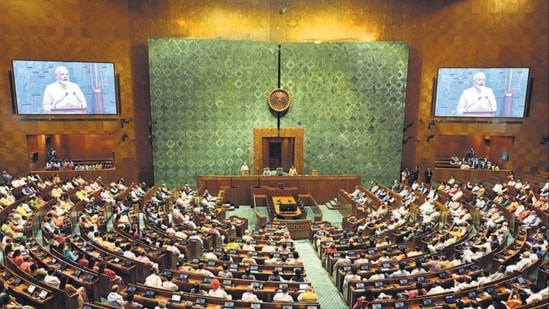
The Congress’s Rajya Sabha chief whip Jairam Ramesh has called the gap a record, longer than the 28-day stretch in 2015, and cited it as evidence the government was stalling on delimitation. Trinamool Congress lawmaker Sagarika Ghose has argued that the government lacks the numbers for a constitutional amendment.
What is prorogation?
The Constitution distinguishes three ways a legislative sitting can end.
Adjournment is a break within a sitting, or between sittings of the same session, ordered by the presiding officer. Adjournment sine die closes a set of sittings without fixing the next date, but the session technically continues. Prorogation ends the session.
Under Article 85(2)(a), the power is vested in the President, who acts on the advice of the Union Cabinet. Dissolution, a separate act under Article 85(2)(b) that applies only to the Lok Sabha, ends the House.
Rajya Sabha at Work, the Secretariat’s manual, records that prorogation usually follows adjournment sine die. The Cabinet Committee on Parliamentary Affairs approves the decision. The ministry of parliamentary affairs conveys it to the secretary-general, who then sends the Prorogation Order to the President for signature.
{{/usCountry}}Rajya Sabha at Work, the Secretariat’s manual, records that prorogation usually follows adjournment sine die. The Cabinet Committee on Parliamentary Affairs approves the decision. The ministry of parliamentary affairs conveys it to the secretary-general, who then sends the Prorogation Order to the President for signature.
{{/usCountry}}The manual records that the time-lag between adjournment sine die and prorogation varies between 2 and 10 days, though it has been longer, and that both Houses need not be prorogued at the same time.
The current gap is at least 29 days.
Also read: Parliament's monsoon session yet to be prorogued nearly a month after proceedings ended
What the delay does, and does not, allow
A session that has not been formally closed has two immediate procedural effects. Parliament cannot be summoned into a new session, and the executive cannot promulgate an ordinance under Article 123.
A new session begins when the President summons Parliament under Article 85(1), and Parliament cannot be summoned while the current session is still open. As long as the monsoon session remains open, no fresh session, including a special session, can be called.
Article 123(1) empowers the President to promulgate an ordinance “except when both Houses of Parliament are in session”. Adjournment sine die suspends sittings but does not end the session, so both Houses remain in session in the constitutional sense.
The ordinance route is closed to the government until at least one House is prorogued. In May 1994, the Lok Sabha was prorogued while the Rajya Sabha continued in session, and the government promulgated ordinances during that period — a reminder that the constitutional test turns on the session’s formal status, not on whether the House is sitting.
Ordinances also cannot be used to enact a constitutional amendment, which under Article 368 requires the special procedure prescribed for that purpose. A Constitution amendment bill on delimitation or Lok Sabha strength cannot be pushed through by the ordinance route.
What Opposition is reading into it
The government’s April 17 attempt to pass a Constitution amendment bill expanding Lok Sabha strength failed on the two-thirds test: 298 in favour, 230 against. A constitutional amendment under Article 368 requires a majority of the total membership of each House and a majority of not less than two-thirds of the members of that House present and voting.
Ramesh has argued that keeping the current session open lets the government preserve the option of summoning a special sitting at short notice while it works on building a two-thirds majority. He has called the delay manufactured suspense. Ghose has argued that the government does not have the numbers and that the extended gap is a political manoeuvre.
Also read: Signals from Parliament’s monsoon session washout
The timelines
Article 85(1) does not set a deadline for prorogation. It sets a deadline for Parliament to sit. Not more than six months may pass between the last sitting of one session and the first sitting of the next. The monsoon session's last sitting was August 13, 2026, so Parliament must sit again by roughly mid-February 2027.
But, as convention has been, MPs will likely meet much sooner – with or without any special sitting. Parliament meets in three sessions a year — budget, monsoon and winter — and the winter session is typically summoned in November. Although that summon – for the winter session – will require the monsoon session to be prorogued first.