Israeli Prime Minister Benjamin Netanyahu spent less than eight hours in New York on Thursday. He flew there across the airspace of three countries that were bound by a treaty to arrest him, delivered a combative address to the United Nations General Assembly (UNGA), and was due to fly home the same day. All the while he remained the subject of an International Criminal Court (ICC) arrest warrant.
Flight-tracking app Flightradar24 showed his plane crossing Greece, Italy and France. All three are parties to the Rome Statute, the treaty that set up the Hague-based ICC and obliges its members to arrest suspects on their territory.
France said on Thursday that allowing the flight broke no rule. In New York, mayor Zohran Mamdani, who had campaigned on the promise of arresting Netanyahu if he came to the American city, had already conceded he had no power to do so.
In New York
Netanyahu reached New York around 9am local time and was expected to fly back later in the day after his speech. Two Israeli officials told Reuters he would be in the city for less than eight hours, of which his speech at UNGA took up 40 minutes.
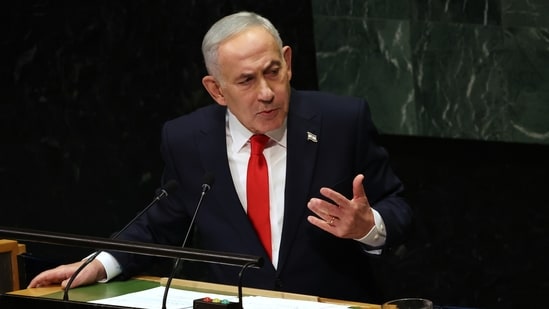
As dozens of delegates walked out during the speech, Netanyahu called them "moral cowards" and described allegations of genocide in Gaza as "the biggest lie of the century".
{{/usCountry}}As dozens of delegates walked out during the speech, Netanyahu called them "moral cowards" and described allegations of genocide in Gaza as "the biggest lie of the century".
{{/usCountry}}Mamdani, whom Netanyahu also attacked from the podium, responded in a statement, saying: “No lie can change the fact that he remains the subject of an International Criminal Court arrest warrant alleging war crimes and crimes against humanity.”
The ICC warrant
The case arises from Israel's war in Gaza, which began after Hamas attacked Israel on October 7, 2023, killing around 1,200 people and taking 251 hostages. In response, Israel bombed Gaza, killing thousands.
The ICC prosecutor opened an investigation into the ‘Situation in the State of Palestine in March 2021’ and said that the investigation extends to the escalation of hostilities since the Hamas attacks. The prosecutor filed applications for arrest warrants with Pre-Trial Chamber I on May 20, 2024.
Pre-Trial Chamber I of the ICC issued the warrants for Netanyahu and his then defence minister Yoav Gallant on November 21, 2024, in a unanimous decision that also threw out two challenges brought by Israel. The court lists the offences as the war crimes of starvation as a method of warfare and of intentionally directing an attack against the civilian population, and the crimes against humanity of murder, persecution and other inhumane acts, covering a period from at least October 8, 2023, to at least May 20, 2024.
The court also issued a warrant for Hamas's then military commander, Mohammed Deif. Judges ended the proceedings against him in February 2025 after prosecutors notified the court of Deif’s death.
Netanyahu denies the ICC's claims. Israel rejects ICC’s jurisdiction, denies committing war crimes in Gaza and is contesting the warrants.
How can ICC act against a leader whose country is not a member?
Israel has never ratified the Rome Statute.
But, in its November 2024 decision, Pre-Trial Chamber I held that Israel's consent was unnecessary because the court can exercise jurisdiction on the basis of Palestine's territorial jurisdiction.
Palestine accepted the court's jurisdiction by a declaration lodged on January 1, 2015, and acceded to the statute the next day. In February 2021, a majority of the same chamber, in an earlier composition, ruled that this jurisdiction covers Gaza and the West Bank, including East Jerusalem.
Israel appealed. In April 2025, the Appeals Chamber found that the lower chamber had not adequately dealt with Israel's argument that it was entitled to challenge jurisdiction, and sent the question back for a fresh ruling. The appeals judges dismissed as moot Israel's request to suspend the two warrants.
Also read: ‘Biggest lie of the century’: Benjamin Netanyahu rejects Gaza genocide allegations in UNGA speech
Who is supposed to arrest Netanyahu?
Member states are. The ICC has no police force or enforcement arm of its own, and depends on governments to make arrests and transfer suspects to its detention centre in The Hague.
Under the statute, member states must cooperate fully with the court, and the court may send an arrest request to any state "on the territory of which that person may be found".
Parties to the statute include 125 countries. The United States and Israel are not among them. (India is not a member either.)
But the warrant has left Netanyahu unable to travel to many countries, Reuters reported.
Holding office also offers no protection under the treaty. Article 27 says official capacity as a head of state or government exempts no one from criminal responsibility, and that immunities attached to that office do not bar the court from exercising its jurisdiction.
How did Netanyahu fly over France?
France, a party to the statute, defended its decision to let the Israeli leader's plane cross its airspace. Foreign ministry spokesperson Pascal Confavreux told reporters the clearance was "in full conformity with international law".
"The Rome Statute does not impose any obligations regarding overflights of its territory by a state plane which has a passenger who is targeted by an arrest warrant," Confavreux said.
A spokesperson for Italy's foreign ministry could not immediately say whether Israel had sought permission to overfly Italy, according to Reuters. Last year, media reported that Netanyahu took a circuitous route to New York that skirted several European countries, including France.
The statute's arrest duty is framed around a person being found on a state's territory. Part 9 of the statute, which governs arrest and surrender, does not define territory or say whether an aircraft passing overhead meets that test. The ‘use of terms’ clause in that part defines only surrender and extradition.
The only airspace provision in the treaty's chapter on arrest and surrender deals with a suspect who is already in custody and being flown to the court. It says no transit authorisation is needed if no landing is scheduled. If the plane makes an unscheduled landing, the state concerned may ask the court for a transit request and must hold the prisoner for up to 96 hours until the request is received.
France's position rests on the gap that the treaty has no provision on a wanted person flying freely over a member state.
Why could Netanyahu not be arrested at the UN?
The United States has no obligation to the ICC. Under the statute, the court can only invite a non-member state to help, through an ad hoc arrangement or an agreement with that state. The ICC is not a United Nations body, although the two have a cooperation agreement.
The Donald Trump administration has also moved against the ICC. The US under Trump has imposed financial sanctions and visa bans on the ICC staff and Trump has said the campaign against ICC is aimed at protecting Netanyahu.
What if member countries don’t make an arrest?
The court can name them and refer them onwards, and that is the extent of its power. Under Article 87(7), if a member state fails to cooperate and so prevents ICC from doing its work, the judges may record that finding and refer the matter to the Assembly of States Parties, the body of member governments.
The judges have made such findings before, including in the case of Sudan's then president Omar al-Bashir. The two most recent cases involve states that hosted wanted leaders.
Mongolia and Putin. In October 2024, a pre-trial chamber found that Mongolia had failed in its obligations by not arresting Russian President Vladimir Putin during his visit, and restated that the immunity of heads of state is "not opposable before the ICC, and no waiver is required".
Hungary and Netanyahu. Hungary argued a similar point on his behalf. It told the court that because Israel is not a party and had not waived Netanyahu's immunity, he was protected by state immunity, and Article 98(1) barred the court from asking Hungary to arrest him. In a finding dated July 24, 2025, Pre-Trial Chamber I nonetheless ruled that Hungary broke its obligations by not arresting Netanyahu while he was in the country from April 3 to 6, 2025, and referred the matter to the Assembly of States Parties.
Hungary announced during that visit that it would leave the court. It later reversed course. It withdrew its notice of withdrawal with immediate effect, notifying the UN secretary-general on May 29, 2026.
The attack on ICC
Trump used his UNGA address on Tuesday to urge countries to quit the court, calling it "evil" and "a rogue institution". In July, US secretary of state Marco Rubio launched a campaign to dismantle the court "brick by brick, if necessary".
So far only Naoero, the Pacific island nation formerly known as Nauru, has said this week it will withdraw. After Rubio's statement, Venezuela and Chad also announced plans to leave, according to Reuters.
Burkina Faso, Mali and Niger announced their exits last year and have now filed formal notice.
The presidency of the Assembly of States Parties has said that leaving does not free a state from obligations that arose while it was still a member.
European governments have closed ranks behind the court. EU foreign policy chief Kaja Kallas said the bloc had "tools in our toolbox" to defend it, Reuters reported. Dutch Prime Minister Rob Jetten told the Assembly the court was "under attack".