In Whalefall, a survival thriller released in cinemas this month, a diver is swallowed whole by a sperm whale, the one whale with a throat wide enough to take a person, though no whale has ever been known to swallow anyone.
The only animal with documented cases of swallowing people whole is a snake, the reticulated python.
Director Brian Duffield calls his film "the opposite of Jaws", the 1975 Steven Spielberg thriller about a man-eating shark, because he hopes audiences leave in awe of whales instead of being afraid of them. "I think in a lot of ways the whale is the hero of the movie," he told Reuters at the London premiere on October 5.
Based on Daniel Kraus's 2023 novel, Whalefall follows a teenager who dives off California's Monastery Beach to find his late father's remains and ends up inside a sperm whale. Its global release was scheduled to begin on October 14.
Real life has come close. In June 2021, a humpback whale scooped up Michael Packard, a commercial lobster diver, off Cape Cod in Massachusetts, and spat him out after what he estimated was 30 to 40 seconds in its mouth. He got no further than its mouth.
Whalefall’s premise is anatomically possible, but it has never been recorded. The difference comes down to three things: how wide an animal’s throat is, how deep it feeds and what it hunts.
{{/usCountry}}Whalefall’s premise is anatomically possible, but it has never been recorded. The difference comes down to three things: how wide an animal’s throat is, how deep it feeds and what it hunts.
{{/usCountry}}Also read: Will it get easier to experiment on animals in India? What the draft rules propose
Big mouths, narrow throats
Rorquals, the family of baleen whales that includes blue, fin and humpback whales, feed by lunging at shoals with their mouths wide open. An adult fin whale takes in 60 to 82 cubic metres of water in a single gulp, more than the volume of its own body, and strains out krill and small fish through baleen, the comb-like plates that hang from its upper jaw.
The fin whale’s throat is narrow. "I can barely get my arm down the throat," Joy Reidenberg, a comparative anatomist at the Icahn School of Medicine at Mount Sinai in New York who dissects stranded whales, told Science News of the fin whale.
"There's no way a human could be swallowed," Reidenberg, who worked as a consultant on the film, told the magazine.
In all the cases on record, the people who ended up in whales’ mouths were taken by rorquals.
In June 2021, a humpback took Packard into its mouth about 14m down off Cape Cod. He said he spent 30 to 40 seconds there, still breathing through his regulator, before the whale surfaced and spat him out.
In February 2025, a humpback engulfed Adrián Simancas, a Venezuelan kayaker, along with his kayak in Chile's Strait of Magellan, and released him unharmed within seconds.
In 2019 a Bryde's whale, another rorqual, took a dive tour operator head-first into its mouth off Port Elizabeth, South Africa, as it lunged through a shoal of sardines.
In each of these cases, the whale was apparently feeding near the surface or in shallow waters, and spat out the humans.
The one whale that could, in theory
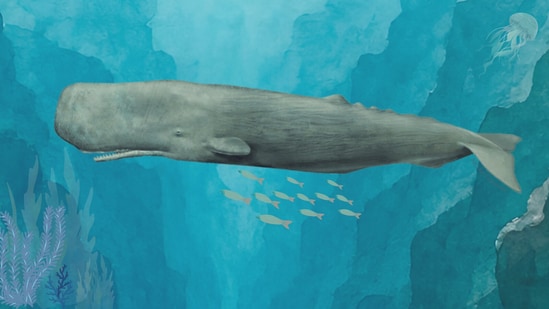
The sperm whale, which goes by the scientific name physeter macrocephalus, is the largest toothed whale and its head makes up about a third of its length.
The species lives in deep, ice-free waters across almost all the world's oceans, and and feeds on squid, sharks, skates and fish. It is listed as vulnerable on the International Union for Conservation of Nature (IUCN) Red List.
Reidenberg told Science News that a very big adult sperm whale could swallow a person, but it would take a full-grown bull of 18m or more.
The sperm whale is thought to suck its prey in. It drops the hyoid, the bone that anchors the tongue at the base of the throat, and draws the tongue back like a piston, so pressure in the mouth falls and water and prey rush in. Researchers have filmed this method in captive pilot whales and recorded it in feeding trials with pygmy and dwarf sperm whales, the sperm whale's smaller relatives.
Nobody is known to have watched a sperm whale do it.
In toothed whales, the larynx, or the voice box, juts through the throat and narrows the path of the food. Biologists have found that it is shifted to the left, which, they argue, leaves a wider channel on the right side for large prey. Together with the animal's size, that wider channel puts an adult human within reach of the largest bulls.
Also read: From the edge of extinction, two captive-bred Great Indian Bustards released into wild in Rajasthan
Too deep, and the wrong prey
Whales do not feed on humans. And for sperm whales, which theoretically could, the depth at which they hunt isn't where humans would be found easily.
Researchers fixed digital tags to 37 sperm whales in the Atlantic, the Gulf of Mexico and the Ligurian Sea, and recorded 198 foraging dives. Averaged across individual whales, the deepest dives reached 985m, 644m and 827m in the three regions, according to their 2006 study in the Journal of Animal Ecology.
The whales spent more than 72% of their time in foraging dive cycles, found prey with long-range echolocation clicks and made about 18 attempts to catch prey on each dive.
Packard was caught 14m down. The sperm whale finds its prey by sound, hundreds of metres below that level, and all documented cases of a whale taking a person into its mouth have involved a rorqual feeding near the surface.
The survivor who never was
The best-known story of a man surviving inside a whale is that of James Bartley. In the story that circulated from 1891, Bartley, a sailor on a whaling ship, was swallowed by a sperm whale off the Falkland Islands in February that year and found alive in its stomach about 36 hours later.
Edward B Davis, a historian of science, then at Messiah College in Pennsylvania, checked the story against shipping records and newspaper archives for a 1991 paper in the journal Perspectives on Science and Christian Faith. The crew agreement for the ship – the Star of the East – which named every man aboard for that voyage, did not feature a James Bartley. The ship, it so turned out, was a barque, a merchant sailing vessel, and an archivist told Davis that whaling off the Falklands did not begin until 1909.
The captain's wife had also denied the story in a letter later printed in The Expository Times: “[T]here is not one word of truth in the whale story. I was with my husband all the years he was in the Star of the East. There was never a man lost overboard while my husband was in her.”
Davis concluded that the account was a hoax.
The animal that does
The reticulated python of Southeast Asia is the world's longest snake, regularly growing past 6.25m.
Large pythons swallow prey whole, and the limit is the gape, the width to which the mouth can open.
A snake's lower jaws are joined at the chin by soft, stretchy tissue. In Burmese pythons, relatives of the reticulated python, that tissue supplies about 43% of the gape area and helps give them four to six times the gape area of a brown treesnake of similar length, researchers reported in Integrative Organismal Biology in 2022.
Three large Burmese pythons measured for a 2024 study in Reptiles & Amphibians opened to 26cm across. The smallest had eaten a 35kg deer that filled 93% of its maximal gape area.
Among the Agta, hunter-gatherers on the Philippine island of Luzon, 26% of adult men had survived attacks by reticulated pythons and six deaths were recorded, according to a 2011 study in the Proceedings of the National Academy of Sciences.
In Indonesia, a 25-year-old man harvesting oil palm in West Sulawesi was found inside a 7m reticulated python in March 2017, and a 54-year-old woman tending her vegetable garden on Muna island in Southeast Sulawesi was found inside another 7m python in June 2018, the Associated Press reported. At least three more women have died the same way since, two of them in South Sulawesi in 2024, AFP reported.
The python deaths were largely linked to adults working on plantations, in gardens and in forest where large pythons hunt prey of comparable size, such as deer and pigs.
Sperm whales hunt squid by sonar hundreds of metres down, and the whales that have taken people into their mouths were rorquals, which cannot swallow them.