Wednesday's collision south of Madrid, which killed at least 64 people on the line where Spanish high-speed rail began in 1992, followed a breakdown of the system that keeps fast trains apart and an order from a control centre to send a train on regardless, according to Spain's transport minister.
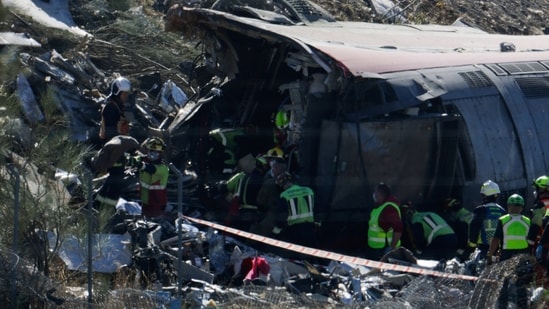
A high-speed train run by Renfe, the state-owned operator, hit a train run by its rival Iryo between the villages of Los Yébenes and Urda just before 9am, Bloomberg reported, citing an official at Adif, the state company that manages Spain's rail infrastructure. The Iryo train had stopped on the track, and both were travelling from Madrid towards Seville, the Associated Press reported. It is Spain's deadliest rail accident since 2013 and the second fatal crash this year on the high-speed line running south from Madrid.
ALSO READ: Spain train crash: Aerial footage shows derailed coaches after collision kills 64
What the minister said
Óscar Puente, the minister responsible for Spain's railways in Prime Minister Pedro Sánchez's government, blamed what he called an "inexplicable" order from the central command centre for Spain's trains, AP reported. He said the train's engineers were not to blame.
{{/usCountry}}Óscar Puente, the minister responsible for Spain's railways in Prime Minister Pedro Sánchez's government, blamed what he called an "inexplicable" order from the central command centre for Spain's trains, AP reported. He said the train's engineers were not to blame.
{{/usCountry}}By Puente's account, a computer malfunction knocked out the security system on a 63km stretch of the line at 8.30am, and every train on that stretch stopped. The central command then told the Renfe train to start running again without any speed restrictions. At 8.53am it ran into the stationary Iryo train.
Puente said the train should never have been told to move, since a "stop signal" was still active on the line, and that if it was sent on, it should at least have been told to go at reduced speed. Officials were still studying how fast it had been travelling, he said, but it could have been doing 200km/h on that stretch. "I am not attributing responsibility to anyone, I am just stating the facts," he said.
Earlier in the day a Transport Ministry spokesperson told Bloomberg that the initial assessment suggested human error, potentially by an Adif rail traffic controller. The Adif official declined to comment on what might have caused the accident.
Puente did not name the system that failed. The Madrid–Seville line began operating with LZB, a safety and communications system that the Transport Ministry describes as made specifically for Spain. The European Commission describes it as automatic train control with continuous inductive transmission, which means instructions pass from the track to the train without a break.
In April 2025 the ministry said Adif would finish installing ERTMS Level 2, a newer European system, over the rest of 2025 and in 2026. Officials have not said which of the two systems governed the stretch on Wednesday.
Spain's first high-speed line
On April 21, 1992, a Renfe train made the first commercial high-speed journey between Madrid and Seville, according to the Transport Ministry. The ministry calls the 470.5km line, built for a top speed of 300km/h, the biggest railway engineering project Spain had undertaken at the time. It is also the first Spanish high-speed line to be completely renewed, under a €700 million programme.
Spain's high-speed network now runs to nearly 4,000km, the world's second-largest according to the International Union of Railways (UIC), the global industry body. Some 40 million people travelled on commercial high-speed services in 2024, up 77% from 2019, according to Spain's national competition authority, Bloomberg reported. Iryo, controlled by Italy's state-owned Ferrovie dello Stato, competes with Renfe on the same tracks.
Speed and network
The UIC treats a commercial speed of 250km/h as the main test of whether a line counts as high-speed. Spain ties its speed limits to the safety equipment on the train and beside the track. Under the country's railway traffic regulations, trains may run at up to 350km/h with ERTMS Level 2, 300km/h with ERTMS Level 1 or LZB, and 200km/h with ASFA, an older system. Where the protection systems on the train and the track are incompatible, out of service or absent, the limit is 120km/h.
China runs the fastest commercial services, at 350km/h, according to the UIC. France standardised its newer lines at 320km/h, and trains on Japan's original Shinkansen route between Tokyo and Osaka run at 285km/h. JR East, one of Japan's railway companies, began running its Hayabusa trains at up to 300km/h in 2011.
China also has by far the largest network, with 40,493km of high-speed line. Spain is second with 3,993km, ahead of Japan with 3,146km and France with 2,735km, according to UIC figures for 2023. The speed record for a train on rails, 574.8km/h, was achieved in France in 2007.
Signalling system
At 300km/h a train covers about 83 metres a second. It also needs "several kilometres to brake to standstill", according to the European Union Agency for Railways (ERA), which works through an example of a high-speed train needing 7,513m to stop from 300km/h. A driver cannot see that far ahead, let alone spot a lamp beside the track in time to act on it.
Railways keep trains apart by dividing the track into block sections, stretches that only one train may occupy at a time. Interlockings, which Adif describes as the devices that manage all the signals on a stretch of track, stop controllers from routing two trains onto conflicting paths. On a conventional line the driver reads lineside signals that show whether the section ahead is clear.
On high-speed lines the signal is shown in the cab. Automatic train protection systems such as LZB and the European Train Control System (ETCS) give the driver a permitted speed and a movement authority, the point up to which the train may travel, and brake the train if the driver does not. ETCS "supervises both the position and speed of the train", according to ERA, and its emergency braking limit is "the point beyond which ETCS will bypass the human in charge".
Under full supervision the driver "is not required to look outside" at lineside signals, the agency says. Spain's rules generally allow a single driver in the cab only on lines with such a protection system; elsewhere a second qualified person must ride along.
Passenger deaths are rare on Europe's railways. ERA puts the EU's passenger fatality rate at about 0.019 for every billion kilometres travelled by passengers. Spain's three deadliest high-speed crashes have still killed at least 190 people.
The most advanced systems
Europe had more than 20 national train control and safety systems, which ETCS is meant to replace, according to a 2018 background paper by Siemens, which builds signalling equipment.
At ETCS Level 1, transponders fixed to the track, known as balises, pass information to trains running over them. At Level 2, trains stay in continuous contact with a radio block centre over a dedicated railway radio network, GSM-R, and the centre sends each train its movement authority, "making fixed-location signals unnecessary", in Siemens' words. Spain allows its top speed of 350km/h only on Level 2 lines.
At Level 3, trains work out their own position with "positioning beacons and sensors" and must confirm that no carriage has come loose, so trackside equipment to detect trains is no longer needed, according to Swiss Federal Railways (SBB). Trains can then follow one another at braking distance, an arrangement known as a moving block, without fixed sections. SBB calls Level 3 a "long-term objective".
Japan's Tokaido Shinkansen, in service since 1964, has had "No accidents resulting in fatalities or injuries of passengers on board since operations commenced", according to its operator, Central Japan Railway Company (JR Central).
Where people still control the switch
Controllers in central command centres still route the trains, and Spain's rules let them override a red signal. The regulations allow the traffic controller to authorise a train to pass a signal showing stop "si procede", where appropriate, using a written form called a Boletín de Autorización de Rebase. A driver told to run on sight must advance "con la precaución que requiera el caso", with the caution the situation requires, and be able to stop short of any obstacle. Where the protection systems are out of service, the regulations cap speed at 120km/h.
In Puente's account of Wednesday, the train was told to restart without any speed restrictions while a stop signal was still active, and may have been travelling at 200km/h on the stretch where it hit the Iryo train.
Three crashes, three failures
In 2013, an eight-carriage high-speed train left the track on a sharp bend near Santiago de Compostela in north-western Spain, hit a concrete wall and caught fire, killing 80 people and injuring 145. A Transport Ministry commission concluded that the train was speeding and the driver had been distracted by a call from a superior. A victims' association blamed the railway's security systems as well as human error.
On January 18 this year, 46 people died near Adamuz in Córdoba province after a high-speed train derailed and collided with an oncoming one. Renfe's chief, Álvaro Fernández Heredia, said there were 20 seconds between the derailment and the impact, too short for the automatic braking system to activate, Reuters reported. A preliminary report by Spain's Civil Guard in February named defects in the track, rail or weld between two sections of track as the main hypothesis, and kept seven other theories open.
On Wednesday, by the minister's account, a computer fault stopped the trains and a human order started one of them again. The Adamuz crash is still under investigation, and the government's account of Wednesday's collision is preliminary.