The Supreme Court’s direction that peaceful, unarmed protesters in Delhi cannot be detained except in accordance with the “procedure established by law” invokes one of the Constitution’s most consequential protections against arbitrary State action.
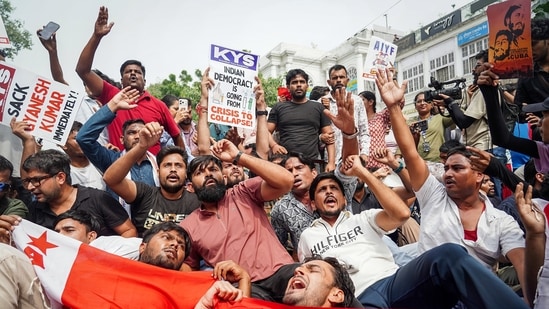
Issued amid allegations of mass detentions, restrictions on movement and the suspension of internet services during Saturday’s protest against chief election commissioner Gyanesh Kumar, the direction places a constitutional question at the heart of the controversy: can the State curtail personal liberty merely by invoking public order, or must every such restriction withstand legal and constitutional scrutiny?
A special bench of justices Joymalya Bagchi and V Mohana, hearing a clutch of petitions on Sunday, also directed that metro and railway services operate normally, internet connectivity remain undisturbed in accordance with law, and free movement be permitted subject to law.
The court has yet to conclusively determine the legality of every detention or the allegations of contempt against officials. But its reliance on Article 21 of the Constitution brings into focus a doctrine whose meaning has evolved significantly since the Constitution came into force.
A phrase born out of a constitutional compromise:
Article 21 states: “No person shall be deprived of his life or personal liberty except according to procedure established by law.” The protection extends to every person, not merely citizens, and is intended to restrain the State from depriving anyone of life or personal liberty without lawful authority and procedure.
{{/usCountry}}Article 21 states: “No person shall be deprived of his life or personal liberty except according to procedure established by law.” The protection extends to every person, not merely citizens, and is intended to restrain the State from depriving anyone of life or personal liberty without lawful authority and procedure.
{{/usCountry}}The wording was the product of a difficult debate in the Constituent Assembly. An earlier formulation proposed protection against deprivation of life and liberty “without due process of law”, a phrase associated with the American Constitution. The drafting committee replaced it with “procedure established by law”, drawing on the Japanese Constitution (1946), partly because the latter was considered more specific.
The distinction mattered. A “due process” guarantee would allow courts to examine not only whether a law authorising deprivation of liberty existed, but also whether the law itself and the procedure it prescribed were fair. The narrower formulation appeared to give the legislature greater latitude that if a validly enacted law prescribed a procedure, compliance with that procedure could ostensibly satisfy Article 21.
The choice was contested. During the assembly debates, members warned that an executive backed by a legislative majority could use the narrower formulation to curtail liberty. Others were concerned about giving unelected judges an expansive power to invalidate legislation. The assembly ultimately retained “procedure established by law”.
The Supreme Court’s subsequent interpretation, however, would substantially transform the phrase, bringing many of the protections associated with due process within Article 21.
From AK Gopalan to Maneka Gandhi:
In AK Gopalan Vs State of Madras (1950), the Supreme Court adopted a restrictive reading of Article 21. The majority held that the provision required deprivation of personal liberty to be authorised by a law enacted by the State and that the court could not simply read the American concept of due process into the Constitution.
The judgment also treated fundamental rights largely as distinct constitutional guarantees, ruling that each fundamental right operates independently and should therefore be interpreted in isolation. On that approach, a law affecting personal liberty was primarily examined under Article 21, rather than being assessed through the combined requirements of equality, freedom and life and liberty.
That approach changed decisively in Maneka Gandhi Vs Union of India (1978), which concerned the impounding of Maneka Gandhi’s passport without furnishing her the reasons at the outset. The court held that a procedure depriving a person of life or personal liberty could not be arbitrary, unfair or unreasonable.
The ruling established that Articles 14, 19 and 21 could not be read in isolation. A law or State action affecting personal liberty must meet the applicable requirements of equality and freedom, while the procedure under Article 21 must be “right, just and fair”, not arbitrary, fanciful or oppressive. The mere existence of an enacted procedure was no longer sufficient to establish its constitutional validity.
This was the crucial evolution. Although the Constitution did not expressly adopt the American phrase “due process”, the court’s interpretation gave Article 21 a substantive fairness requirement. The State could no longer justify a deprivation of liberty merely by pointing to a formal legal provision.
Also read: India hits back at UN rights office over remarks on Delhi protests, calls concerns ‘misplaced’
What the principle means for arrests and detention:
The protection is particularly important when the police exercise powers of arrest or preventive detention. Article 21 must be read alongside Article 22, which lays down specific safeguards for arrested and detained persons, including requirements concerning the grounds of arrest, access to legal representation and production before a magistrate within the constitutionally prescribed period, subject to the exceptions and qualifications set out in that article.
The distinction is between the existence of a power and the lawful exercise of that power. Even where legislation authorises arrest or detention, the authorities must act within its limits and comply with applicable constitutional safeguards. An arrest cannot be justified simply because the police consider it convenient or desirable.
In Joginder Kumar Vs State of Uttar Pradesh (1994), the Supreme Court emphasised that the existence of a power to arrest did not, by itself, justify its exercise in every case. The court underscored that arrest and detention affect liberty and must be justified by the circumstances and necessity, rather than treated as routine consequences of police authority.
In DK Basu Vs State of West Bengal (1997), the court laid down safeguards governing arrest and detention, including requirements intended to make the process transparent and reduce the risk of custodial abuse. These included documentation of arrest, informing a relative or friend and medical examination at prescribed intervals. The judgment reinforced the principle that procedural safeguards are not formalities: they are essential checks on the exercise of State power.
The broader lesson is that Article 21 protects not just against deprivation of liberty without any legal authority, but also against the arbitrary or abusive use of powers that the law does confer.
When the State invokes public order:
The Delhi episode brings this distinction into sharp relief. The right to assemble peacefully and express dissent is protected under Article 19(1)(b) and Article 19(1)(a), respectively. These rights are subject to constitutionally permitted reasonable restrictions, including restrictions on assembly in the interests of public order under Article 19(3), and on speech under Article 19(2).
The Constitution therefore does not confer an unlimited right to protest, nor does it prevent the police from taking lawful measures to prevent violence or maintain public order. But restrictions must have a legal basis and remain within constitutional limits. A public-order justification cannot, by itself, place every police action beyond judicial review.
At Sunday’s hearing, the bench was told that protesters, lawyers and political leaders had been detained, some allegedly beyond the area covered by prohibitory orders under section 163 of the Bharatiya Nagarik Suraksha Sanhita (BNSS). Solicitor general Tushar Mehta disputed several allegations, including claims that metro services had been shut down on a widespread basis. The court directed authorities to explain the circumstances of detention, the manner in which detentions were carried out and their justification.
Those questions go to the heart of Article 21. Was there lawful authority for the detention? Were the prescribed safeguards followed? Were the restrictions justified by the circumstances and necessity, and were they consistent with other fundamental rights? Did the steps meet the standards of proportionality? The answers must come from the authorities and the evidence, rather than from assumptions based on the existence of a protest or the invocation of public order.
ADM Jabalpur and the warning against unchecked power:
The constitutional history of personal liberty also carries a stark warning. During the Emergency, in additional district magistrate, Jabalpur Vs Shivakant Shukla (1976), a majority ruling of the Supreme Court held that a person could not seek judicial enforcement of the right to personal liberty under Article 21 while the relevant presidential order suspending enforcement was in operation.
Justice HR Khanna dissented, maintaining that life and liberty could not be taken away by the State without the authority of law. His dissent later came to be regarded as a defining defence of constitutional liberty.
The majority ruling was repudiated by the Supreme Court in subsequent constitutional jurisprudence. In the 2017 privacy judgment, KS Puttaswamy Vs Union of India, the court expressly recognised the error of the majority position in ADM Jabalpur and reaffirmed that life and liberty cannot be made subject to executive whim. The judgment described legal protection for life and liberty as fundamental to the rule of law.
The reference to ADM Jabalpur by TMC MP and senior advocate Menaka Guruswamy during Sunday’s hearing was therefore more than a historical analogy. It evoked a period when the availability of judicial protection for liberty was severely curtailed, and underscored why constitutional safeguards must remain meaningful precisely when the State invokes extraordinary circumstances.
Also read: Right-wing groups assault protesters, journalists amid heavy security deployment in Delhi protest
A constitutional check but not immunity from law:
The phrase “procedure established by law” does not mean that every detention is automatically unlawful, or that the State is powerless to act against violence and genuine threats to public order. Nor does it dispense with the need to examine the particular statute, the circumstances and the safeguards applicable to a given case.
Its significance lies in the opposite proposition: State power is not self-justifying. Where personal liberty is curtailed, authorities must identify the legal basis, necessity and proportionality; demonstrate compliance with the prescribed procedure; and remain answerable to constitutional scrutiny. After the Maneka Gandhi judgment, that procedure must also meet the standards of fairness and non-arbitrariness.
In the present matter, the Supreme Court has directed that peaceful, unarmed protester cannot be detained except in accordance with the procedure established by law, while requiring the authorities to respond to allegations of unlawful detention and non-compliance with its earlier order. These are interim directions, not a final finding that every allegation has been established.
But the constitutional principle is clear. Public order is a legitimate State concern; arbitrary deprivation of liberty is not. Article 21 requires the State to demonstrate that the line between the two has been respected.