When the moon slid across the sun on Wednesday, dimming skies from Greenland to Spain, sky-watchers gathered for the spectacle. Scientists, though, were after something else: a few minutes of the rarest laboratory conditions on offer — a clear view of the sun’s outer atmosphere, the streams of charged particles pouring off it, and the way Earth’s atmosphere reacts when daylight vanishes suddenly.
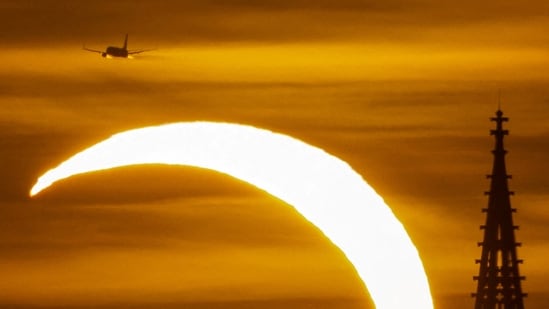
The August 12 total solar eclipse cut a narrow path of totality across the Northern Hemisphere — through Greenland, Iceland, the North Atlantic, Spain and a sliver of Portugal. Much of Europe, parts of North America and northwestern Africa saw a partial eclipse. India missed the event entirely as the sun was already below the horizon by the time totality arrived. Nasa carried a live feed for viewers elsewhere.
What made the eclipse scientifically useful?
A solar eclipse happens when the moon passes between Earth and the sun. In a total eclipse, the moon covers the sun's bright disc completely for observers inside the path of totality, briefly exposing the corona, the star’s tenuous, extremely hot outer atmosphere.
{{/usCountry}}A solar eclipse happens when the moon passes between Earth and the sun. In a total eclipse, the moon covers the sun's bright disc completely for observers inside the path of totality, briefly exposing the corona, the star’s tenuous, extremely hot outer atmosphere.
{{/usCountry}}The corona is far fainter than the sun’s visible surface, whose glare normally makes it impossible to see directly. Totality lifts that glare and offers researchers a rare chance to study structures and processes close to the sun.
Among the biggest puzzles that prompts scientists to study the eclipse is temperature. The corona reaches around 1 million degrees Celsius, though it sits above a visible surface that is far cooler.
Amir Caspi, an astrophysicist at the Southwest Research Institute, told Nature that scientists are still trying to work out where the sun’s magnetic energy comes from “and how does it get transported to get the corona to be a thousand times hotter than the surface underneath”.
Shadia Habbal, an astronomer at the University of Hawaii, said totality gives “continuous coverage, so close to the sun”, while cutting down interference from scattered light and diffraction.
The moon’s shadow
Ground-based observation was only part of the effort. A Nasa-funded team flew a WB-57 high-altitude research aircraft into the shadow at about 50,000 feet, extending the observing window and staying above cloud cover that might otherwise have blocked ground telescopes.
Four cameras mounted in the aircraft’s nose were built to photograph the corona in several wavelengths of visible and infrared light, capturing at least 20 images per second. That frame rate lets scientists track structures, outflows and rapid changes in the corona in something close to real time.
Researchers were especially keen on solar prominences — giant, glowing loops of hot gas that arch above the sun’s surface. The imagery, they believe, could help explain why the outer atmosphere runs so extraordinarily hot, and how the sun flings streams of charged particles into space.
“The sun is always changing. Every eclipse is different,” Caspi said.
Balloons over Iceland and Spain
Some experiments were pointed downward. Teams from the Nasa-supported Nationwide Eclipse Ballooning Project launched scientific balloons in Iceland and Spain before, during and after the eclipse to see how the sudden loss of sunlight altered Earth’s atmosphere.
In Iceland, two teams planned 80 balloon launches in total, beginning 18 hours before the eclipse and running until eight hours after. Their target was the atmospheric boundary layer — the lowest slice of atmosphere, which sits in direct contact with Earth’s surface.
Balloon flights during eclipses in October 2023 and April 2024 recorded the boundary layer thinning or collapsing at clear-sky sites during totality. Whether the same happens in Iceland, with its long August daylight and different atmospheric conditions, is what the teams wanted to test.
In Spain, three teams planned six balloons carrying 360-degree cameras and instruments to measure ozone. Earlier experiments had picked up a dip in ozone during totality; researchers wanted to see whether the different season and timing of the 2026 eclipse produced a different signal.
Beyond astronomy
Understanding the corona goes beyond solar physics. The sun’s activity has practical consequences for satellites, spacecraft, astronauts and infrastructure on Earth.
Solar eruptions can hurl vast quantities of charged material towards the planet. When those particles meet Earth’s magnetic environment, they can trigger geomagnetic storms that disrupt satellites and induce electrical currents that can affect power grids.
Currently, scientists can gauge the magnetic properties of Earth-directed solar material only when it reaches monitoring spacecraft relatively close to Earth.
A sharper picture of what happens inside the corona could eventually feed into better forecasts of geomagnetic storms and other space weather. Eclipses like Wednesday’s remain among the best opportunities to get one.