The midterm rout that cost Donald Trump's Republicans both chambers of the US Congress could reach well beyond Washington, into the war with Iran, America's ties with Israel, and Ukraine's fight against Russia.
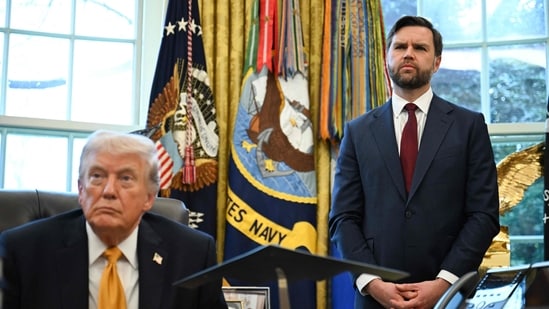
Vice-President JD Vance, who is widely expected to seek the Republican presidential nomination in 2028, blamed his party's defeat on the war with Iran. "The reason we lost is the war," he wrote in a long post on X on Wednesday, listing four steps that he said could bring disgruntled Trump voters back on their side.
"1) End the war 2) Focus on cost of living/inflation 3) Put America First 4) Change our relationship to Israel," Vance wrote.
Trump, who is barred by the US Constitution from seeking a third term, agreed the war had cost his party votes but stood by his decision to launch it in February. "If I had to do it again, I'd have to do it again," he told reporters. He also said his defence secretary Pete Hegseth, who heads the Pentagon, was "doing a great job", despite voters' dissatisfaction with the war and Democratic threats to seek his impeachment.
Democrats won at least 54 of the 100 Senate seats, up from the 47 they hold now, gained at least 30 seats in the House of Representatives, and will take control of both chambers on January 3, 2027. Daniel Byman, a foreign policy expert at the Center for Strategic and International Studies, a Washington think tank, said Vance's post seemed like "a way of separating himself from Trump", according to the BBC.
Iran: A deal, or a wider war
{{/usCountry}}Democrats won at least 54 of the 100 Senate seats, up from the 47 they hold now, gained at least 30 seats in the House of Representatives, and will take control of both chambers on January 3, 2027. Daniel Byman, a foreign policy expert at the Center for Strategic and International Studies, a Washington think tank, said Vance's post seemed like "a way of separating himself from Trump", according to the BBC.
Iran: A deal, or a wider war
{{/usCountry}}The war began on February 28, when the US and Israel launched strikes on Iran. In the eight months since, Iran has hit back at shipping and energy facilities across West Asia, and the conflict has driven up fuel prices around the world. Anger over the war’s role in raising the cost of living has helped Democrats win the Senate, election analysts have said.
Tehran has treated the American midterm results as a verdict on the war. "If the US government betrays their public will to serve international paymasters and blackmailers, it will learn our NO comes with a Nightmare," Mohammad Bagher Ghalibaf, the speaker of Iran's parliament, who has led its negotiations with the US, wrote on X on Wednesday. Iran's Supreme Leader, Mojtaba Khamenei, who has the final word on the country’s affairs, was also quoted as saying that anyone who believed the results would shift US policy was "deeply mistaken".
Talks between the US and Iran, which had stalled over the summer, have picked up in the past week, with Iranian officials meeting Qatari mediators who have been passing proposals between the two sides. In the same week, Trump told some journalists he was considering striking Iran hard and told others he had no immediate plans to escalate the conflict. Iran has warned that its retaliation would be far wider than in earlier rounds.
Trump has given little sign of pulling back. "The Iran thing we had to do, and we continue to do it," he told reporters on Wednesday, even as Vance and other Republicans blamed the war for the party's losses. Mitt Romney, the party's 2012 presidential nominee, criticised what he called an "impulsive" war.
Ali Vaez of the International Crisis Group, a conflict-prevention organisation, told CNN the war had left Trump "with a stark choice: cut a face-saving deal and declare victory, or double down militarily to reclaim the initiative". "The danger is that a president weakened at the ballot box may seek redemption on the battlefield," he added.
Until January 3, when Democrats take control of both chambers, any decision on new strikes rests with Trump and a Congress his party still controls.
Also read: Trump shares thoughts on potential impeachment after midterm losses: ‘It would destroy Democrats’
Israel: Losing ground in Washington and at home
Tel Aviv has long counted on support from both US parties, but that backing was already strained by Israel’s campaign in Gaza and Netanyahu’s embrace of Trump and the Republicans.
Democratic control of Congress, together with growing Republican unease, could now bring the biggest reassessment of US support for Israel in decades, analysts said. Many of the Democrats who won in the November 3 midterms had campaigned against military aid to Israel and against the US-Israeli war on Iran. Among them was Abdul el-Sayed of Michigan, a critic of Israel, who became the first Muslim elected to the US Senate.
Trump made his own move just as Americans were voting. In a Fox News interview on election day, he said he had made a deal with Prime Minister Benjamin Netanyahu to end annual US security assistance to Israel, though it was not immediately clear that he had the legal authority to stop the billions of dollars Washington sends each year. According to The Guardian, Trump suggested replacing nearly $4 billion in annual military aid with arms sales, under which Israel would pay for American weapons instead of receiving them as grants.
The shift in Congress, though, began well before the vote. In September, 46 of the 47 members of the Senate Democratic caucus backed a resolution to force the administration to report on rising violence against Palestinians by Israeli settlers in the West Bank. Republicans blocked the resolution, but the near-unanimous Democratic vote broke with decades of reliable bipartisan support. In a survey by the Associated Press-NORC Center for Public Affairs Research in June, 58% of Democrats said the US was "too supportive" of Israel, up from 45% in January 2024.
Some Republicans are rethinking, too, and Vance put the relationship with Israel on his list. Resistance to spending US tax dollars abroad, and anger over the Iran war, could lead the party's "America First" wing to push back as well, Reuters reported. Price Floyd, a former US official who is now a senior adviser at Argyll Strategy, a London-based communications firm, said the result could see "weird bedfellows of left and right come together in condemnation of Israel".
Democrats will still struggle to force big changes. Trump has promised to be "Mr Veto", and they may not reach the two-thirds majorities in both chambers needed to override him. They can still "make ... a lot of noise", said William Wechsler, senior director of Middle East programmes at the Atlantic Council, a Washington think tank. "They can threaten to hold up nominees. They can create lots of questions about various assistance deals," he told Reuters. Senator Chris Van Hollen, a Maryland Democrat who has led attempts to put human rights conditions on aid to Israel, said: “There should not be an Israel exception.”
At the same time, Netanyahu, who has tied himself closely to Trump, is weaker back home. His bloc won 53 of the 120 seats in the Knesset, Israel's parliament, in the October 27 election, eight short of a majority. The bloc led by his main rival, Gadi Eisenkot, a former army chief, won 48, and two Arab-led parties took the remaining 19. With no side having won a majority, talks to form a government are expected to drag on, even as Netanyahu's Likud party has amplified claims, without proof, that the election was "stolen".
Jonathan Schanzer, executive director of the Foundation for Defense of Democracies, a think tank that advocates a strong US-Israel alliance, told Reuters that a new Israeli government less closely tied to Republicans could work more easily with Democrats. "Nothing is going to change in the United States until January when Congress takes their seats and by then, there may be a new Israeli government that would also have an impact on this," he said.
Netanyahu has been pushing to resume strikes on Iran, CNN reported. In a piece titled '6 Jewish takeaways as Democrats dominate US midterm elections’ published in The Times of Israel on Wednesday, the author argued there was "little chance that the combination of a weakened Trump and an emboldened Democratic Congress produces similar levels of support for aggressive action against Iran and its proxies".
Ukraine: Hoping Congress makes up for the White House
Ukraine, which has been fighting Russia’s full-scale invasion since February 2022, sees an opening in the result. Its President Volodymyr Zelensky told Germany's ZDF television that the Democrats "speak very clearly about supporting Ukraine and providing assistance to Ukraine". "Therefore, there is hope that a balance of power will emerge and that we will receive more support," he said.
Zelensky's relationship with Trump has been rocky since an Oval Office meeting in February 2025, at which Trump accused him of being "ungrateful" for US aid. In recent weeks, Trump has made several moves that favour Russia, including a deal to import Russian diesel and an easing of sanctions.
Ukraine's dependence on the US was plain in October. For more than a week, restrictions on Starshield, the military version of SpaceX's Starlink satellite internet**, which AP has described as** the backbone of Ukraine's drone operations, disrupted front-line operations. Elon Musk, SpaceX's founder, said Ukraine's military had "violated Starlink terms of service and used it for offensive drone strikes to kill people", while maintaining that the US government controlled any changes to Starshield. Trump has said he did not make the decision, and secretary of state Marco Rubio and Hegseth have denied any involvement by the administration. Reuters, however, reported that the order came from inside the White House. Zelensky said last week that service had returned to its earlier levels, but added of Musk: “We certainly do not like his position on this war.”
Ukraine also relies on Washington for air defence. On October 26, Zelensky said Ukraine had waited "nearly a month" for Hegseth to sign off on missiles for its US-made Patriot and NASAMS air defence systems, which Ukraine uses to shoot down Russian missiles and drones. Rubio acknowledged that a batch of interceptors may not have been delivered, but said the delay was not political.
Four days later, the administration approved a proposed $2.1 billion sale of 500 Patriot missiles, paid for by Canada, Germany and Norway with no American funds.
A Democratic-controlled Congress can help Kyiv only so far, however. The House passed a Ukraine aid bill in June, with more than $1 billion in security and reconstruction aid and $8 billion in loans, but it stalled in the Senate. Democratic aides have told US media that helping Kyiv will be a priority once the party takes control in January, Al Jazeera reported. Any new aid bill would still need Trump's signature.
Meanwhile, Steve Witkoff, Trump's special envoy, said the US would bring Ukrainian and Russian delegations together in Abu Dhabi on November 10 and 11 to discuss ending the war, the first such talks in several months. In Europe, some leaders doubt the new Congress will change Trump's course. "Quite frankly, over the last two years, Trump has largely governed by bypassing Congress. Why should that be any different now?" German Chancellor Friedrich Merz said. In Moscow, Kremlin spokesman Dmitry Peskov said Russia hoped Trump "will continue his peacemaking efforts".