I think often about a stretch of Mumbai's coast I used to walk as a child, where mangroves stood thick enough to hide egrets. A restaurant sits there now, with a view of a horizon that used to belong to birds. A shoreline rarely disappears all at once. Attention leaves first, and by the time we look again, the mangrove has thinned to memory, and what remains is a coastline that has learned to look like the absence of one.
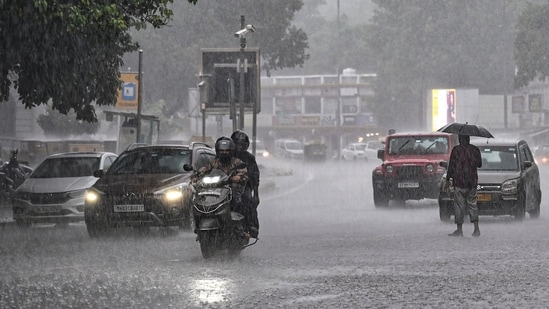
Recent monsoons have recorded rainfall at 600 to 1,700% of normal through sudden cloudbursts, even as the season overall ran at a national deficit. Kerala is living this paradox. Districts that had gone months carrying a rainfall deficit of more than 50% have since been deluged, receiving 232% excess rainfall within a three-day period. Its own rivers and canals, silted and constrained over decades of underinvestment, carry water to the sea at a pace far slower than the hills now send it down.
The rain is the climate crisis's doing. What happens to it after is ours. India loses food worth close to ₹2 lakh crore every year after harvest, and 5 to 10% of perishable food is lost during transportation alone. The fields grow what our neglect quietly takes back.
The work that prevents a crisis rarely looks like anything at all. Maintaining a drainage network. Strengthening a public health system. Building local capacity for adaptation. Its success looks like nothing happening, and nothing happening has never been an easy thing to fund. It asks for conviction, a kind of faith that the people closest to a problem are usually closest to its solution. Private, patient, collaborative funding has historically been the thing willing to sit with that kind of ambiguity, to build institutions whose only real proof of worth is a crisis deferred until beyond the point of its inevitability.
{{/usCountry}}The work that prevents a crisis rarely looks like anything at all. Maintaining a drainage network. Strengthening a public health system. Building local capacity for adaptation. Its success looks like nothing happening, and nothing happening has never been an easy thing to fund. It asks for conviction, a kind of faith that the people closest to a problem are usually closest to its solution. Private, patient, collaborative funding has historically been the thing willing to sit with that kind of ambiguity, to build institutions whose only real proof of worth is a crisis deferred until beyond the point of its inevitability.
{{/usCountry}}Gujarat carries a version of this story, written by government and non-State actors together. After a 2010 heat wave left over 1,300 excess deaths in Ahmedabad in a single month, the state signed an MoU with the Natural Resources Defense Council (NRDC) and the Indian Institute of Public Health IIPH) at the Vibrant Gujarat Summit, a room built to invite outside partners in. That MOU became South Asia's first Heat Action Plan, a district-by-district early warning system across all 33 of Gujarat's districts, each carrying its own temperature threshold. The state brought the mandate and the machinery of government, its hospitals, schools, municipal corporations. NRDC and IIPH brought the epidemiology, the programme design, and years of consistent, unremarkable follow-through. The plan has since travelled to 11 states and 30 cities.
Assam carries the other half of the story. A boat that pulls someone from a flood is worth everything in that moment, but so is the slower work of keeping the rivers, the canals, the dams tended so the water can go back to doing what it always did. That is the harder thing to fund, because it asks us to care before the boat is needed.
And yet one of India's most climate-vulnerable states receives less than 2% of mapped CSR spending. Funders often perceive climate as its own siloed sector, separate from development, though people living through a flood have never experienced it that way. For them it arrives all at once, as a climate event, a housing crisis, a health crisis, a food systems failure, a livelihoods strain, an infrastructure problem, indistinguishable from one another, never waiting politely for the other to pass.
Samantha Harvey, in her book, Orbital, writes of astronauts in orbit watching entire weather systems form and dissolve beneath them, one half of the earth lit and calm while the other sits dark and in a storm. All inside a single, unbroken frame. From that height, the planet did not organise itself into our sectors and ministries and funding categories. Only we did that, and only we have the slower, quieter work left to do. Of noticing that makes tending unavoidable, the relationships sustained over years that make any of it possible in the first place.
Somewhere along that coast, someone is still folding a net by hand, still pressing a vegetable to listen for its ripeness, still tending something the rest of us have long stopped seeing. I would like us, this time, to fund that noticing as much as the fixing. So that what gets inherited is the attention and not just the ruin it was meant to prevent.
(The views expressed are personal)
This article is authored by Shloka Nath, former founder and CEO, The India Climate Collaborative.