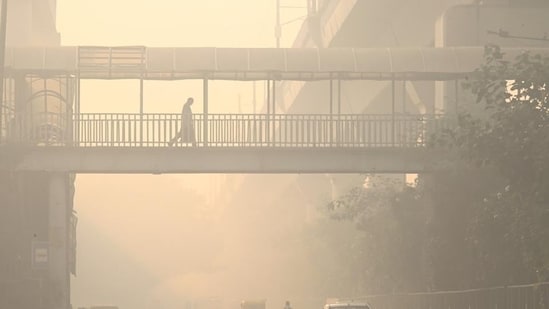
Delhi recorded its most polluted Diwali since 2021, but missing monitoring data raised questions about whether the published figures reflected the severity of pollution. CREA estimates that PM2.5 concentrations may have been 49% higher than reported. The question is not only how bad the air was, but how much was measured.The Central Pollution Control Board (CPCB) recorded an Air Quality Index (AQI) of 376 at 4pm on Diwali, November 8, the highest since 2021. AQI is a scale measuring air pollution. Other readings of 370 and 373 reflected different reporting times, not necessarily conflicting figures.By 1am on November 9, 36 of Delhi’s 59 stations had missing readings. According to the Centre for Research on Energy and Clean Air (CREA), 45 stations had missing hourly observations for at-least one pollutant, while only 14 reported complete data.The missing readings increased sharply during the peak pollution hours. According to CREA monitoring data, one station had missing readings at 7pm on November 8, rising to seven at 10pm, 23 at 11pm and 29 by midnight. By 1am on November 9, 36 of Delhi’s 59 stations had no readings. The number subsequently fell to 30 at 3am, 20 at 4am and seven by 8am. The missing readings coincided with the hours when pollution levels were rising sharply, raising concerns that the published figures may have underestimated the severity of the episode.Later, the Delhi Pollution Control Committee (DPCC) released the missing values. According to reports, all 125 missing station-hours were above 1,000 micrograms per cubic metre (µg/m³), and 11 of the DPCC stations recorded readings above 2,000.The missing readings raised questions about whether the published AQI adequately reflected the severity of pollution during the peak hours. Continuous monitoring data showed that multiple stations recorded values as high as 5,000 µg/m³ during the same period. These raw DPCC readings have not been independently validated here, and values above 1,000 µg/m³ may reflect real pollution spikes or measurement limitations.The difference between the CPCB and DPCC figures is particularly relevant. While the CPCB database had missing readings, the DPCC site had values that were not in the CPCB database. According to CREA's analysis, replacing 255 missing PM2.5 station-hours with 1,000 µg/m³ increased the estimated average from 269 to 400 µg/m³, approximately 49% higher than reported. This estimate does not establish the actual concentrations during the missing hours.There are other possible explanations too. Several missing readings coincided with concentrations nearing the reported upper limit of 1,000 µg/m³. However, this does not prove that the instruments themselves were saturated. The CPCB subsequently acknowledged that readings exceeding the system's design range could appear as data gaps and would not contribute to the relevant pollutant's 24-hour average. The CPCB also referred to its existing AQI methodology and consultations on how readings beyond the design range should be processed.Delhi environment minister Manjinder Singh Sirsa denied allegations of manipulation. His earlier statement that no data was missing, however, concerned a previous pollution episode and should not be treated as a fresh explanation of the November 2026 readings.The problem is not limited to Diwali 2026. Missing readings were also reported during October 2025. The missing readings during previous pollution episodes raise questions about whether this is a long-running problem rather than a one-off. Sunil Dahiya of Envirocatalysts and Anumita Roychowdhury of the Centre for Science and Environment have also raised concerns about missing pollution monitoring data.The stakes are medical. The average PM2.5 concentration recorded on Diwali in 2026 was 257 µg/m³, approximately 17.1 times the 24-hour guideline of 15 µg/m³ set by the World Health Organization (WHO). If we use Berkeley Earth's rule of thumb that 22 µg/m³ over 24 hours is approximately equivalent to smoking one cigarette, then the 2026 reading represents roughly 12 cigarettes' worth on Diwali.
Children, the elderly, and people with asthma and heart disease are particularly at risk. These surges can trigger asthma attacks in children and put extra strain on the hearts of the elderly. Short-term pollution surges are not the same as the chronic annual exposure used in the life-expectancy estimates of the University of Chicago's Air Quality Life Index (AQLI). According to its 2025 report, based on 2023 data, Delhi's annual mean PM2.5 concentration was 88.4 µg/m³, with an estimated loss of 8.2 years of life expectancy relative to the annual WHO guideline of 5 µg/m³ if such exposure continues over the long-term.Four reforms follow. First, the CPCB should provide station uptime alongside each AQI and make it clear when the average is based on incomplete monitoring data. This should be done within 30 days. Second, incorporate real-time reconciliation of CPCB and DPCC feeds within 60 days, as values available on the DPCC site were missing from the CPCB database. Third, the CPCB and DPCC should release raw PM2.5 concentrations along with AQI values within 60 days, including concentrations that exceed the range represented by the AQI ceiling of 500. Fourth, the Commission for Air Quality Management (CAQM) should arrange independent audits of outages, including sensor saturation, power, connectivity and contractor records, and publish the results for public scrutiny within 90 days. The consequences of bad air are already apparent. From November 7, Delhi schools shifted to hybrid mode for students up to Class 5 under GRAP Stage III. A CAQM precautionary order issued on October 30 called for 50% office attendance in Delhi and five NCR districts from November 5 to 20. These measures were not taken as a result of the missing Diwali-night readings, and GRAP restrictions are based on current AQI levels and forecasts, not just those readings.But if pollution peaks are underestimated, public health advice and subsequent assessments of the response may be affected. The missing readings are still important. Until the data is independently verified, Delhi's published post-Diwali AQI for November 9 should come with a clear disclaimer that the missing readings might have led to an underestimation of the severity of the pollution. The CPCB and DPCC should explain the reasons for the missing readings, while the CAQM should ensure that independent audits are carried out and the results made public for scrutiny.
(The views expressed are personal)
{{/usCountry}}(The views expressed are personal)
{{/usCountry}}This article is authored by Era Sakhuja, deputy programme director, Emerging Technologies and Risk, Centre for International Security and Economic Strategy.