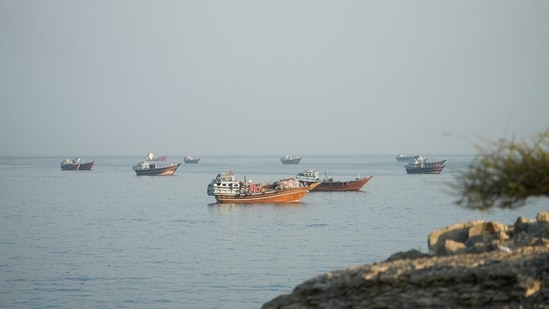
Nearly eight months into the Hormuz crisis, commercial shipping through the Strait remains severely restricted. The average daily transits of vessels reduced from 130 pre-war to less than 10 by mid-October 2026. Although the Strait of Hormuz is in principle governed by the right of transit passage under the UNCLOS, Iran, which has signed yet not ratified the treaty, is leveraging the passage as a permission rather than a right. Iran has now evolved a permit system under Persian Gulf Strait Authority (PGSA), and maintains a Non-Compliance List, with blacklisted vessels facing threats of detentions or fines.
India’s diplomatic and naval efforts secured passage for Indian-flagged vessels in the first half of 2026. However, favourable access for Indian-flagged ships does not equal comprehensive maritime security as the situation in the strait is evolving but also because over 90% of India’s trade is carried on foreign-owned or foreign-flagged ships. For this reason, the crisis shows a strong need to expand the Indian-flagged fleet and building more ships in Indian yards.
Indian flagged vessels carry only about 5% of the country’s trade and the rest is carried out by foreign shipping lines. This dependence is acute in energy sector as oil and gas, which account nearly 28% of India’s trade volume. Roughly 1,554 Indian-flag vessels, only 492 trades overseas, and in this, only 135 are oil tankers and 28 are gas carriers. As a result, India pays around $ 75 billion a year in freight to foreign shipping lines for importing cargo including crude oil. Recently, Union minister Hardeep Singh Puri highlighted that Indian oil companies spent about $ 8 billion over five years chartering foreign ships.
Though India ensured the continued movement of energy imports and other critical cargo through the Strait by diplomatic efforts and naval initiatives, diversifying its sources of oil imports, and rerouting vessels where necessary. But a significant portion of Indian cargo transported on foreign-flagged vessels did not benefit from these arrangements. In April 2026, the Liberia-flagged container ship Epaminondas, which was carrying cargo bound for Mundra Port in Gujarat, was seized by Iran’s Islamic Revolutionary Guard Corps (IRGC).
{{/usCountry}}Though India ensured the continued movement of energy imports and other critical cargo through the Strait by diplomatic efforts and naval initiatives, diversifying its sources of oil imports, and rerouting vessels where necessary. But a significant portion of Indian cargo transported on foreign-flagged vessels did not benefit from these arrangements. In April 2026, the Liberia-flagged container ship Epaminondas, which was carrying cargo bound for Mundra Port in Gujarat, was seized by Iran’s Islamic Revolutionary Guard Corps (IRGC).
{{/usCountry}}To address these vulnerabilities, India has already accelerated the expansion of Indian-flagged vessels in the recent months such as roadmap to add 62 vessels in 2026-27 (including crude and LPG carriers), a planned Shipping Corporation of India–oil PSU joint venture to acquire 59 vessels for carrying India’s energy imports on Indian ships, and financial support through the Bharat Maritime Insurance Pool. However, over the longer term, Indian-owned ships built in Indian yards are essential.
Shipbuilding is a long-gestation industry whose benefits take years to materialise. In 2025, the Indian government has already pushed for a comprehensive package of ₹70,000 crore to strengthen India’s shipbuilding sector. This includes Shipbuilding Financial Assistance Scheme to support the yard costs until 2036, Maritime Development Fund to address the high cost of capital that keeps Indian owners from ordering ships, and Shipbuilding Development Scheme to support greenfield and brownfield yard expansions.
Recently, Prime Minister Narendra Modi called for Atmanirbharata in India's shipbuilding industry. This year, the government granted in-principle approval to greenfield clusters in Tamil Nadu (Thoothukudi), Gujarat (Kuchhadi), Andhra Pradesh (Dugarajapatnam), Maharashtra (Dighi), and Odisha (Kendrapara). In this, the central port authority and a state agency own an equal percentage of the cluster via a Special Purpose Vehicle where the Centre pays for the shared basics of the infrastructure, and the state government provides the land and local permissions. As of October 2026, the Mazagon Dock is the anchor shipyard in Andhra Pradesh and Maharashtra, and HD Hyundai from South Korea is at Thoothukudi in Tamil Nadu. As the shipbuilding is a multi-year, multi-phase, and capital-intensive sector, the realisation of these projects will take a few years.
As of October 2026, Gujarat and Odisha are yet to select their anchors, but none of the other three clusters has an Indian private shipyard as an anchor yet: two are led by Mazagon Dock, a defence PSU, and one by South Korea’s HD Hyundai. In leading shipbuilding countries such as South Korea and Japan, private companies anchor majority of the shipbuilding clusters with strong government support. While challenges to private yards persists such as financial distress, higher borrowing costs or acute supply-chain risks; yet India could still encourage the private companies to build the capacity and scale needed for India’s growing trade numbers.
If India is to become one of the world’s top five shipbuilding nations by 2047, as envisaged under the Maritime Amrit Kaal Vision 2047, India should address the risks that deter Indian private yards from building ships at the scale and the capacity the country needs. Although the cluster model and schemes by government are introduced, subsidies for shipbuilding and schemes such as MDF, credit-risk cover are in place; the participation of the private firms is also crucial to scale-up India’s market share growth from less than 1% currently to 5% by 2030. Firms such as Larsen & Toubro (L&T) and Swan Defence and Heavy Industries (SDHI), which won an order for ammonia dual-fuel bulk carriers in April 2026 at Pipavav shipyard, Gujarat show that the capability exists.
Thus, India’s access to energy and other cargo, the safety of its seafarers, and the cost of its imports depend on ships it flagged or owned. Turning the crisis into an opportunity will depend on identifying the root-cause vulnerabilities in expanding the Indian-flagged fleet, building ships in Indian yards over the next decade, encouraging private players, and understanding the strategic risks for the sustainable survival of private yards.
(The views expressed are personal)
This article is authored by Lakshmi Kusuma Kotha, research analyst and Cchavi Vasisht, associate fellow, Chintan Research Foundation, New Delhi.