The Shanghai Cooperation Organisation (SCO) puts India in a position of a strategic paradox. On the one hand, it brings New Delhi to the same organisation as China, despite the fact that the two countries are considered strategic rivals. On the other hand, it gives some chances for cooperation in counterterrorism, fighting against drugs and organised crime, disaster management, climate and energy issues, connectivity, and new technologies. The key question is not whether India and China start to trust each other, but whether they will be able to cooperate in the areas of common interests without allowing their rivalry to affect SCO.
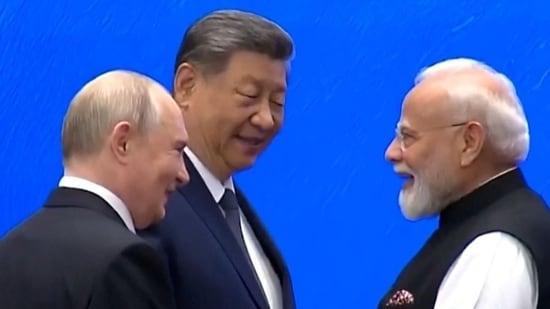
This question becomes even more significant given the recent developments in India-China relations which have reached a cautious phase of stabilisation. The relationship evolved from Hindi-Chini bhai-bhai to dragon-elephant of competition and cooperation taking place simultaneously. The 2020 Galwan events brought a transformation of this relationship turning rivalry from the military sphere into economy, technology, trade, and connectivity. At the same time, resumption of high-level contacts indicates that both countries realised the danger of allowing all disagreements to spoil the relationship.
The talks that Special Representatives recently had demonstrate the duality in this regard. The talks between foreign minister Wang Yi and national security adviser Ajit Doval have resulted in movement on the boundary delimitation, border management and transboundary rivers, along with areas like the Kailash Mansarovar Yatra and border trade. However, as Happymon Jacob points out, diplomatic progress should not be seen as a return to the pre-2020 status quo. The main issue is the situation on the ground as far as the Line of Actual Control is concerned.
This is an important point for India’s SCO strategy. The country is not trying to resolve the India-China rivalry through the SCO, but is rather compartmentalising the relationship in order to protect core security interests while keeping the channels open for cooperation.
{{/usCountry}}This is an important point for India’s SCO strategy. The country is not trying to resolve the India-China rivalry through the SCO, but is rather compartmentalising the relationship in order to protect core security interests while keeping the channels open for cooperation.
{{/usCountry}}One of the best points to begin from in the context of the maintenance of cooperation in the security sector should surely be the fact that terrorism, drugs, organised crime, radicalisation, and cyber threats do not know borders at all. In view of this fact, interests of India, China, and Central Asian States do coincide even if these countries are quite different overall. Moreover, it is important to notice that India does not need to establish strategic trust with Beijing in order to cooperate with it in fighting terrorism, disrupting drug traffic and increasing sharing of information. Hence, what matters here is the establishment of cooperation without a necessity to build strategic trust.
Nonetheless, it is important to know that security cooperation has its limits. The experience of India demonstrates that it is impossible to substitute deterrence by means of diplomatic measures. In this situation, India should know how to stay militarily prepared in spite of the fact that it is engaged in diplomatic dialogue.
The challenge that transit and connectivity represent is amplified by the fact that China is far better positioned financially than India in the race to improve infrastructure in Eurasia through the Belt and Road Initiative (BRI); thus, India won’t be able to compete project by project. Instead, India should focus on ensuring the development of alternative and complementary corridors, such as Chabahar and the International North-South Transport Corridor, while being firm in its position on respecting sovereignty and territorial integrity in the process of establishing connectivity. In 2025, Prime Minister Narendra Modi linked his initiative regarding Indian connectivity with these projects at the SCO summit held in Tianjin.
India, therefore, needs to refrain from falling into the trap of the false dichotomy of cooperation and competition. It can enhance connectivity in Eurasia without supporting those projects that compromise the sovereignty of India.
The Central Asian dimension is equally important in the sense that countries like Kazakhstan, Uzbekistan, Kyrgyzstan, Tajikistan, and others want to diversify their partners rather than depend on one country. While the SCO opens up this part of the world for India, access is not enough. Therefore, New Delhi will need to transform participation into permanent collaborations in sectors like pharmaceuticals, health care, education, technology, energy, and connectivity.
It would be fair to say the importance of the SCO for India has decreased because the geopolitical scenario has altered. China has emerged as India’s main strategic rival, and Russia has become closer to China. At the same time, the US has become an important strategic partner for India. Therefore, the SCO cannot be utilised as a basis of India’s strategy in Eurasia.
However, India must keep engaging in the SCO and should not allow it to become just an anti-western platform. The importance of SCO rests in specific cooperation rather than strategic bloc-building.
New Delhi is a member of both the SCO and BRICS, and simultaneously promotes its presence in the Quad alliance and close ties with the US, Japan, Europe, and other partners in the Indo-Pacific. These are not necessarily contradictory actions. Although the SCO facilitates movements within continental Eurasia and Quad promotes India's interests in the Indo-Pacific, various bilateral partnerships provide India with additional economic, technological and security solutions. India does not wish to have to pick a side between China and the West, rather it would like to preserve its strategic independence of action and manoeuverability.
That said, there are still limitations on the possibility of such manoeuvering. For instance, India is worried about close ties between Pakistan and China, and the rise of India-Japan relations in the framework of Quad. The longstanding territorial disputes and asymmetries in the economy create distrust. While recent successes in the field of border management and people-to-people exchanges demonstrate that countries can cooperate, there is also a lot of competition between them.
We must evaluate the SCO not by whether it brings India and China closer together but by its ability to ensure that coexistence is achieved without convergence. India can collaborate with China in areas like terrorism, drugs, disaster management, or climate change while being locked in competition for dominance and connectivity.
The Indian position toward the SCO should be guided by the principles of cooperation on shared interests and competition on divergent issues, as well as partnership diversification to make sure that India’s relations with the SCO remain independent of China. The success of India’s SCO strategy should be judged not by whether it manages to turn its rivalry with China into partnership, but rather whether it has figured out how to make cooperation possible without overcoming the rivalry.
(The views expressed are personal)
This article is authored by Janvi Singhi, independent researcher and Kanav Sharma, public policy researcher.