Actor Bhumi Satish Pednekkar, who was in flood-hit Assam from August 6 to 9, says witnessing the devastation first-hand was very different from seeing it online. She joined the Bharat Disaster Relief Foundation (BDRF) in relief work across affected areas, where over 1.12 lakh people have been impacted.
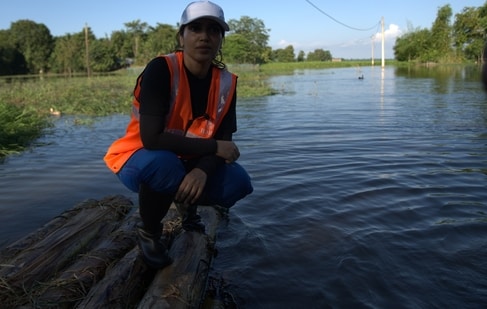
“The volunteers had already been on the ground for almost 14 days by the time I reached, doing incredible work,” Bhumi tells us, adding that she wanted to go “responsibly” and “contribute meaningfully” without adding to the burden of the local administration. She recalls, “I’ve actually grown up in an environment where I’ve seen my family do a lot of relief work. From a very young age, we were taught to give back. I have so many memories from my childhood when we were sent to collect as much as we could , going from colony to colony, door to door, collecting donations and sending them to organisations that were doing relief. So, over the years, that naturally became a part of who I am. It wasn’t something I consciously decided to start doing one day; it was something I grew up seeing and participating in.”
The actor adds, “Even last year, when the floods affected Punjab, Jammu, Himachal Pradesh, Bihar and several other states, I worked with the BDRF team and Ketto, and I went to Jammu to participate in the relief work on ground.”
{{/usCountry}}The actor adds, “Even last year, when the floods affected Punjab, Jammu, Himachal Pradesh, Bihar and several other states, I worked with the BDRF team and Ketto, and I went to Jammu to participate in the relief work on ground.”
{{/usCountry}}On her family’s concern as she took off to volunteer in Assam, she says, “Of course, my mother worries; she’s my mother, she’s always going to worry! But I try my best to stay in touch and make sure I don’t give her too much reason to be anxious.”
Recalling the condition of villages in Sivasagar and Jorhat, she says, “In several villages, the water had still not receded. In places where it had, what was left behind was heartbreaking... homes filled with muck, sand and debris, and families who had essentially lost everything they owned. I remember thinking, how does one even begin to rebuild a life from here?”
What stayed with her most, however, was the resilience of those affected: “Despite everything they had lost, there was still this incredible spirit to keep going. Speaking to the families made me realise that relief is so much more than just food and ration. You have to understand what people actually need at that moment. They need mattresses because they have nowhere to sleep. Solar lights because there is no electricity. Sanitary napkins. Clothes for women and children. Medical assistance. Stoves and gas. These are basic necessities, but when you’ve lost everything, even the most basic things become a luxury." She recalls, “I saw people washing clothes in stagnant water. I saw elderly women who were unable to leave their homes and had been living in knee-deep water. And you find yourself asking, how do you actually give someone like that relief? How do you make their life even a little bit easier?”
Urging people to help, Bhumi says donations, clothes or volunteering can all make a difference, but cautions against arriving without a plan: “Connect with an organisation that is already working there, understand what the actual needs are, and then go and do seva in whatever capacity you can.”