Delhi’s post-Diwali air has slipped into the ‘Severe’ category, with AQI levels crossing 400 across the capital and pollution exceeding the World Health Organization’s (WHO) recommended limits by over 50 times. As smog disrupts daily routines, here’s how Delhiites are adapting:
1. Campus shifts back to screen time
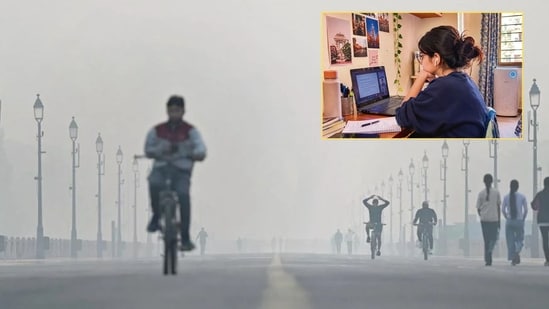
Several Delhi University institutions, including Delhi College of Arts and Commerce (DCAC) and Dr Bhim Rao Ambedkar College, have shifted classes online between November 6 and 10. Mata Sundri College and Lakshmibai College have also issued advisories to minimise student commutes during peak smog hours. “It’s annoying because post-Diwali is when the campus is so lively, with all of us sharing stories and gifts. But it’s still better to miss out than inhale this air and end up unwell. It’s sad that I even have to choose between the two,” says Ananya Sharma, a second-year Lakshmibai College student.
Karan Verma, a final-year Ram Lal Anand College student, says, “The commute from Noida to North Campus was getting brutal on my lungs. Going online saves me two hours of breathing smog on an auto ride. I’m keeping an air purifier running in my room, but studying alone gets monotonous. A few of us are organising group study sessions on Discord to stay focused.”
2. Cycling clubs suspend rides
With AQI levels soaring, cycling groups across NCR are cancelling their early morning rides, with organisers alerting members on WhatsApp. “Early November is usually peak season for us, but not when the city is struggling to breathe,” says Rohan Malhotra, 34, from a South Delhi cycling club. “Doing high-intensity cardio in 400+ AQI is equivalent to smoking a pack of cigarettes on the move. As organisers, we simply cannot risk people’s lungs, so all our group rides are on hold until the smog clears.”
{{/usCountry}}With AQI levels soaring, cycling groups across NCR are cancelling their early morning rides, with organisers alerting members on WhatsApp. “Early November is usually peak season for us, but not when the city is struggling to breathe,” says Rohan Malhotra, 34, from a South Delhi cycling club. “Doing high-intensity cardio in 400+ AQI is equivalent to smoking a pack of cigarettes on the move. As organisers, we simply cannot risk people’s lungs, so all our group rides are on hold until the smog clears.”
{{/usCountry}}Simran Kaur, 28, an IT analyst and cyclist from Vasant Kunj, adds, “I ride with the Delhi Cyclists Club, and all our weekend rides for the next two weeks are cancelled. I’ve adjusted my routine instead. I monitor real-time AQI apps and, if there’s a rare afternoon dip around 2pm, opt for a low-effort, low-heart-rate ride with an N95 mask on.”
3. Parks clear out, indoor sports take over
Morning walks, yoga sessions and weekend sports matches are also moving indoors as residents avoid outdoor exposure. “Our morning group usually meets at Siri Fort for yoga, but doing breathwork in heavy smog makes no sense,” says Meenakshi Sundaram, 45, a freelance instructor. “We’ve moved to Zoom for the next two weeks. I tell my batch to focus on gentle indoor stretches and stay hydrated.”
Aman Gupta, 24, a Gurugram-based corporate analyst, adds, “Sunday box-cricket matches with my office colleagues are usually non-negotiable for venting work stress, but the smog forced us to call them off. Instead, four of us booked an indoor badminton court at a local sports complex. It’s fully enclosed, keeps us out of the haze and lets us continue playing.”
How to protect yourself against the smog
Exercise indoors: Avoid outdoor cardio and strenuous activities. Opt for low-impact indoor workouts
Avoid peak smog hours: Limit early morning and late evening outings. Step out in the afternoon if necessary
Wear an N95/N99 mask: Cloth and surgical masks offer inadequate protection against fine particles. Avoid strenuous exercise while wearing a respirator
Keep indoor air clean: Shut doors and windows, use a HEPA-filter air purifier, avoid incense and candles, and wet-mop floors
Stay hydrated: Drink water and herbal teas to soothe throat irritation. Include vitamin C-rich and antioxidant-rich foods in your diet
Inputs by Dr Sujata Rawat