From the choice of fabric and intricate craftsmanship to the time and cost involved, sarees featuring Maa Durga’s imagery bring together art, devotion and heritage. Designers share how they translate the Goddess’s many facets onto fabric, the techniques they use and the effort that goes into creating these pieces.
Bring the craft alive
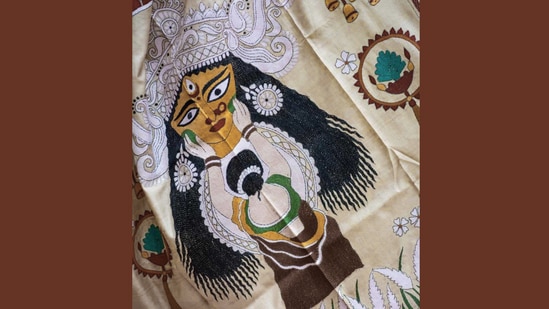
These festive pieces celebrate Maa Durga in her divine form, drawing inspiration from her face and eyes, Trishul, lion, lotus and other associated symbols. “The most challenging element is capturing Maa Durga’s expression, which portrays both her fierce strength and maternal compassion through handcrafted detailing,” says Adetee Banerjii, founder of Sui Dhaga – A Weaving Saga.
Echoing this, Sayanti Ghosh, director and creative head of Sayanti Ghosh Designer Studio, says, “Translating that expression into textile requires precision and careful detailing.”
A new trend?
Depiction of Maa Durga have long featured in temple reliefs, stone carvings, terracotta panels and ritual utensils, but now the Goddess is now emerging as a design element in contemporary ethnic wear. Ghosh attributes this shift to the evolving interpretation of traditional imagery in contemporary expression. “Pieces that combine the Goddess’s imagery with Bengal’s traditional textile vocabulary hold a unique emotional appeal. Today, women increasingly appreciate fashion that carries cultural meaning, individuality and craftsmanship. I see this not merely as a trend, but as a renewed appreciation for wearing our heritage,” she adds.
{{/usCountry}}Depiction of Maa Durga have long featured in temple reliefs, stone carvings, terracotta panels and ritual utensils, but now the Goddess is now emerging as a design element in contemporary ethnic wear. Ghosh attributes this shift to the evolving interpretation of traditional imagery in contemporary expression. “Pieces that combine the Goddess’s imagery with Bengal’s traditional textile vocabulary hold a unique emotional appeal. Today, women increasingly appreciate fashion that carries cultural meaning, individuality and craftsmanship. I see this not merely as a trend, but as a renewed appreciation for wearing our heritage,” she adds.
{{/usCountry}}Fabric and craft
While traditional Pujo sarees include Laal Paar (cotton), Garad and Korial (silk), Jamdani (cotton muslin), people are also experimenting with organza, tissue silk and muslin, as interest in Maa Durga’s iconography in fashion grows. This is brought to life with a range of techniques such as Bengal Kantha embroidery, traditional Batik and hand-block printing, Aari work, and woven or painted details, where appropriate. “The traditional lal paar shada saree is an emotion for every Bengali woman. We build on this tradition by using the fabric as a canvas that narrates Maa Durga’s story,” says Banerjii.
The craftsmanship behind each saree
The time taken to create these sarees varies with the complexity of the design and the craftsmanship involved. Handcrafted Batik creations require a 45-day pre-order period, while Kantha sarees can take up to six months.
Shop these festive picks
Legacy of Bhojraj (www.legacyofbhojraj.com) | Starting at ₹1,799
Sayanti Ghosh Designer Studio (@sayantighoshdesignerstudio) | Hand embroidered sarees starting at ₹40,000 and blouses at ₹18,000
Suta Bombay (suta.in) | ₹7,900
Sui Dhaga – A Weaving Saga (www.suidhagaaweavingsaga.com) | Select Batik sarees at ₹10,000; intricate Kantha pieces up to ₹24,000