Luxury fashion has long used hyper-realistic animation, illustration and fantastical storytelling to build worlds around its products. What feels different now is the renewed emphasis on visibly handmade techniques. At a time when AI can generate increasingly sophisticated imagery in seconds, the brands are turning to hand-painted watercolour and gouache, as well as painstaking frame-by-frame animation, to tell their stories. Dior’s latest Miss Dior film transforms the fragrance into a vintage anime heroine, while LOEWE and Chanel have similarly used crafted animation to move beyond the traditional campaign. Experts decode what it means to the fashion world.
A Story of Love and Perfume: Dior
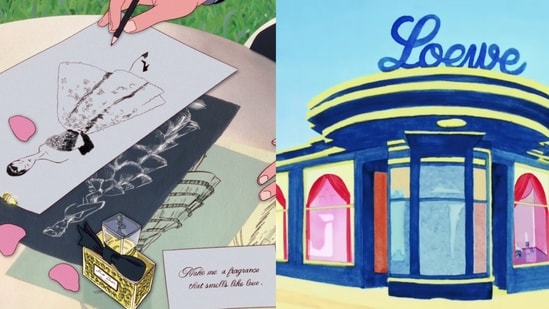
Last week, Dior Beauty released Miss Dior, A Story of Love and Perfume, an animated short film that turns the Miss Dior fragrance into a vintage anime character while tracing its story back to its 1947 launch.
While the project is distinctly French in its origins and creators, its visual language takes direct inspiration from Japanese animation. It recreates the soft, painterly look of vintage anime using a rare Japanese gouache technique dating back to the 1980s. Background artist Louise Seynhaeve hand-painted the scenery using gouache and acrylic, bringing the imagined landscapes, rose gardens and Parisian settings to life.
Chanel’s cinematic Seoul
Chanel took an artisanal approach to its Métiers d’Art 2026 collection with an animated teaser directed by Matthieu Blazy, ahead of the collection’s restaged presentation at Centre Pompidou Hanwha in Seoul in May.
{{/usCountry}}Chanel took an artisanal approach to its Métiers d’Art 2026 collection with an animated teaser directed by Matthieu Blazy, ahead of the collection’s restaged presentation at Centre Pompidou Hanwha in Seoul in May.
{{/usCountry}}Created with South Korean illustrator Jisu Choi, the hand-drawn film takes viewers through a stylised, panoramic Seoul, using detailed isometric architecture and frame-by-frame 2D animation. Traditional Korean buildings sit alongside the city’s skyline, while changing weather, greenery and quiet everyday moments. Rather than leading with the collection itself, the film creates a visual world, bringing together traditional Korean techniques with modern elements, that sets the mood for the collection.
LOEWE’s history in watercolour
To celebrate its 180th anniversary in June, Spanish luxury house LOEWE commissioned illustrator Joanna Blemont to create a hand-painted animated watercolour film tracing the maison’s journey. Blemont used a slow, contemplative visual style to revisit the brand’s history through a series of atmospheric, sequential scenes rather than a conventional chronological brand film. The film comprised more than 2,000 individual hand-drawn frames, each animated frame by frame. The film’s deliberately slow pace allows the texture and movement of the painted frames to remain visible.
Balancing AI with craft
For Indian designers, the answer isn’t necessarily to reject AI, but to use it in control rather than allowing it to take the lead. Ketan Sethi, fashion designer and co-founder of Chaashni by MK, says, “I use these tools for what they’re good at: exploring ten directions that once took a week, fast visualisation. What keeps me the author is feeding it something it doesn’t already have, my own archive, my fabrics, my craft, instead of the same references everyone pulls off the internet, and knowing what to reject. The hand skills matter here: sketching, draping, construction teach you to see, so you can tell when the tool is lying.”
The pull of the craft
For brands, animation opens up new possibilities for storytelling and a greater freedom to express the vision behind the product. “Fashion has always borrowed its language from wherever imagination lives most freely, and right now that place is digital... Animation can bring together elements such as weather, light and movement that a conventional studio shoot cannot deliver,” says fashion designer Pallavi Mohan.
On why the focus is on handcrafted techniques, fashion and costume designer Nidhi Yasha says that with the rise of AI, the human hand has become more valuable. “Allowing a little imperfection is probably now the real luxury in a sea of sameness. AI can make everything polished, balanced, beautiful and seductive. That’s exactly why polish alone is becoming less valuable,” she adds.