What Children Lose When Screens Take Over
- The Vanishing Childhood
- Growing Up Online: The Hidden Cost of Constant Connectivity
- Children Need Roots, Not Just Clicks
When Childhood Moves Behind a Screen
A seven-year-old sits quietly in a room full of family members. Nobody is arguing. Nobody is upset. Yet there is little conversation. The child is absorbed in a smartphone, scrolling through an endless stream of videos. Increasingly, this scene is becoming the new face of childhood, raising concerns about what children are losing as they gain unprecedented access to the digital world.
The concern is not that technology exists, but that it increasingly replaces many of the real-life experiences that help children develop resilience, independence, and meaningful human connections.
Every minute spent in a virtual world comes at the expense of experiences that are essential for healthy childhood development.
Every child needs real life experiences for mental development. They need to solve puzzles and physical development needs outdoor plays, ride bicycles, participate in sports, argue with friends, solve playground disputes, and learn patience through boredom. Today's children increasingly encounter a different reality: curated feeds, instant gratification, and algorithm-driven entertainment available around the clock.
Childhood is never meant to be frictionless. It is meant to include scraped knees, missed goals, difficult conversations, failed attempts, and hard-earned friendships. These experiences build the resilience that screens cannot provide. As society embraces powerful new technologies, the question is no longer whether children should be connected. The question is whether they will remain connected to the real world that teaches them how to thrive within it.
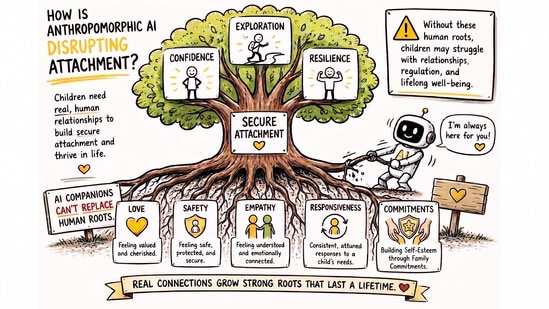
Replacement of real-life relationships. Healthy relationships require personal commitments and responsibilities guided by personal purpose. Purpose helps to develop emotional skills to deal with failures and disappointments. The frictionless, subservient, and readily accessible nature of AI chatbots are quietly training children to prefer and depend on machine relationships over full, genuine human relationships, leading to long-term social issues.
{{/usCountry}}Replacement of real-life relationships. Healthy relationships require personal commitments and responsibilities guided by personal purpose. Purpose helps to develop emotional skills to deal with failures and disappointments. The frictionless, subservient, and readily accessible nature of AI chatbots are quietly training children to prefer and depend on machine relationships over full, genuine human relationships, leading to long-term social issues.
{{/usCountry}}Reduced social skills. The best way for children to learn emotional and social cues is through personal experiences during searching for solutions on how to best support their families, through observing, mirroring, and gentle critical feedback from family members, teachers, friends and others in contextual settings.
Anthropomorphic AI Companions Social Chat bots are depriving children of their ability to navigate authentic, reciprocal and difficult social interactions, which are essential skills for adulthood. Prolonged interactions with AI Companions Social chatbots distort children’s ability to empathise, interact, and self-regulate emotions with peers in the real world, at home, schools, and eventually at work and family.
The Addictive Power of the Digital Devices & Platforms World
Digital platforms are designed to capture and retain attention. Endless entertainment, instant rewards, personalized content, constant availability, and social validation create an environment that is difficult even for adults to resist. For children, whose self-regulation skills are still developing, the attraction is especially addictive.
Many children spend hours scrolling, gaming, watching videos, or interacting with AI-powered companions rather than participating in outdoor play, face-to-face conversations, or unstructured exploration.
What Research Suggests
A significant proportion of adolescents display smartphone use patterns consistent with behavioral addiction. Teenagers spend roughly 35 hours per week on smartphones, while increased screen exposure has been associated with social difficulties, loneliness, language-development challenges in younger children, and attention-related problems. Excessive screen time interferes with activities that are crucial for child development, like focused learning, physical activity, social interaction, resilience, sleep.
The Hidden Costs
The consequences of an overwhelmingly digital childhood are not always visible immediately. However, experts frequently point to several areas of concern:
- Reduced ability to tolerate frustration and boredom.
- Shortened attention spans and difficulty concentrating.
- Greater dependence on external stimulation and instant gratification.
- Weaker interpersonal relationships.
- Increased feelings of loneliness and isolation.
- Declining academic performance and problem-solving abilities.
Many of these challenges stem from the displacement of real-world experiences that build emotional strength and social competence.
Why Real Life Still Matters
Children develop resilience by facing setbacks, resolving conflicts, taking risks, and learning from mistakes. They build empathy through face-to-face interactions. They strengthen creativity during unstructured play. They gain confidence by exploring the world independently.
The costs of excessive digital engagement with the benefits of real-life experiences: stronger social skills, emotional intelligence, patience, independent thinking, meaningful friendships, and resilience.
These qualities cannot be downloaded, streamed, or generated by algorithms. They are acquired through lived experience.
Authors: Ms. Margarita Louis Dreyfus and Mr. Viren Shiv Sharma; www.humanchange.com
Note to the Reader: This article has been produced on behalf of the brand by HT Brand Studio and does not have journalistic/editorial involvement of Hindustan Times & HT City.