Nearly 10% of mock attacks launched during India’s largest ever coastal security exercise in January were successful in breaching the multilayered defences, three officials with knowledge of the matter said on condition of anonymity. “It is still possible to sneak in despite a massive infrastructure upgrade,” said one of the officials.
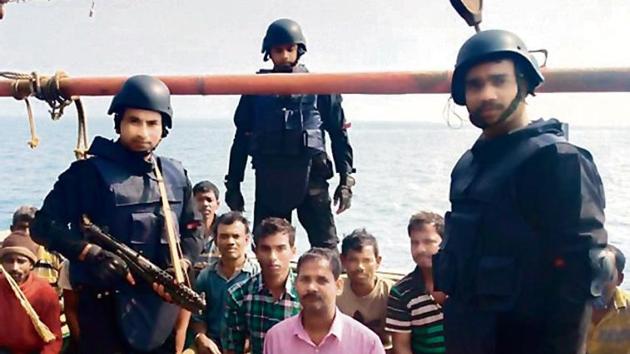
The two-day exercise – Operation Sea Vigil – was simultaneously undertaken on the eastern and western coast to check coastal safety measures put into place after the November 2008 Mumbai attacks. As many as 166 people were killed when 10 terrorists sailed from Pakistan by boat to Mumbai on November 26, 2008, and sprayed bullets and threw grenades across targets in the city over the next three days.
The officials said small boats, which are less that 20 metres in length, and are yet to get Automatic Identification Systems (AIS) remain a primary cause of concern. An AIS automatically provides information about a vessel to other ships and to coastal authorities. India has about 250,000 such small boats, according to figures available with the Indian Navy.
The potential threat from smaller rogue boats is likely to be addressed as a satellite-guided friend or foe identification system of the Indian Space Research Organisation with a two-way messaging system in all local languages is finally ready for induction within the next three or four months.
{{/usCountry}}The potential threat from smaller rogue boats is likely to be addressed as a satellite-guided friend or foe identification system of the Indian Space Research Organisation with a two-way messaging system in all local languages is finally ready for induction within the next three or four months.
{{/usCountry}}The system was successfully tested on about 1,100 smaller fishing boats in Gujarat, Tamil Nadu and Puducherry recently. “The transponders will be inducted soon,” a second official said.
The ill-equipped maritime police forces of coastal states are also a cause of concern for the Indian Navy, which is the lead agency for coastal security. “Serviceability [or availability of boats] is as low as 50%,” said a third official.
Only half the boats are available when required and policemen posted to the state maritime police wings get shifted after two to three years. “Sea training starts all over again,” said the second official cited above.
The Navy has suggested to state police forces to enlist sailors, who are about to retire, to man their maritime wings. “Instead of training a new batch of policemen every three years, superannuating sailors could be inducted into the state maritime police forces,” the second official said. The third official, who is also involved in analysing Operation Sea Vigil, blamed lack of adequate training, motivation and non-availability of boats with state maritime police wings for the success of mock attacks.
The government is now considering doing away with state maritime police forces that are in place in the nine coastal states and four union territories, according to a senior official aware of the details.The Coast Guard, which comes under the defence ministry’s jurisdiction, will now be placed under the Union home ministry and designated the National Maritime Police. The NMP or the Coast Guard will be under the operational control of the ministry of home affairs (MHA) and will function as a police force if the proposal is accepted.
Operation Sea Vigil threw up some positives as well. Fishermen and coastal communities, which were involved in the exercise along the with Navy, Coast Guard and other agencies, turned out to be “extremely aware and vigilant.”
The second official said the number of alerts about the presence of unfamiliar boats and crew they provided were up to the mark. The fishermen and coastal communities spread across India’s over 7,500 km coastline are considered as the “eyes and ears” of coastal security
“As a country, we must realise the centrality of training — both in terms of capacity building and psychological requirements — of the state maritime police forces. Just as the Navy painstakingly rebuilt itself after Independence, a similar single-minded effort is needed to build the state maritime police forces. Else, assets and resources will have to be increasingly committed to police the last mile instead of looking deep into the sea for incoming threats,” Vice Admiral Pradeep Chauhan (retd), director of National Maritime Foundation (NMF), said, reacting to the results of the Operation Sea Vigil. “Just shifting the Coast Guard from one ministry to another, in my opinion, will not solve the problem,” he said reacting to the proposal of shifting the Coast Guard from the ministry of defence to the MHA.
Separately, the defence ministry is considering a proposal for equipping ports in Port Blair (Andaman and Nicobar Islands) and Karwar (Karnataka), where aircraft career INS Vikramaditya is docked, with fresh Vessel Traffic Management Systems (VTMSs) as part of their security upgradation at a cost of ₹500 crore, according to a senior defence ministry official aware of the development who did not wish to be named.
Currently, 32 key ports have a VTMS, which are used to deal with ship traffic. Sixteen more coastal radar stations will also be added for complete visibility of ships moving in the Indian Ocean Region.