
On the night of November 26, 2008, Mumbai came under attack. Ten heavily armed terrorists who arrived from Pakistan struck multiple locations across the city, including Chhatrapati Shivaji Terminus, the Oberoi Trident, Nariman House and the Taj Mahal Palace Hotel. Gunfire and explosions shattered the city's sense of security as people were killed, hostages were taken and several buildings turned into battlegrounds.
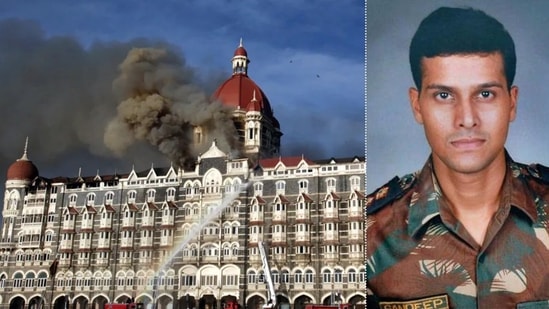
As the attacks unfolded, ordinary citizens and security personnel found themselves caught in an unprecedented crisis. Railway staff and police officers helped people escape danger, hotel employees risked their lives to guide guests to safety, and security forces moved in to confront the terrorists.
The rescue operations lasted three days, with the siege at the Taj Hotel emerging as one of the most intense and prolonged encounters.
Among those who entered the burning hotel to take on the terrorists was Major Sandeep Unnikrishnan of the National Security Guard (NSG). His actions during the operation would become one of the defining accounts of courage and sacrifice during the 26/11 attacks.
Major Unnikrishnan's heroics
As the Taj's interiors filled with smoke and terrorists unleashed grenades and gunfire, Major Unnikrishnan led his team through the hotel, clearing rooms and confronting the attackers. During the operation, a fellow commando, Sunil Yadav, was wounded. Unnikrishnan helped evacuate him from the hotel and get him to a medical team waiting outside.
But he did not retreat with his injured colleague. Instead, he returned to the building and continued the operation.
{{/usCountry}}But he did not retreat with his injured colleague. Instead, he returned to the building and continued the operation.
{{/usCountry}}Before returning to the firefight, he spoke to the other commandos, delivering words that would later become synonymous with his courage: “Do not come up, I will handle them.”
Unnikrishnan went on to engage the terrorists alone. He was eventually shot in the back by the attackers and succumbed to his injuries on November 28, as commandos continued to search the hotel floor by floor. By then, the operation at the Taj had turned into a prolonged gun battle, with the siege lasting around 60 hours.
Looking back
For those who knew him, his decision to return to the fight was not entirely surprising. His childhood friends remembered him as someone who was fearless, decisive and always willing to take responsibility.
Known as “U Sandeep” in school, he studied at Frank Anthony Public School in Bengaluru. His classmate Sandeep Naidu, who spent nearly a decade with him, recalled him as bold and upfront, but never arrogant.
“He was bold, upfront and wanted to be in control. He had so much conviction but was never pompous. He made up his mind to join the army when he was in class eight,” Naidu told HT in an earlier interview.
The Unnikrishnan family had moved from Cheruvannur in Kerala's Kozhikode district to Bengaluru. His father, K Unnikrishnan, worked as an officer at the Indian Space Research Organisation before retiring in 2007. His parents initially hoped their son would become a doctor, but Sandeep had other plans.
His determination to join the armed forces was evident from an early age. As a teenager, he travelled alone from Bengaluru to Bhopal to pursue admission to the Indian Navy through the National Defence Academy (NDA). He informed his parents of his plans only after clearing the entrance examination and then insisted on making the journey on his own.
His mother, Dhanalakshmi, later recalled how other parents called to congratulate the family after learning that he had managed to reach Bhopal on his own.
Although he could not join the Navy because of a minor vision defect, the setback did not end his ambition. A few months later, he received a call from the Army and joined the 7 Bihar Regiment, based in Danapur, after completing his training at the Indian Military Academy in 1999.
At the NDA, Unnikrishnan earned a reputation for being selfless, generous and composed. His slim build concealed a formidable determination, which became evident during training camps and cross-country races. He also topped the Army's Ghatak Course, a demanding programme designed to prepare soldiers for combat operations.
A story from his days at the academy offered a glimpse of the person he was beyond the uniform.
During a trek up Sinhagad Fort near Pune, a group of cadets had run short of water. Unnikrishnan was the first to reach a well and began filling their canteens. But when a tourist approached him with a water bottle, he filled it first. More tourists followed, and he continued drawing water for them. By the time he was done, he had not managed to fill his own canteen.
His friend and fellow cadet, Prasenjit Mund, recalled the incident in an earlier interview with HT as an example of Unnikrishnan's instinctive generosity. Without complaining, he had put the needs of strangers ahead of his own.
In 2007, Unnikrishnan joined the National Security Guard and was assigned to its Special Action Group (SAG), the force's elite counter-terrorism unit. He was eventually entrusted with leading the 51 Special Action Group team deployed during the Mumbai attacks.
ABOUT THE AUTHOR
Shubham Pandey works as Chief Content Producer at the Hindustan Times online desk, where he writes news articles, explainers, and features with a focus on audience engagement, traffic growth, and real-time storytelling. With over a decade of experience across journalism, digital newsrooms, and strategic communications, he brings a strong understanding of online journalism, particularly in leveraging SEO, search trends, and live blogs to drive sustained reader engagement. Previously, he led the sports team at Zee News English, strengthening editorial operations while delivering measurable growth in readership. His reporting experience includes assignments with Firstpost, where he covered sports with a strong narrative focus. Shubham has worked across both startups and large media organisations, including building a sports website from the ground up in a startup environment—demonstrating versatility and leadership. His stint as Senior Account Manager at Edelman India further expanded his expertise in strategic communications, brand storytelling, and reputation management. Across roles, he specialises in content planning, writing, and crafting credible narratives for diverse audiences. He has collaborated with former international cricketers Cheteshwar Pujara, Nick Knight, and Danny Morrison to create compelling, high-impact sports content, blending editorial depth with mass appeal. When he is not writing news or watching sports, he enjoys exploring films from around the world.