
 E-Paper



30 years on, apple growers’, govt staff’s concerns again in focus in Himachal
Apple production, spread across Shimla, Kullu, Kinnaur and parts of Mandi districts contributes 13.5% to the state gross domestic product with annual turnover of over ₹6,000 crore.

 Prefer HTon Google


Govind Chitranta, 67, was part of two agitations in the early 1990s in Himachal Pradesh. One was for higher minimum support prices (MSP) for apples and the second against the no work no pay policy (for agitating government employees) of the then Shanta Kumar-led Himachal Pradesh government. More than 30 years later, he says the same two constituents are unhappy.
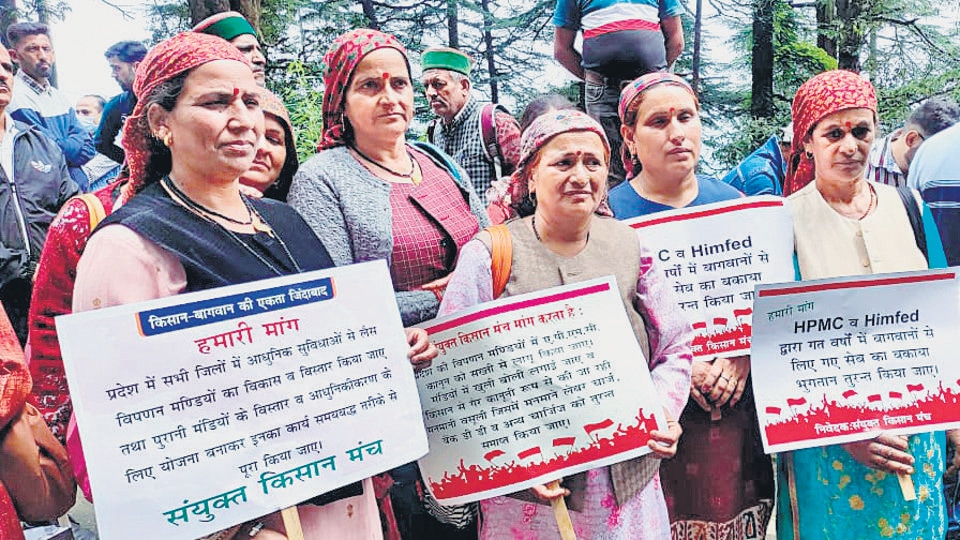
“Apple growers are not happy about the price for their produce and blame the government policies for it. Government servants are demanding social security through restoration of old pension scheme and accuse the government of being pro-corporate,” said 63-year-old Chirtanta, who retired from the Himachal forest department and is an apple grower from Jubbal tehsil in Shimla district.
Apple production, spread across Shimla, Kullu, Kinnaur and parts of Mandi districts contributes 13.5% to the state gross domestic product with annual turnover of over ₹6,000 crore. While apple production has grown by 2-3% a year in the past decades, profitability has dipped due to rising costs and falling market prices.
Also Read| BJP hasn’t fulfilled any promise, failed to take state forward: Himachal Congress chief
Himachal has the highest percentage (3.5%) of population in government service for any state in India; government employees are considered the backbone of the economy in a state where there are not too many other job opportunities. The old pension scheme (OPS) ensures post-retirement monthly payout by government of 50% of the basic of the last drawn salary whereas the new pension scheme, which replaced OPS from April 1, 2004, is a government-employee contributory fund and the pension payout depends on return on investment from market.
Government servants and apple growers are seen as shapers of opinions and narratives in Himachal Pradesh elections, and both sections are economically powerful. Opinion is divided over which of them is more influential.
With government hiring slowing, some experts say government employees don’t hold as much sway as they did in 1993. Apple growers, they add, could influence the outcome in 17 assembly seats. Others say government employees are more influential. “They (government employees ) have a pan-Himachal appeal, unlike apple growers whose influence is limited to only four districts although they try to dominate political narrative in the state,” said Hardesh Arya, a journalist and political analyst.
Voting in the coming polls will be held on November 12 and results declared on December 8.
Similarities in two polls
At the iconic Indian Coffee House on Shimla’s Mall Road, where Prime Minister Narendra Modi stopped to have coffee in 2017, there is consensus that the coming election is similar to the one in 1993.
“Issue wise the two elections are quite similar,” Chitranta said, sitting in a corner table with six of his friends, whom he meets almost every day. Pages of local and national newspapers are strewn across several tables of the Coffee House, which still remains the most popular meeting place for old-timers in Shimla.
Om Prakash Sharma agrees with Chitranta, and says that for the first time in 30 years, apple growers and government employees are on streets almost at the same time against the government policies. “It is just coincidence,” added Harish Chauhan, convenor of Sanyukt Kisan Manch, a body of about half a dozen horticulture produce growing associations formed to spearhead the agitation.
Chauhan said farmers sought to meet chief minister Jairam Thakur for over a year to present a charter of 20 demands, including the withdrawal of Goods and Services Tax (GST) on apple carton boxes, restoration of distribution of subsidised chemicals (pesticides) through the horticulture department, a marketing intervention scheme on lines of the one in Jammu & Kashmir, and a fixed support price for apple.
“He (the CM) agreed to meet only when we decided to march at the state secretariat (in Shimla) on August 5 ,” said Sanjay Chauhan, co-convenor of the Manch. Sanjay claimed the government assured them that it would look into their demands but nothing much happened. To be sure, in July 2022, the Himachal government introduced a scheme to pay back the additional 6% GST imposed on apple carton boxes.
Rahul Mehta, who owns a 10 bigha (approximates 2.5 acres) apple farm in Shimla district’s Chopal tehsil, said input costs for producing apple have increased by over 300% over the past five years and that the government has ended all subsidises. “We used to get fertilizers and chemicals from horticulture department at 40%-50% lesser price than market rates. The government stopped this and private sellers increased prices exponentially. The apple box I bought for ₹52 last year was being sold for ₹65-70 this year.” Participating in the agitation was a matter of “financial survival” for him, he added.
Like him, hundreds of apple growers reached Shimla on August 5. There was huge police deployment but unlike 1993 apple agitation, there was no violence. In 1993, three farmers from Kotgarh, where apples were first introduced in the state in early 20th century by American missionary Samuel Stokes, died. Samuel married a local and changed his name to Satyanand. His daughter Vidya Stokes is a senior Congress leader.
Employee unions under the banner of new employees for pension also started protesting, demanding restoration of the old pension scheme, payment of sixth pay commission arrears, and payout of dearness allowance for 18 months.
In March , the police used force to disperse about 30,000 government employees at the state assembly in Shimla. Thereafter, the employees organised protests in all districts and blocks, which ended on October 14 when the election commission announced elections in the state.
“It would be wrong to say we started the protest looking at polls,” said Pradeep Thakur, convenor of the employees group demanding OPS. He said they first demanded restoration of OPS in 2015-16 and the government did not pay any heed to their demand.
Sitting at Coffee House with Chitranta, Hira Lal, general secretary of HP Electricity Board Employees Union, said this is the first time after 1993 that the employee unions have given an open call to vote for a party which implements OPS. Congress leader Priyanka Gandhi on October 14 announced at an election rally in Solan that restoration of OPS would be the first decision of a Congress government if the party were elected to power.
Senior BJP leader Ganesh Dutta said the government has done a lot for apple growers and government employees. “To reduce pain of apple growers, we started GST payback scheme, where state’s share of GST on apple carton boxes is being returned to farmers.,” he said. On the OPS demand, he claimed it was being pushed by the Congress and would have a “disastrous” consequences for state finances.
Points of differences
Arya said that while the issues on the ground seems similar, a lot has changed in the Himachal political landscape in the past 30 years.
In 1993, the BJP had no answers to give angry government employees and apple-growers. It also made a tactical blunder of nominating all 48 of its sitting MLAs. Such was the rout for then ruling BJP that was not able to win even a single seat in old Himachal areas, a traditional Congress bastion, and lost 14 of 16 seats in the politically most important district of Kangra, which was also home district of then chief minister Shanta Kumar.
This time, the BJP has not given tickets to 11 sitting legislators.
In 1993, the Congress had the experienced Virbhadra Singh marshalling its troops against the incumbent government. Old-timers recalled that Singh at that time held over 100 rallies across in the hill state, where travelling from one constituency to another many take five to six hours. “He worked around the clock,” said Singh’s old associate Subhash Ahuwalia. The Congress won 52 seats and seven went to rebels reportedly propped by Singh.
For decades, the Congress banked on the mass appeal of five-time chief minister Singh, who died due to Covid in 2021. Now, Singh’s wife, Pratibha Singh, is the state Congress chief. She is facing tough challenge from within the party with leader of opposition, Mukesh Agnihotri and former state party chief, Sukhwinder Singh Sukhu, challenging her claim to be CM, if the party wins.
Harish Thakur, professor of social sciences in Himachal Pradesh University, said the Congress is going through a phase of leadership vacuum . “The Congress does not have a leader with pan-Himachal appeal like Virbhadra. This election will tell us whether Pratibha Singh will inherent Virbhadra’s political legacy or not,” he said.
In the past few years, the BJP has seen the emergence of young leaders including 58-year-old CM Thakur and Anurag Thakur, a union minister and former Himachal CM Prem Kumar Dhumal’s son, who have appeal across the state. “Above all, prime minister Narendra Modi is hugely popular with people here. And, that was a reason that BJP got 59% vote share from Himachal in 2019 Lok Sabha polls, the highest for the BJP from any state,” added Harish Thakur.


