
 E-Paper



75% districts in India vulnerable to climate crisis, face risk of floods: Report
The study estimates that over 75% of the Indian districts, including 95% of coastal ones, are extreme event hotspots.

 Prefer HTon Google


A new study has found that 25 of 35 Indian states and Union territories are highly vulnerable to climate crisis-induced “hydro-met” disasters (floods and drought), with Assam, Andhra Pradesh, Maharashtra, Karnataka and Bihar being the most at risk.
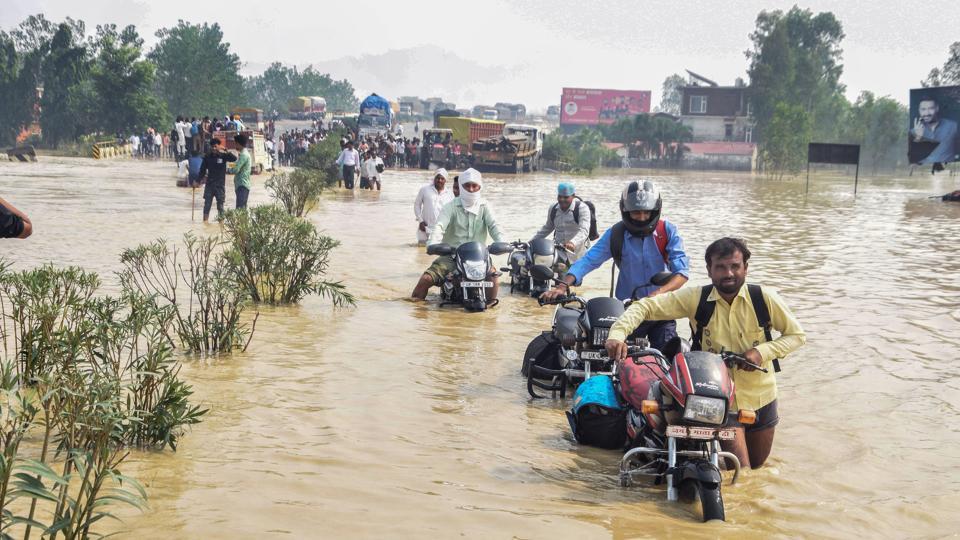
The study based on climate vulnerability mapping of 640 districts in India (according to 2011 census; as of 2021, there were 748) based on rainfall and drought data said that 80% of Indians live in these climate disaster prone districts. The study estimates that over 75% of the Indian districts, including 95% of coastal ones, are extreme event hotspots. Around 45% of these districts have undergone unsustainable landscape and infrastructure changes, a reason for increase in climate vulnerability of these districts.
The study was released on Tuesday, a week before the start of a United Nations climate conference, known as COP26, in Glasgow, where developing countries such as India are expected to demand ramping up of climate finance to help them adapt to climate change.
Rich countries have failed to deliver on their promise of $100 billion every year by 2020, according to a UN report released on Monday.
The developed world has now shifted the deadline to meet the promise to 2023, blaming Covid-19 induced economic slowdown, according to a Reuters report quoting a meeting of finance ministers of G20 countries.
“Combating the rising frequency and scale of extreme climate events is fiscally draining for developing countries such as India. At COP26, developed countries must regain trust by delivering the $100 billion promised in 2009 and commit to stepping up climate finance over the coming decade,” said Arunabha Ghosh, chief executive officer of Council for Energy, Environment and Water (CEEW), a New Delhi-based think tank that conducted the study.
Enhanced climate finance can also support India-led global agencies such as the Coalition for Disaster Resilient Infrastructure (CDRI) to further mainstream climate actions and adaption, Ghosh said.
The study found that Dhemaji and Nagaon in Assam, Khammam in Telangana, Gajapati in Odisha, Vizianagaram in Andhra Pradesh, Sangli in Maharashtra, and Chennai in Tamil Nadu were among India’s most climate crisis vulnerable districts. The study also found that districts in the hill states of Uttarakhand, where 72 people had died in extreme rainfall events in mid October, and Himachal Pradesh, which has seen a 30% increase in extreme rainfall events this year till August, were more vulnerable than ever to climate crisis induced extreme rainfall events.
Further, 59% and 41% of the total districts in the eastern and western states, respectively, are highly vulnerable to severe cyclones, the study said.
Only 63% of districts have a District Disaster Management Plan (DDMP) and only 32% of them had updated the plans till 2019, the study found.
“Our analysis suggests that India’s western and central zones are more vulnerable to drought-like conditions and their compounding impacts. The northern and north-eastern zones are more vulnerable to extreme flood events and their compounding impacts. India’s eastern and southern zones are highly vulnerable to extreme cyclonic events and their impacts and are also becoming extremely prone to cyclones, floods, and droughts combined,” said the study, titled Mapping India’s Climate Vulnerability: A District wise Assessment.


