
 E-Paper



A salty survival story from a scalding Rajasthan summer
Uzman and other salt miners in Phalodi endure scorching temperatures to extract salt, facing risks and health issues, with little support or safety measures.

 Prefer HTon Google


It is 8am, two hours after sunrise, and yet 40-year-old Uzman Khan’s movements have a sense of practised trepidation. First, the only body part he dips in to the shimmering saline water in front of him is his toe. He retracts quickly — the water is scalding, and pain emanates through the burnt pores of his wrinkled feet. But this is his job, one he has done for two decades. He takes a deep breath, steps into the ankle-deep water and stands stock still for a few seconds as his body adapts to the searing temperature. And then he begins to move, quickly and more urgently — spade in hand, he begins to shovel salt that lies beneath the water; salt that is the sustenance for families like his; salt that keeps Phalodi afloat.
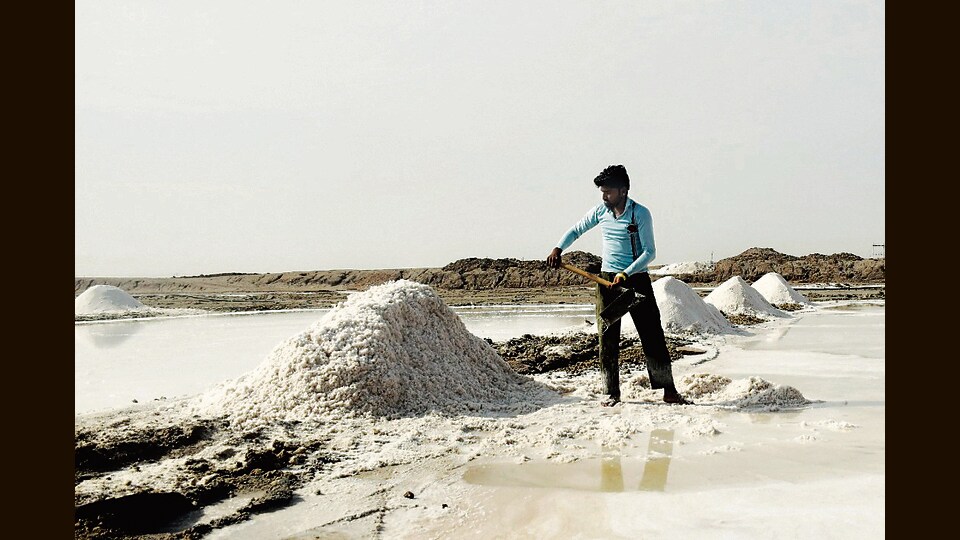
“The heat is rising,” Uzman says. “But for us, it means very little. There is no choice.”
For the past two months, Phalodi — a small town 144km northeast of Jodhpur has been mentioned often. In the days running up to counting day of India’s general election, its “satta bazaar”, among the most famous in the country, kept the news cycle entertained, veering one way and then the other. Then on May 25, Phalodi became India’s hottest place, sizzling at 50°C . In the first two weeks of June, the temperature has been slightly more forgiving, but still ranging between 44 and 47 degrees.
Located just off the Thar desert’s buffer zone, extreme temperatures are not new to the district. For its people, the only real identity of significance stems from the heaps of white salt that dot seven villages in the Bap tehsil; their only source of sustenance in an arid, unforgiving land. Even if the costs attached are working all day under a treacherous sun, running the risk of disease and infections on their limbs, or the occasional gas leak that threatens their lives.
The business
The third largest salt-producing state in India, Rajasthan contributes 8% of India’s total production, but unlike Gujarat and Tamil Nadu where much of the produce comes from the sea, much of its extraction comes from saline groundwater found in Phalodi, and the Sambhar lake.
The organised business of extraction first emerged in the 1960s, when the state government started leasing salt-mine units to local residents. “Now, we have a total of 500 units (1 unit covers roughly 15 acres) which operate in the area. Those that have the lease are required to pay a yearly amount of ₹1,600, renewable every 10 years,” said Phalodi salt inspector Ravindra Singh Rathore.
Spread across a 20 sq km area that abuts seven villages, each of these 500 units have between five or six salt wells, around a 100-foot deep, from where labourers extract the saline water, and transfer it to land to dry under the sun. “This drying process takes 10 to 15 days in summer, and up to two months in winter. Once the water dries, the workers spade the salt and send it to refineries. This then is sent to industrial states such Punjab and Haryana, where it is bought by large companies, branded, and then supplied all over the country,” Rathore said.
There are also illegal units, Rathore admits, started by locals who cultivate salt in their own private land. “The number of such units are between 80 to 100, and these are not registered as salt-mine units with the State Industry and Commerce department,” he said.
Over the past five years, officials in the state government said that the Phalodi salt pan produces around 80,000 tonnes of salt annually. “This was even higher 15 years ago. But the incessant heat has lowered the level of groundwater, affecting production. There are many who don’t want to do this unforgiving work anymore, and are migrating out,” an official said.
Overall, there are close to 20,000 labourers that work in these units — every single one of them fighting daily subsistence; their hard lives a battle against the elements.
Working in a salt mine
For most, the day begins at 4am, before the sun has even risen. “We work in two shifts, starting from 4 in the morning, and go on till 11am. After that the water becomes too hot to touch, even for us. We then return after sunset, and work for another three hours,” Uzman said, loading his first bullock cart of the day.
Khan lives in the village of Reen Malar, where nearly every family has members working as labourers, just like him. There are burn injuries on his feet, and as he breathes, he wheezes often. And yet, for all the trouble, his income ranges from between ₹500 and 700 a day. “Labour is not easy here. If there was anything else nearby, I would have left. Taking care of my parents and four children on this income is next to impossible. But there is nothing else we can do,” he said.
“The salt pan is like a desert,” said Iqbal Churnia (35), as he presses a hand-pump, the only source of drinking water for two or three units.
“Though we drink this water, it is so saline that we cannot bare to taste it at times.”
Most, however, hire a tanker that supplies drinking water from the local Indira Gandhi Nahar timely to the labourers. “But water is so costly here. Each tanker takes ₹400 to ₹500 a month and supplies enough water for two or three people for two days,” said Iqbal.
In many ways, despite the soaring temperatures, it is only the summer that provides for the villages in Phalodi. In the winter, the salt takes too long to dry. In the monsoon, the salt melts away. The salinity in the soil means there is very little agriculture possible. During the monsoons, all they can do is cultivate some millets and send their children to Jodhpur to work as daily wage labourers in agricultural fields.
If Uzman’s job is to dry the saline water and supply salt to factories in his bullock cart, 46-year-old Nur-Uddin’s work is even more treacherous — dig the pits, extract the water from these pits, and transfer them to plots earmarked for them to dry. The risks are higher; the heat in the pits is even higher, and toxic gases underground are a constant threat. “We have no safety equipment such as boots, hard hats or masks. The groundwater has been constantly becoming lower, which means we have to dig further. It used to be 30 to 50 feet, but now we are forced to dig between 70 and a 100 feet. Our lives are constantly at risk,” he said.
His voice quietens. “Last year, three workers from Pali died inside the well from the toxic gases underneath. It scared us, but what else can we do,” he said.
Dr Prem Prakash Suthar, Reen’s chief health officer said that every summer, there is a surge in the number of cases of dehydration and hypertension, both symptoms of heat exhaustion. “We also get several patients from the area who fall sick from inhaling the gases inside the salt wells. There are some that come to us with pruritus problems. For most of these issues, the simple solution is proper safety measures and protection,” he said.
Mitigation measures
Senior government officials admit that while they have been taking some measures to provide protection to salt pan workers, there are still large gaps in the system. “The district administration distributes safety boots and sunglasses to workers who have a labour card in the summer. They are required to collect it from the district industry cell, and one person is entitled to equipment once in six months. But it is true that labourers rarely come to collect these items because they are more comfortable without it,” Ravindra Singh Rathore said.
But in Reen Malar, salt labourer, 47-year-old Khiya Ram, points to the bottom of his feet, a deep blood red — the result of mehendi he has applied, the only rudimentary ointment to the burn injuries he has battled through for over a month. Ram scoffs at suggestions that any safety equipment is available to them. The mine owners give them none, and when the administration does, it is rarely ever replaced on damage. “Last month, the skin on my toe hardened, developing into a painful, bleeding scar. I had to slip work for a few days. The hospital isn’t an option because it is seven kilometres away. Eventually, despite the injury, I returned to work in a week, because any day missed, is a day I do not get paid. Every day, I feel fatigued. Every day, I feel like I should stop in the middle. But that just isn’t possible,” Ram said.
Inspector Rathore admits that no policy has thus far been devised specifically for salt pan workers. “The benefits they get are under various umbrella schemes in the state. But looking at the deteriorating conditions — the government is planning some policies that deal with their problems specifically, and schemes to secure their lives financially,” he said.
But local experts said that Rajasthan must learn from states like Gujarat and Tamil Nadu, which offer a bouquet of schemes for families of salt-pan workers. Srikant (who goes by a single name) of the Gramin Vikas Vigyan Samiti which works in the area said, “States like Gujarat and Tamil Nadu have sound policies for salt labourers which not only provide financial support but also ensure children’s right to education, insurance for accident cases, and treat their health issues. Factory owners should be bound to ensure safety when their representatives work in the field. But Rajasthan’s salt labourers are denied even the most basic rights.”
Phalodi district collector, Harji Lal Atal said, “The local administrative body conducts camps every two months in the salt pan area to make the people aware of the various state and central welfare schemes available to them. During the camp, we also give them health check-ups. However, we are also working to ensure more sound schemes and policies for them.”
But in Reen Malar, hope has ebbed under the searing sun. Rupa Ram, 22, watches with a scowl as his father Khiya Ram hobbles on his injured feet, wincing in pain. The family has never had any money, and Rupa Ram dropped out of school after Class 10, closing the avenue of a government job. There are only two choices left; the only two choices that have ever existed. “My father doesn’t want to leave but maybe I will go to a different district to work in the fields. Otherwise, I will have to work here. But I have to earn some money. What other choice is there?”


