A day before the Supreme Court is expected to consider setting up an expert committee to suggest measures on controlling freebies, the Aam Aadmi Party (AAP) on Tuesday told the Supreme Court that any attempt to regulate electoral speeches promising hand-outs will end up being a “wild goose chase”.
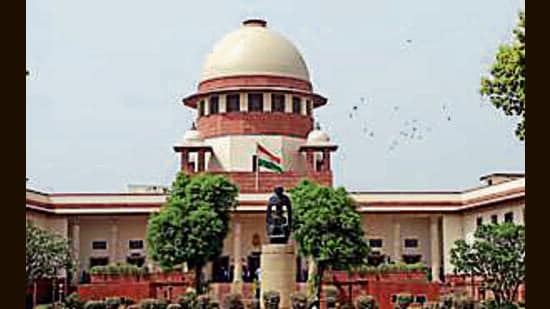
Submitting additional grounds in a plea, the political party ruling Delhi and Punjab asked the top court to refrain from considering any curb on electoral speeches and keep this issue out of the terms of reference of the panel that may be constituted by the bench, led by Chief Justice of India NV Ramana.
According to AAP, there could be no occasion at all for the court-mandated expert panel to scrutinise poll promises in the absence of any law that prohibits or regulates a political party from making such promises, which, it said, serve an “important democratic function”.
“The terms of reference of the expert body may not encompass the regulation, let alone prohibition, of certain types of electoral speech. Such a restriction or prohibition, executively or judicially imposed, would amount to a curtailment of the freedom of speech guaranteed under Article 19(1)(a) without the backing of legislative sanction,” stated AAP’s plea.
In the absence of any legislative guidance on the scope of policies that may be considered ‘freebies’ or on the consequences of promising such policies in electoral campaigns, AAP argued in the top court, any decision in this regard taken by a prospective expert body will be constitutionally without authority.
{{/usCountry}}In the absence of any legislative guidance on the scope of policies that may be considered ‘freebies’ or on the consequences of promising such policies in electoral campaigns, AAP argued in the top court, any decision in this regard taken by a prospective expert body will be constitutionally without authority.
{{/usCountry}}“Further, if concerns over fiscal deficit and responsibility are indeed the point of the present proceedings, targeting and regulating electoral speech will amount to nothing more than a wild-goose chase,” added AAP, contending that electoral speeches made by unelected candidates cannot be official statements of intent about a future government’s budgetary plans.
AAP added that trying to address issues of fiscal deficit by attacking electoral speeches will hurt the democratic quality of elections by prohibiting parties from communicating their ideological stances on welfare, while also making no progress in achieving fiscal responsibility.
“This court’s intervention, if any, in the interests of fiscal responsibility should instead focus on the point of actual outgo of funds from the public exchequer, that is budgetary actions of already elected governments and their fiscal planning processes,” said the party, asking the court to exclude considerations of electoral speeches and promises because that would implicate concerns of freedom of speech.
On Tuesday, another political party, Dravida Munnetra Kazhagam (DMK), too filed a plea in the Supreme Court, seeking permission to be heard in the public interest litigation filed by lawyer Ashwini Upadhyay, who has sought directions for issuance of stringent guidelines to deregister errant political parties and seize their election symbols for offering “irrational freebies” ahead of polls.
DMK submitted that welfare schemes intended to ensure social and economic justice can’t be termed “freebies” and that such schemes have been introduced in order to provide basic necessities which the poor households cannot afford.
The ruling party of Tamil Nadu cited free or subsidised electricity. “Electricity can provide lighting, heating and cooling, resulting into a better standard of living. It can facilitate a child in his education and studies. A welfare scheme therefore, can have a wide reach and multiple intentions behind its introduction and the cascading effect arising from it cannot be defined in a restrictive meaning as a freebie”, DMK’s application stated.
A bench, led by the CJI and comprising justices JK Maheshwari and Hima Kohli, will on Wednesday take up Upadhyay’s plea. Stating that all freebies cannot be couched as welfare schemes, the court had on August 11 observed that “some financial discipline” must be there to tackle the “serious issue” of hand-outs as electoral promises, adding that a debate should be initiated to assess its impact on the economy of a state and tax payers.
The bench had asserted that a distinction between welfare measures and freebies should be drawn when tax payers keep questioning governments over lack of basic amenities such as good roads and electricity, even as freebies are doled out as poll promises.
Freebies and poll promises have become the latest bone of contention between the Union government and the states. Prime Minister Narendra Modi has repeatedly spoken of the malaise of freebies in recent weeks whereas Delhi chief minister Arvind Kejriwal and Tamil Nadu finance minister Palanivel Thiaga Rajan have weighed in on it from the other side. The plea in the apex court itself was filed by Upadhyay, who is a Bharatiya Janata Party (BJP) member.
While considering Upadhyay’s petition on August 3, the court remarked that no political party wants freebies to go, even as the Union government termed such hand-outs the “road to an economic disaster” and urged ECI to devise ways to deal with them. The Centre conveyed its stand to the court days after Prime Minister Narendra Modi hit out at the culture of freebies (calling it the ‘revadi’ culture) while speaking at an event in Uttar Pradesh on July 16.
On that day, the court also indicated that it may consider setting up a panel which can go into the issue “dispassionately” and make recommendations to the Centre and ECI, as it sought suggestions from all parties by August 11.
On August 8, AAP moved the court seeking to be heard. In its plea, the party opposed Upadhyay’s petition arguing that electoral promises such as free water, free electricity or free public transport are not “freebies” but examples of discharging “constitutional responsibilities of the State” towards creating a more equitable society.