Delhi’s air quality plunged to its worst levels since the monsoon rains began as the weather slowly transitions into what will bring much needed respite from one problem — humidity — but soon lead to another: high pollution.
The overall Air Quality Index (AQI), according to the 4pm bulletin, was 182, the highest since June 25, five days before the monsoon rains arrived. The monsoon season is marked by windy conditions and precipitation that helps blow and wash away pollutants, leading to clear blue skies.
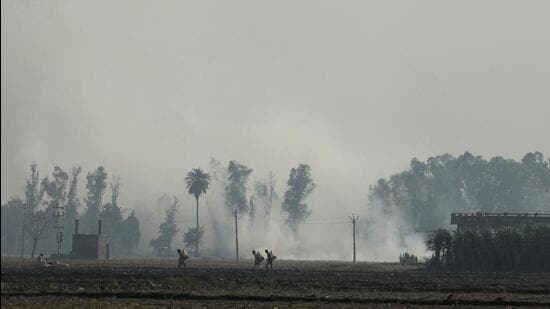
That brief period, which lasted about two-and-a-half months, is now coming to an end, experts said, and the situation is only likely to get worse with farm fires in some nearby regions having already begun.
“During the night on September 17 and 18, there were calm winds over the Delhi-NCR region. This resulted in an accumulation of pollutants. In fact, air quality is likely to be in moderate category on Tuesday because light rain is expected but it may deteriorate after that,” said Vijay Soni, a scientist at IMD’s air quality division.
Soni added that calm winds and high humidity at present had led to increase in the accumulation of pollution particles. “This particulate pollution is mainly from dust and local emission sources. We do not see any crop fires in the northwestern states — Haryana and Punjab — yet,” he said, adding that the nights have also begun to get cooler at 24°C.
“Normally, such accumulation of pollutants is seen after monsoon has withdrawn or started withdrawing from Delhi. This year we are seeing it very early,” the weather scientist added.
{{/usCountry}}“Normally, such accumulation of pollutants is seen after monsoon has withdrawn or started withdrawing from Delhi. This year we are seeing it very early,” the weather scientist added.
{{/usCountry}}While there may not have been a large number of fires recorded by the federal weather forecasting agency, experts at Punjab Remote Sensing Centre said on Sunday that instances of harvest residue burning have begun to be recorded. Since September 15, at least 22 incidents have been seen, and officials attributed it to farmers who grow early varieties of paddy.
According to IMD’s Air Quality Early Warning System for Delhi, air quality is likely to remain in ‘moderate’ to ‘poor’ category on Tuesday and in ‘poor’ category on Wednesday. Air quality is likely to improve marginally on Thursday but remain in ‘poor’ to ‘moderate’ category.
The ventilation index on Monday was only 2400 square metre per second (m2/s). It is likely to be 6000 m2/s on Tuesday and 4700 m2/s on Wednesday and Thursday, the forecast said. A ventilation index of lower than 6000 m2/s with average wind speed of less than 10 kmph traps pollutants.
The key factor behind these changes is an anti-cyclonic condition. This refers to an area of high pressure, which causes winds to die down, trapping local pollutants. The phenomenon is typical in the transition from monsoon to winter.
“There is an anti-cyclonic wind pattern over several parts of NW India. Over West Rajasthan and Punjab there has been no rainfall for 5-6 days and the air is dry. We will announce withdrawal of monsoon from these areas, particularly districts of Ganganagar, Bikaner, Jaisalmer etc,” said RK Jenamani, senior scientist, national weather forecasting centre, IMD.
Jenamani added that monsoon will not withdraw from other parts just yet. “We have not announced the monsoon withdrawal date for Delhi, for example. Some parts of northwest India may get rain for a few more days.”
“Monsoon withdrawal from Delhi may take time. We are expecting some weather activities over Delhi until September 25-26. This is because the low-pressure area that has formed over Bay of Bengal may travel towards east UP and Uttar Pradesh, causing the wind direction to change to moist, easterly again very briefly. Monsoon, however, will withdraw from Saurashtra, Kutch, West Rajasthan during the next 24 to 48 hours. The wind direction over Delhi is variable now, a mix of westerly and easterly,” explained Mahesh Palawat, vice president, climate change and meteorology at Skymet Weather.
The last time Delhi’s AQI was higher than 182 was on June 25, when it was 230. Since then, AQI has been in “satisfactory” (less than 100) or “moderate” (less than 200) ranges. There was even a “good” AQI day when the number was 47 on September 16.
The pollution problem is feared to be exacerbated later next month when winds die down further and nights and days become nippier. To add to this, farmers in the states of Punjab and Haryana are expected to burn harvest residue, sending up plumes of smoke that drift over to much of north India, blanketing the region in hazardous air pollution.