E-Paper



Annual Rath Yatra of Lord Jagannath begins in Odisha’s Puri
The rituals leading up to the yatra included the Snana Purnima, wherein the deities were bathed with 108 pitchers of sanctified water, followed by a 15-day Anavasara period of seclusion

 Prefer HTon Google


The annual Rath Yatra of Lord Jagannath and his siblings, Lord Balabhadra and Devi Subhadra, began in Odisha’s temple town of Puri on Friday morning with the three deities embarking on their journey to the Sri Gundicha Temple for a nine-day sojourn.
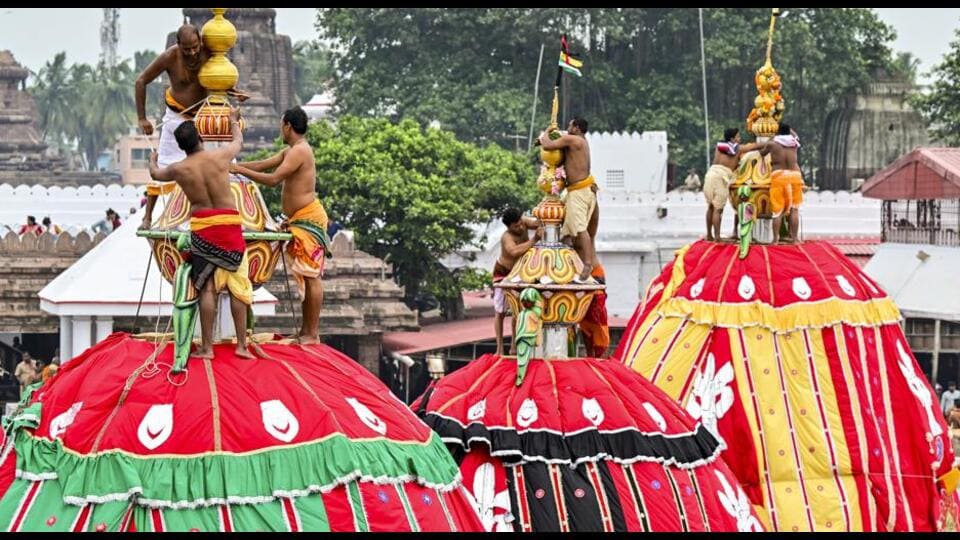
After the rituals like mangal arati, abakash, tadap lagi, mailum, rosa homa, suryapuja, and offering of Gopal bhog to the deities, the servitors of the temple began the process of carrying the three deities from the temple to the decorated chariots placed on the Bada Danda or Grand Road. After Gajapati Dibyasingha Deb of the erstwhile Puri royal family does the ceremonial sweeping of the chariots, tens of thousands of devotees will pull chariots Nandighosa, Taladhwaja, and Darpadalan at 4pm.
The rituals leading up to the yatra included the Snana Purnima, wherein the deities were bathed with 108 pitchers of sanctified water, followed by a 15-day Anavasara period of seclusion. The Sri Gundicha Temple was cleaned and sanctified on June 26 during the Gundicha Marjana ritual for the deities’ arrival.
Over a million devotees from across India and abroad gathered along the Bada Danda to witness the journey of the deities to the Gundicha Temple, their maternal home. Each chariot, constructed annually using five types of wood and standing 45 feet tall, is completed in just 58 days. The chariots, weighing over 200 tons, will carry the deities on their three-km journey to the Gundicha Temple, where they will reside for a week before returning on July 4 during the Bahuda Yatra.
The Odisha government has deployed over 10,000 security personnel and 275 AI-powered cameras across Puri to ensure an incident-free Rath Yatra. Puri police superintendent Vinit Agrawal said that three unauthorised drones were intercepted on Friday. The Indian Railways operated 365 special trains connecting Puri to states such as West Bengal and Bihar, and the state government deployed 800 buses for the devotees.