E-Paper



‘Antithetical to the right to life with dignity’: Supreme Court declares menstrual hygiene a fundamental right
The court issued a series of directions to ensure functional toilets, sanitary napkins and menstrual support systems in every school across the country.

 Prefer HTon Google


Bengaluru: The Supreme Court on Friday held that access to menstrual hygiene is inseparable from the constitutional right to life, ruling that forcing girls to manage menstruation without privacy, dignity or basic facilities violates Article 21 of the Constitution.
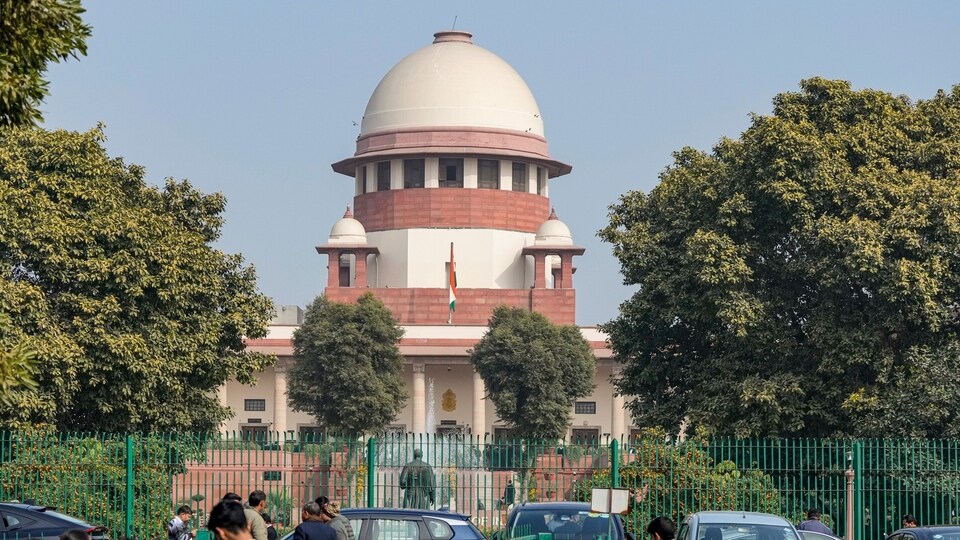
A bench of justice JB Pardiwala and justice R Mahadevan said menstruation does not merely raise sanitation concerns but implicates “personal liberty, privacy, and decisional freedom”.
The court issued a series of directions to ensure functional toilets, sanitary napkins and menstrual support systems in every school across the country.
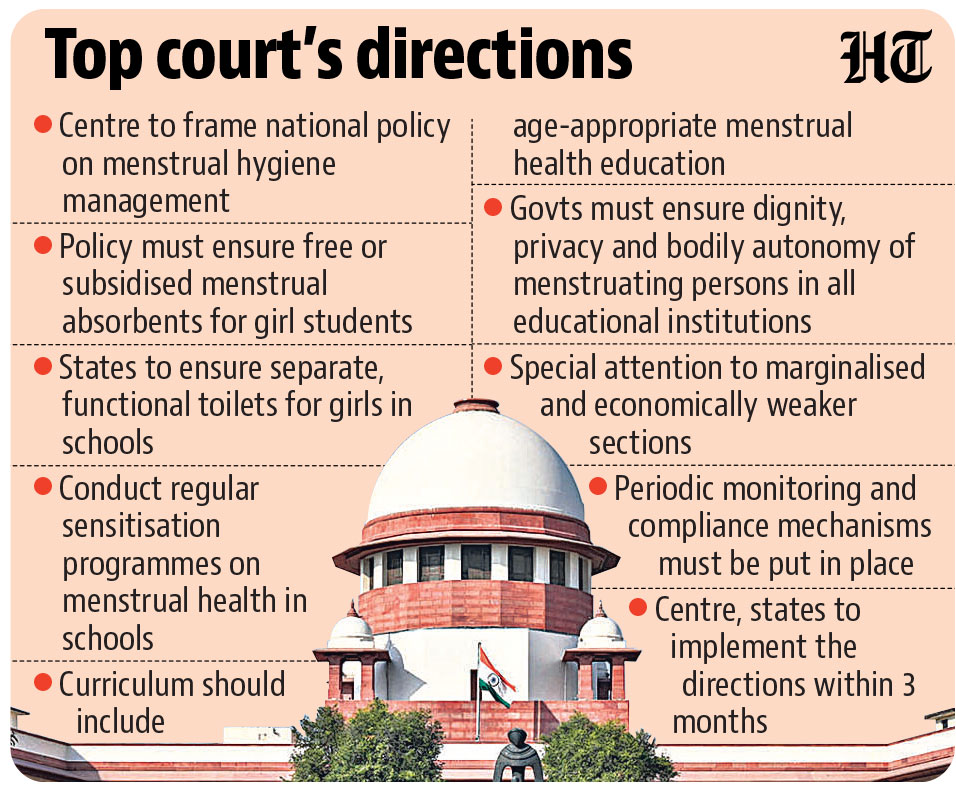
It directed the Union government, in consultation with the states and Union territories, to formulate a “uniform and comprehensive national policy on menstrual hygiene management” for school-going children, with particular focus on adolescent girls. The policy must address access to “adequate and age-appropriate sanitary products, functional gender-segregated toilets, availability of water, privacy for changing, and safe and hygienic disposal mechanisms”, the court said.
The bench said menstrual hygiene must be treated as essential educational infrastructure rather than a discretionary welfare measure, adding that resource constraints can never justify denial of dignity. The right to life, the court said, “includes the right to safe, private, and autonomous menstrual care”.
The bench stressed that menstruation cannot be reduced to sanitation alone and instead concerns a girl child’s autonomy over her body and her ability to manage a natural biological process in privacy and with dignity.

“Menstrual hygiene management is not confined to sanitation. It includes bodily autonomy and decisional freedom. The denial of adequate facilities, appropriate sanitary products, or privacy compels a girl child to manage her body in a manner dictated by circumstance rather than choice, which is antithetical to the right to life with dignity under Article 21,” it said.
The bench passed the order on a plea seeking directions to the Union government to ensure free sanitary pads and separate toilets for girl students in Classes 6 to 12 in government-aided schools.
It ordered that all schools, whether private or state-run, must ensure adequate toilets, sanitary napkins, water, soap for handwashing and spare uniforms for all girl students.
The court framed and answered a set of core constitutional questions around equality, dignity, privacy and education. It examined whether the absence of separate toilets for girls and lack of access to menstrual hygiene products violated the right to equality under Article 14, the right to life and dignity under Article 21, and the right to free and compulsory education under Article 21A read with the Right of Children to Free and Compulsory Education Act, 2009. It answered these questions in the affirmative.
It held that denial of access to functional toilets, water, sanitary products and safe disposal mechanisms forces girls to regulate their bodies according to circumstance rather than choice, amounting to a violation of the right to live with dignity.
The court further directed all states and Union territories to ensure effective and time-bound implementation of menstrual hygiene facilities in all schools, including residential and special schools. This mandate includes regular “supply of sanitary products, maintenance of toilets, provision of water and disposal systems, and monitoring at the school level”. States and Union territories must also conduct awareness and sensitisation programmes for boys, teachers and school staff to dismantle stigma around menstruation and create safe, inclusive school environments.
The court directed governments to ensure that policies remain inclusive and intersectional, taking into account the needs of “girls from marginalised communities, children with disabilities, and those living in remote or resource-poor settings”. It warned that the mere existence of schemes does not meet constitutional requirements and called for accountability and monitoring mechanisms to ensure compliance.
The court said states and Union territories must establish menstrual hygiene management systems in schools, equipped with spare uniforms and essential materials to address menstrual emergencies.
“This judgment speaks not only to lawyers, administrators, and legal stakeholders, but to classrooms where girls hesitate to ask for help, to teachers constrained by lack of resources, to parents unaware of the harm caused by silence, and to society at large.”
The bench said progress must be measured by how society protects its most vulnerable and described the judgment as a message to every girl forced into absenteeism because her body became a burden. “The fault is not hers,” it said.