E-Paper



Crime to politics: Atiq Ahmad’s chequered life story
Through the 1990s, Atiq Ahmad kept bolstering his interstate gang, which at one point had 153 members, led by his younger brother Ashraf.

 Prefer HTon Google


Atiq Ahmad was already gaining notoriety in erstwhile Allahabad when the 1989 assembly elections were announced in Uttar Pradesh. Using the political churn in the region that decade, Ahmad had quickly established himself in the world of organised crime, using his fief to dictate local land deals, contracts and real estate developments. At the age of 17, he had stabbed a local rival Mohammed Gulam in full public view, but that year, his rival was far more entrenched – the local gangster Shauq Ilahi or Chand Baba, who also wanted to contest the election.
A high-voltage campaign ensured. The younger criminal cashed in on his ties to the local community, riding a horse through the old city and taking out a motorcycle rally to stamp his authority among young people. A day before the votes were to be counted, Ahmad and Ilahi’s gangs clashed at the city’s old chowk area. A gun battle ensued, and Ilahi died. The next day, Ahmad was declared the winner as an independent candidate, thus marking the beginning of a long and controversial career where he used a mix of crime and politics to cement his hold on the region.
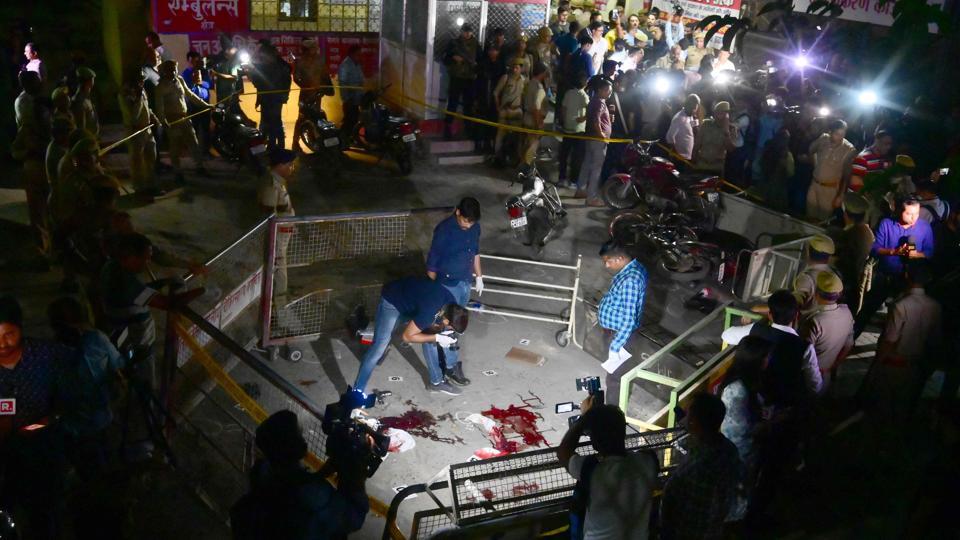
That reign ended on Saturday evening in a hail of bullets as three assailants pieced a police cordon to gun down Ahmad and his brother Khalid Azeem, alias Ashraf. Born in Shravasti to a Muslim family, the five-time state legislator and former member of Parliament from Phulpur had 101 cases against him, but was convicted for the first time only earlier this year. Only 54 of these cases today survive in the courts. The rest are under investigation, a testament to the reign of fear he commanded.
“Atiq Ahmad evaded conviction in criminal cases through different tactics such as buying the silence of witnesses or silencing them,” said Bharatiya Janata Party MP Brij Lal, who served as the state director general of police.
But his fear was also mixed with grudging popularity among a section of the population in a region used to strongman twisting the law to their benefit. Roughly 2km from the Colvin Hospital premises where he was gunned down, Ahmad would hold court at his palatial home in the Chakia locality. He would be regularly approached by locals to settle property or domestic disputes, and financial quarrels.
“People went to him as he delivered quick judgement and enforced it on his command, as against courts where cases dragged on for years,” said a local resident. Ahmad would hold court and decide the fate of his rivals. He even awarded punishments in several cases that were “settled” outside the court, he added.
That house is now a pile of rubble after the government demolished it in September 2020.
Through the 1990s, Ahmad kept bolstering his interstate gang, which at one point had 153 members, led by his younger brother Ashraf. He always travelled with a posse of armed gunmen travelling in high-end SUVs, and used his reputation to intimidate people, grab properties and force owners to transfer them to him or his aides.
“Atiq built his empire by scaring off people. There was a time when no common man could think of raising a voice against him,” said senior lawyer Rohit Kant Srivastava.
He won again as an independent in 1991, and then in 1993. That year, he joined the Samajwadi Party and stood for elections three years later from the same seat, winning again. In 1999, he joined the newly formed Apna Dal and served as its state president, only to return to the SP in 2003. The next year, he fought the Lok Sabha elections from Phulpur on an SP ticket and won.
During this time, his political influence was on the rise, and several parties scrambled to be close to him. But a rival was on the horizon – Bahujan Samaj Party lawmaker Raju Pal, who defeated Azeem in the assembly election in 2005.
Things came to a head three months later, when Raju Pal was shot dead outside his house by gunmen allegedly acting at the behest of Ahmad and Ashraf. The public killing of the lawmaker sparked outrage and forced the state government to move against Ahmad and charge him with murder. He went to jail for the first time. But imprisonment didn’t temper his influence. He allegedly continued to run his crime empire from the police lock-up even allegedly ordering hits and murders. In 2018, a Lucknow-based realtor was thrashed and abducted allegedly by Ahmad’s aides. This case finally prompted the Supreme Court to order Ahmad be shifted out of the state.
Due to his rising notoriety, Ahmad didn’t win an election after 2004, and slowly, political parties started dissociating from him. But electoral reverses didn’t hurt his enterprise -- when he filed his nomination from jail in 2012, some judges refused to hear his bail plea, until it was finally granted, said a senior police officer familiar with the matter who asked not to be named.
But electoral reverses didn’t deter him. He rode his signature Bullet motorcycle through the streets of Prayagraj and in 2017, went to Kanpur in a huge convoy of vehicles as a show of strength from Prayagraj to push for his candidature – only to be denied by the Samajwadi Party.
The first signs of his impending downfall came in 2016, when his aides allegedly assaulted the staff of a college in Prayagraj for taking action against students caught cheating in an exam. The incident triggered an outrage, and no political party was willing to nominate him anymore. He was arrested and imprisoned next year, and in 2018, moved out of the state.
On March 28, 2023, he was given life term for abducting lawyer Umesh Pal in 2006. A prime witness in the 2005 Raju Pal murder case, Umesh Pal was kidnapped and threatened in 2006. This was a popular trick in Ahmad’s playbook, said an official familiar with the matter.
On February 24, 2023, Umesh Pal was shot dead outside his house, along with two bodyguards. Ahmad’s end came soon after.