Mohammed Aminul’s bedroom is in India but cattle shed in Bangladesh. His neighbour, Yahid Rahman’s house is in India, except for the kitchen which is in Bangladesh.
Residents such as Aminul and Yahid do their household chores shuttling between the two countries. (Representative file photo)
Both live in Nekkipara, a village on the outskirts of North Bengal’s New Jalpaiguri district. It is different from the around 200 villages that are in so-called no man’s land along the 4096.7 km-long India-Bangladesh border. It is one of only two villages (Haripukur in Uttar Dinajpir district is another) through which the international border line passes, touching houses along its way and dividing its rooms in two different countries.
For instance, a border pillar stands between Aminul’s house and his cattle shed.
Residents such as Aminul and Yahid do their household chores shuttling between the two countries — sleeping in India, cooking in Bangladesh, dining in India, but late-night walks inside Bangladesh. Most close friends and relatives of Nekkipara residents live in the adjacent Bangladesh village , which is also called Nekkipara.
This is how the 69 Indian villagers in 14 houses have lived for as long as they can remember.
The border line did little to change their lives all these years -- until last week.
“On paper, it may be a different country but for us it was only an imaginary line. I tied my cattle in India, let them graze in the fields of Bangladesh while I spent time chatting with my friends there. Some of my closest friends are in the next village. But everything is different now,” Yahid said.
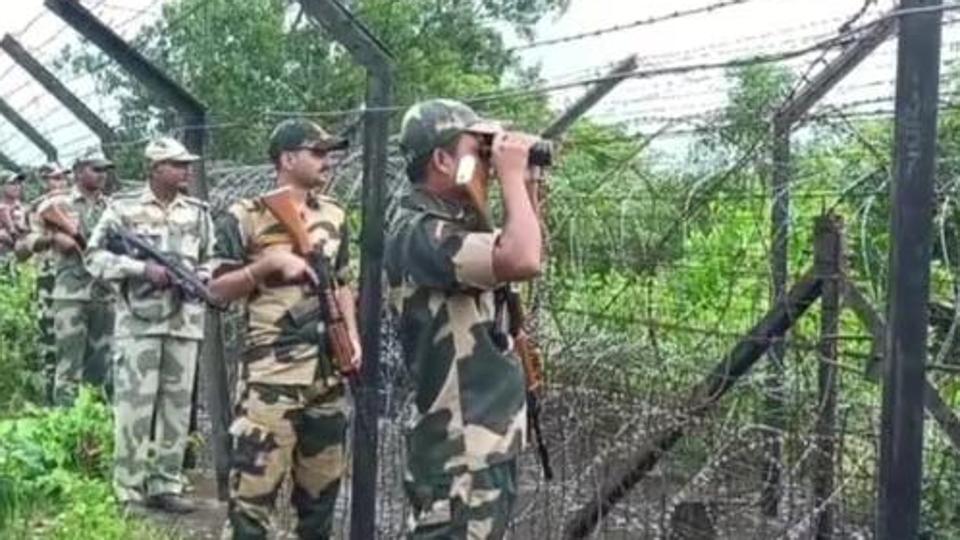
The political turmoil in Bangladesh, the collapse of the Sheikh Hasina regime, violence across the country and mass infiltration attempts has led to a high alert across the India-Bangladesh border. Border Security Force personnel are now posted around-the-clock in the village to ensure there is no violence or infiltration. Standing next to the border pillar adjacent to Yahid’s cattle shed are three armed personnel from Border Guards Bangladesh(BGB).
Restrictions introduced
For the last one week, residents of the two Nekkiparas have been instructed to adhere strictly to the respective boundaries. Night walks inside Bangladesh have been banned. For reasons of safety, there is night curfew after 9 pm in Nekkipara.
“In the days before Sheikh Hasina’s ouster, we would regularly walk across and speak to our friends in Bangladesh about what was happening there. It was normal to just meet somewhere between our villages and catch up . We learnt about people getting killed during protests there from our friends in the next village,” Islamuddin, 32, said.
It isn’t just about being cut off from friends in the adjacent village. Many also have relatives settled in the Nekkipara across the border or in other parts of Bangladesh.
“My father’s youngest sister is married to a Bangladesh resident who lives somewhere in Dhaka. She lost a relative in Dhaka during the protest. Some days ago when we spoke, she said Dhaka was unsafe and that they wanted to leave. Maybe she wants to come here but she does not know how things have changed on the ground. She will be living just a few houses away, but rules and border guards won’t even let us meet. Even if she manages to reach here safely, we must stay within our respective boundaries,” Aminul said.
Over the past week, there have been at least five major infiltration attempts at the border by crowds numbering 100-1,000. This is a new challenge for India’s border guards — Bangladesh nationals trying to enter India by climbing fence or crossing the land and river borders. This has led to stricter surveillance at the border by border guards from both countries.
Then, living lives under surveillance is not new for villagers here. To enter Nekkipara, one has to pass through iron gates manned by BSF guards. The gate itself comes beyond several check posts .
The gate, which is on the border, is only opened for village residents whose biometric details are in government’s records. Each time, BSF guards write down their names and time of entry, verify identity papers, and then allow them inside. Outsiders, including government officials are allowed only after permission from headquarters .
“We know every person inside the village. Every item they take with them in the village is recorded and verified. We know how much sugar or salt each family consumes in this village. If they take more than what is required for their family, we will know that it is for smuggling. They could be taking it for Bangladesh villagers next door as cost of sugar is 3-4 times higher there,” a BSF officer said.
The officer, who asked not to be named, added that during weddings in the village they know exactly how much gold has been brought to the village. Each detail must be noted and written in a book. “The Bangladesh side does not have a fence like ours. Once inside the village, it is very easy for the residents to hand over such items to their neighbours (across the border) who can make profits by selling it there.”
Lives altered
Residents here said surveillance and checks are fine, but admitted that adjusting to the new normal is a challenge.
“In the last 8-10 years, we have lived under strict surveillance, but adapting to the change that has come because of the situation in Bangladesh is going to be difficult,” Aminul said, citing an example.
Almost two decades ago, elders of both villages had decided to celebrate Rakshabandan together.
“We would pray together and celebrate the festival symbolically. This time the border guards from both counties may not give us any leeway,” he added.
Rakshabandan falls on Monday.
Villagers are also worried about other changes -- big and small.
Will the border guards of India and Bangladesh be as friendly as they have been in the past 15 years? Will there be skirmishes? Most importantly, will they be trapped in between?
There are questions but no clear-cut answers. For now, the villagers of India’s Nekkipara are waiting, and watching -- political developments, 480 km away in Dhaka.
Prawesh Lama, an Associate Editor at Hindustan Times with nearly two decades of frontline reporting experience across India’s conflict zones, border regions, and disaster-hit areas. He writes on internal security, insurgency, the Northeast, and Left-wing extremism and has reported from India’s hinterland and some of the most sensitive and strategically critical regions.Read More

 E-Paper