E-Paper



Bhupendra Patel is asked about Congress vs AAP in Gujarat. He explains
Gujarat chief minister Bhupendra Patel said it is easy for the BJP to win the Gujarat elections expected to be held in November-December this year “because of the good work they have done for the people”.

 Prefer HTon Google


AHMEDABAD: Expressing confidence that the Bharatiya Janata Party (BJP) is all set to win for the sixth consecutive time in Gujarat where assembly elections are expected to be held in November-December this year, Gujarat chief minister Bhupendra Patel, 59, said that his aim is to win the elections and not defeat anybody.
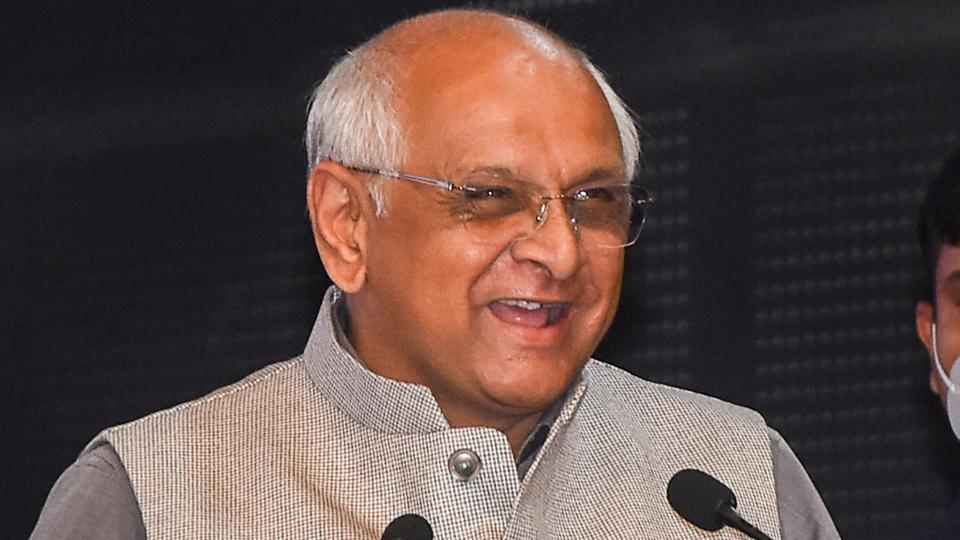
“For a party that has been voted to power five times because of the good work they have done for the people, it is easy to win another term,” the chief minister said at an interaction with journalists on Sunday.
Patel said his party works for the people round the clock, every day and not like others that are seen only during elections.
“I am a positive person. My aim is not to defeat somebody but to win. We will try and win every seat,” he said.
Elections in Gujarat are mainly seen as a contest between BJP and Congress with little space for a third front. This time, however, the Aam Aadmi Party (AA), encouraged by its stunning win in the Punjab elections, plans to contest the state elections and hopes to emerge as the lead opposition force.
Brushing aside talks of AAP being a major force in Gujarat or being seen as an alternative to the Congress, Patel said, “If Congress wants to give away some seats, two, five or seven seats to AAP, they are free to do so. Frankly, I do not see AAP taking up the opposition space in Gujarat,” the chief minister said.
Patel said his party ensures that the last man standing in the queue is not left out and utmost care is taken while drawing up schemes. He said the government has started an exercise where they make door-to-door visits to see that the schemes reach out to all the beneficiaries.
On a question about the ambitious seaplane project that has been facing hurdles due to the pandemic and some other issues, Patel said his government is working to resolve the issues and it will soon be up and flying. “The project will soon start. And this time around, there will be no stopping it,” he said.
The seaplane project, launched by Prime Minister Narendra Modi during the 2017 election campaign, was seen as a response to the Congress campaign pitched around an effort to puncture the BJP’s claims of development in Gujarat.
To the Congress campaign in 2017 around the tagline ‘Vikas Gando Che’ (development has gone berserk), the BJP came with up a counter; Hun Chu Vikas, Hun Chu Gujarat (I am development, I am Gujarat).
Patel was dismissive of the AAP’s poll promises to offer free power and water in the states where it contested the elections, saying freebies was not the solution.
“I can also offer freebies. But it will deeply impact the state’s fiscal deficit. Look at Rajasthan. Post-Covid, the fiscal deficit ratio has shot up immensely. Usually, it should be equal to or less than 3%. Gujarat’s fiscal deficit hasn’t touched 2% and neither have we burdened the people by introducing any new taxes this year. The Centre has allowed a fiscal deficit of up to 4.5% keeping in view the pandemic situation. In some non-BJP states, the deficit has gone beyond this limit,” said Patel.
In 2017, Congress bagged 77 out of 182 assembly seats, its best performance in Gujarat in the last two and half decades. The BJP managed to clinch victory got 99 seats.
“Ahead of the assembly elections, there are local body elections. Today we are in full power in all the local district panchayats. So, I don’t think there is much of a challenge for us this time. The BJP and the government work together to reach out to the people at the grassroots level,” said Patel.
Recently there has been buzz that Naresh Patel, chairman of the Shree Khodaldham Trust, a very popular Patidar or Patel leader, is being wooed by all parties including the BJP.
“If someone joins a party, he looks for respect and status. He has weighed all the options. There is only one party in Gujarat that can offer him this – it is the BJP. I am quite sure he will not go anywhere (else),” said Patel.
On speculation that some senior BJP leaders may not get the party tickets for the assembly elections, Patel said in the BJP, even a chief minister cannot confirm his own candidature, leave alone others.
Patel suggested that new and emerging technologies in green energy space are the next focus area for the state government in this election year to reduce carbon footprint. From electric vehicles, batteries and green hydrogen, the government is expected to roll out some policies this year.
“Green energy and carbon neutrality are some of the areas the government is actively working on. We have signed MoU of ₹10,445 crore with Japan’s Suzuki Motors Corp for electrical vehicles and batteries. We have also signed another pact worth ₹5 lakh crore with Reliance Industries in the green energy space,” said Patel.
Gujarat is the home state for Prime Minister Narendra Modi and Union home minister Amit Shah and elections in this state are watched closely. On being asked if he feels to be under pressure in the CM’s seat that was once occupied by PM Modi, Patel said that there is no match for Modi.
‘Narendra Bhai ek hi hai (There is only one Narendra Bhai). We work under his guidance. Even globally, there is no match for him. The hard work and effort that he has put in the past have made work much easier for us,” said Patel.