Dear Reader,
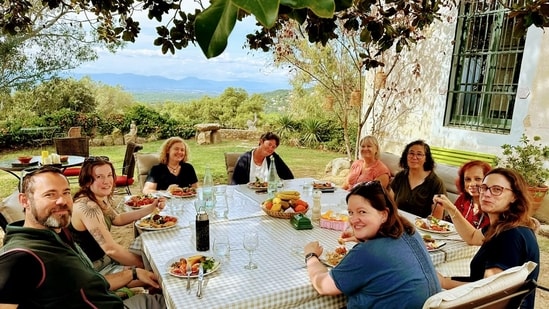
I am at a writing retreat in Spain, in Romanyà de la Selva, a small village on the Costa Brava near Barcelona. It is run by the writers Priscilla Morris and Melissa Fu.
Priscilla and Melissa met when they were on a panel at a literary festival on the island of Alderney in 2024. Both have written historical novels rooted in their family histories and set against war. Priscilla’s Black Butterflies is set during the Siege of Sarajevo
Dear Reader,
I am at a writing retreat in Spain, in Romanyà de la Selva, a small village on the Costa Brava near Barcelona. It is run by the writers Priscilla Morris and Melissa Fu.
Priscilla and Melissa met when they were on a panel at a literary festival on the island of Alderney in 2024. Both have written historical novels rooted in their family histories and set against war. Priscilla’s Black Butterflies is set during the Siege of Sarajevo and inspired by her great-uncle, while Melissa’s Peach Blossom Spring begins with the Japanese occupation of China in 1938.
Spending a week with such accomplished writers in an old Spanish country house with a swimming pool, writing and reading all day with fellow writers —surely this is the idea of writerly heaven?
Yet the first few days are uncomfortable.
I struggle to fit into the group—two Americans, a Canadian, an Irishman, a French woman, and five English people. Aside from Melissa, who is ethnically Chinese but grew up in New Mexico and now lives in England, I am the only Asian writer in the group. In the first few days I become conscious of this. At the dinner table, I sit between groups of bantering writers feeling oddly tongue tied. They are talking about Paris and London and gap years in Cambodia. I know none of these worlds. I have come to writing late, from another country, another life. Priscilla notices my silence and asks me a question about book clubs. I answer and then, feeling that I am talking too much, I shut up and lapse back into awkward silence.
I am petrified at the prospect of being ‘workshopped’, of submitting a sample of my writing to the group, who will then each read it and give their critical feedback.
At 4 am the first morning, my phone rings. It is the stonemason from home. He needs money and he needs more stones. The next day my mother calls. My father needs to go into hospital for minor surgery. “It’s nothing to get alarmed about,” she says. Yet he is 83 and I worry.
I toss and turn, getting out of bed to a cloudy morning.
At the morning session, I enjoy the free writing, but find it difficult to concentrate on building plot structures and drawing timelines. It is hard to be present in Spain when your mind is tethered to a house under construction or an aging parent thousands of miles away. And then there is the workshop ahead of me.
“Are you excited?” asks the bubbly Yorkshire biker who writes the most amazing short stories.
“I am terrified,” I confess. It has been years since I have read my writing aloud to a roomful of people. The only times I have done this before were at my book launch events, and that doesn’t really count, because the dynamics are different. You are the ‘author’ and your readers ask nice, polite questions. You can count on them not to give you critical feedback like “X character didn’t gel for me,” or “This time shift wasn’t clear to me.”
We break for lunch, piling our plates with rocket salad and dried figs, falafel and bran bread. The sun is out and we sit outdoors under the magnolia tree, eating carrot cake with coffee.
Later, I read out my extract. The other writers seem intrigued by my story of Maia, the middle-aged woman who runs away to the mountains and starts a book club there. She also makes mint chutney. Everyone loves the chutney bit; we laugh and talk about ‘chutneyfication’. They want more details about Maia’s marriage. They suggest sentences I could cut out to tighten the prose.
..
Then it is time to head to the Costa Brava coastline, which turns out to be stunning—full of little coves and bays, waves cascading and swirling over ochre and black rocks.There is a beach and people head for the sea. I watch them jump into the clear turquoise waters of the Mediterranean, and swim across the little bay, and it feels perfect. But I am awkward about being in a swimming costume in front of all these strangers. I sit on the sand instead and read Peach Blossom Spring by Melissa Fu, my book on the beach being pretty perfect too.
The next day we browse through books on writing. There is The Book You Need to Read to Write the Book You Want to Write by Sarah Burton, a book that many friends have been talking about. There's Writing Towards Home by Georgia Heard with lots of fun prompts like writing from photographs and telling the stories of objects. We chat about the stories we wrote and the ones that we still want to write. In between sessions, I call home. The stonemason has got his stones and his money. My father’s surgery has gone well.
And now it is time to leave and I am loath to go. I want to hear the rest of the climate fiction story and the next part of the story about the little sister of Billy the Kid. I want to read more about the Canadian woman from Quebec who creates gardens wherever she goes, and about the woman who may or may not have murdered her husband. And I want to dive further into the YA novel set in the spooky Yorkshire countryside. There’s a last set of readings tonight, and maybe I will hear more of these stories. And oh, there is another beach trip too—and this time I just may swim.
Sonya Dutta Choudhury is a Mumbai-based journalist, Founder of Sonya’s Book Box, and a teacher of Storytelling in Business. Got a knot in your life, a dilemma at work, or a reading slump you can’t shake? Send your questions and book requests to sonyasbookbox@gmail.com, and she promises to give each one her most earnest consideration.
One Subscription.
Get 360° coverage—from daily headlines
to 100 year archives.
Archives
HT App & Website