Union finance minister Nirmala Sitharaman announced a ₹5,000 crore fund to develop the city economic region (CER) centred around temple towns and tier-2 and tier-3 cities, a ₹100 crore incentive for municipal bonds issued over ₹1,000 crore, and seven high-speed intercity rail corridors as “growth connectors”, among others, for the urban sector during her Budget speech on Sunday.
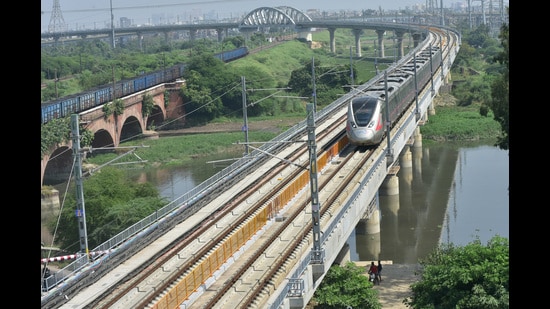
The seven rapid rail corridors will connect Mumbai to Pune, Pune to Hyderabad, Hyderabad to Bengaluru, Hyderabad to Chennai, Chennai to Bengaluru, Delhi to Varanasi, and Varanasi to Siliguri.
Sitharaman said that one of the six areas of intervention for this budget was developing city economic regions and delivering a powerful push to infrastructure. She said that capital expenditure allocation has been raised to ₹12.2 lakh crore for the coming fiscal year.
“We shall now focus on tier two, tier three cities and even temple towns which need modern infrastructure and basic amenities. This budget aims to further amplify the potential of cities to deliver the economic power of agglomerations by mapping city economic regions based on their specific growth drivers and allocation of 5,000 crore per CER over five years is proposed for implementing their plans through a challenge mode with a reform cum result based financing mechanism,” she said.
The seven city economic regions proposed in the budget are Bengaluru, Bhubaneswar-Puri-Cuttack tricities, Coimbatore-Erode-Tiruppur, Pune, Surat, Varanasi, and Visakhapatnam
{{/usCountry}}The seven city economic regions proposed in the budget are Bengaluru, Bhubaneswar-Puri-Cuttack tricities, Coimbatore-Erode-Tiruppur, Pune, Surat, Varanasi, and Visakhapatnam
{{/usCountry}}She also announced a new ₹25,000 crore infrastructure risk guarantee fund.
“To strengthen the confidence of private developers regarding risks during the infrastructure development and construction phase, I propose to set up an infrastructure risk guarantee fund to provide prudentially calibrated partial credit guarantee to lenders,” she said.
Commenting on this, Raghav Madan, director, Deloitte India, said, “A ₹25,000 crore infrastructure risk guarantee fund has the potential to significantly improve project bankability by addressing construction-phase risks and accelerating financial closures, though its impact will ultimately depend on the details of the scheme.”
She also announced a dedicated REIT (Real Estate Investment Trust) for asset recycling for the central public sector enterprises.
On the issue of municipal bonds, Sitharaman said the existing AMRUT (Atal Mission for Rejuvenation and Urban Transformation) incentive for municipal bond issuance of over ₹200 crore will continue. The Economic Survey tabled on January 29, too, had mentioned municipal bonds as an essential but currently underdeveloped mechanism for bridging India’s urban infrastructure gap.
It is to be noted that a ₹1 lakh crore Urban Challenge Fund (UCF), announced in the Union Budget 2025-26, has yet to be operationalised — which was meant to implement proposals for ‘cities as growth hubs’ through “creative redevelopment”.
Commenting on the announcement for the scheme on tier-2 and tier-3 cities, Tathagata Chatterji, professor of urban management and governance at XIM, Bhubaneswar, said, “Dedicated funds for development of these cities are critically important. However, as this scheme is likely to be operationalised through the Challenge Fund, it has to be ensured that the development is linked to the overall development needs of the city for an integrated development model as emphasised by the Economic Survey, not as standalone programmes.”
He added that while central schemes are good as seed capital, there is a need for follow-up mechanisms. “One such example is the Smart Cities Mission, which raised much hope but is now facing operation and maintenance challenges, as there are no dedicated revenue streams for that purpose.”
Sitharaman also announced measures to move cargo toward a greener path. “To promote environmentally sustainable cargo movement, I propose the creation of a new Dedicated Freight Corridor connecting Dankuni in the east with Surat in the west. Over the next five years, 20 new waterways will be operationalised, starting with National Waterway-5 in Odisha, which will connect the mineral-rich areas of Talcher and Angul, as well as industrial hubs like Kalinganagar, with the Paradip and Dhamra ports.”
She also proposed a scheme for container manufacturing to create a globally competitive container manufacturing ecosystem with a budgetary allocation of ₹10,000 crore over a five-year period.