
 E-Paper



Cafe blast probe reveals links with ’12, ’20 cases
Investigations have found common suspects across all three cases, with an unidentified “online handler” believed to be operating from Pakistan

 Prefer HTon Google


After the arrest of the fifth accused in the Rameshwaram blast case, further investigations have revealed that there was a link between members of three terror modules in the state in the execution of the blast, state police officers familiar with the matter said.
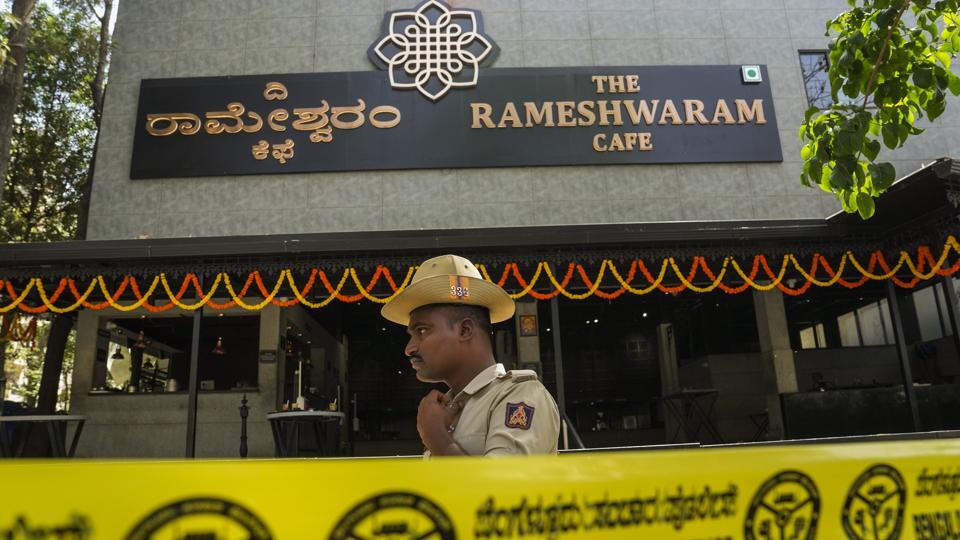
According to the officers, the blast at the Rameshwaram cafe, which took place on March 1, has been linked to two earlier terror plots, revealing a web of connections dating back to 2012 and 2020 in Karnataka. Investigators have found common suspects across all three cases, with an unidentified “online handler” believed to be operating from Pakistan.
On Friday, the National Investigation Agency (NIA) arrested Shoaib Ahmed Mirza (35) alias Chhotu from Hubballi. He was taken into custody under the Unlawful Activities Prevention Act (UAPA) for assisting the mastermind of the Rameshwaram Cafe blast.
He was previously convicted in a 2012 Lashkar-e-Taiba (LeT) conspiracy, had served a five-year sentence and was released in 2017. According to NIA, Mirza introduced Abdul Matheen Taha (the main planner of the Rameshwaram blast) to the “online handler” through encrypted emails in 2018.
Taaha came under scrutiny in 2020 when authorities dismantled an Islamic State-inspired Al Hind terror cell in Bengaluru. This group was allegedly preparing to establish insurgency camps in southern India’s jungles. Taaha, along with his associate Mussavir Hussain, was a primary suspect. Both evaded capture until April this year.
After the Al Hind module was disrupted, Taaha and Hussain reportedly formed the Thirthahalli module, recruiting people from their hometown in southern Karnataka. This group, once merely associated with graffiti near a police station in Mangaluru, has metamorphosed into the most wanted terrorist outfit in the state. This group has orchestrated a string of devastating bomb attacks across Mangaluru and Bengaluru, with an ambition to establish an IS caliphate in the forests in state.
They, residents of Thirthahalli, have been implicated in three separate terror incidents. These are - involvement in pro-terror graffiti found in Mangaluru in October 2020, the trial detonation of an Improvised Explosive Device along the banks of the Tunga River in Shivamogga in September 2022, and a cooker bomb explosion in Mangaluru in November 2022.
Authorities have arrested four individuals from Thirthahalli in connection with these incidents. Among them, Taahaa and Hussain stand accused in all three cases. “From the investigations, it was clear that the duo were running the group and there were concerns about the duo recruiting more youths,” the officer added.
Senior officials indicate that the handler who guided the Al Hind and Thirthahalli modules may be the same individual introduced to Taaha by Mirza. This connection is critical as it ties together the 2012 LeT conspiracy, the 2020 Al Hind plot, and the 2024 cafe blast. “We are hoping to get more information about this handler from the NIA. The information is going to crucial in the further investigation,” one of the officials said.
The 2012 LeT case involved 13 people, including Mirza, who were convicted for plotting to assassinate journalists, police officials, and Hindu community leaders. The charge sheets from that time mentioned a Pakistan-based handler whose identity remained unknown. The possible involvement of this handler in subsequent cases points to a coordinated terror strategy spanning over a decade.


